Why Your Competitors Are Being Cited by ChatGPT and Perplexity - and What to Do About It
You search your service category in ChatGPT or glance at a Google AI Overview and there's your competitor - named, recommended, cited. You're…
Why Your Competitors Are Being Cited by ChatGPT and Perplexity - and What to Do About It
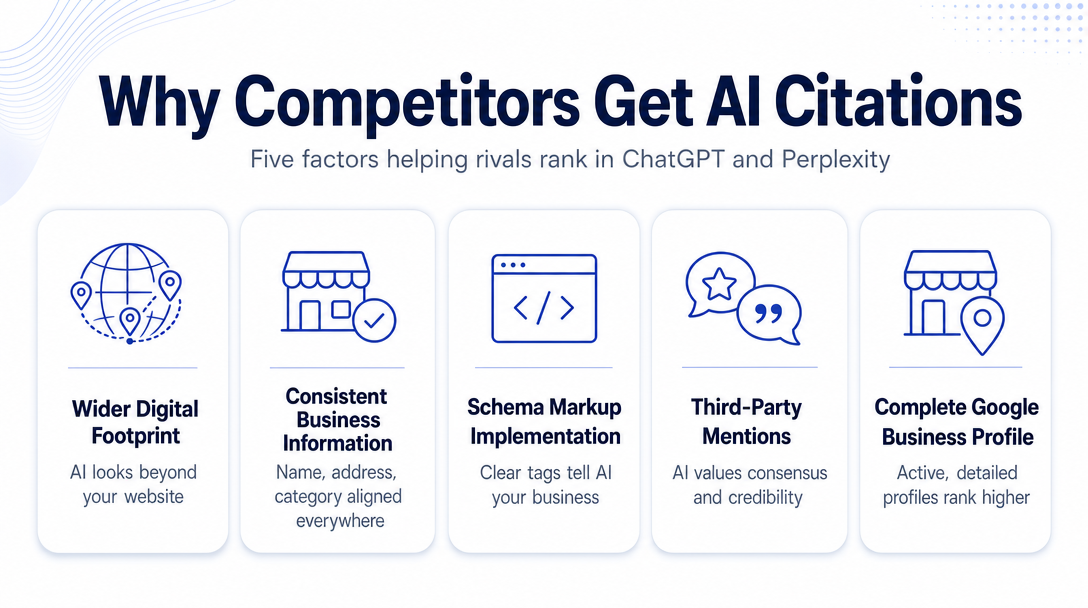
You search your service category in ChatGPT or glance at a Google AI Overview and there's your competitor - named, recommended, cited. You're invisible. You might even outrank them on Google. This isn't random. AI engines use a fundamentally different scoring system than traditional search, and there are six specific, diagnosable reasons your competitor clears that bar while you don't - yet.
(Already familiar with what GEO is? Our GEO vs SEO guide for Australian small businesses covers the strategic case. This article is about the diagnosis.)
What Is the Off-Site Citation Gap - and Why It Explains Everything
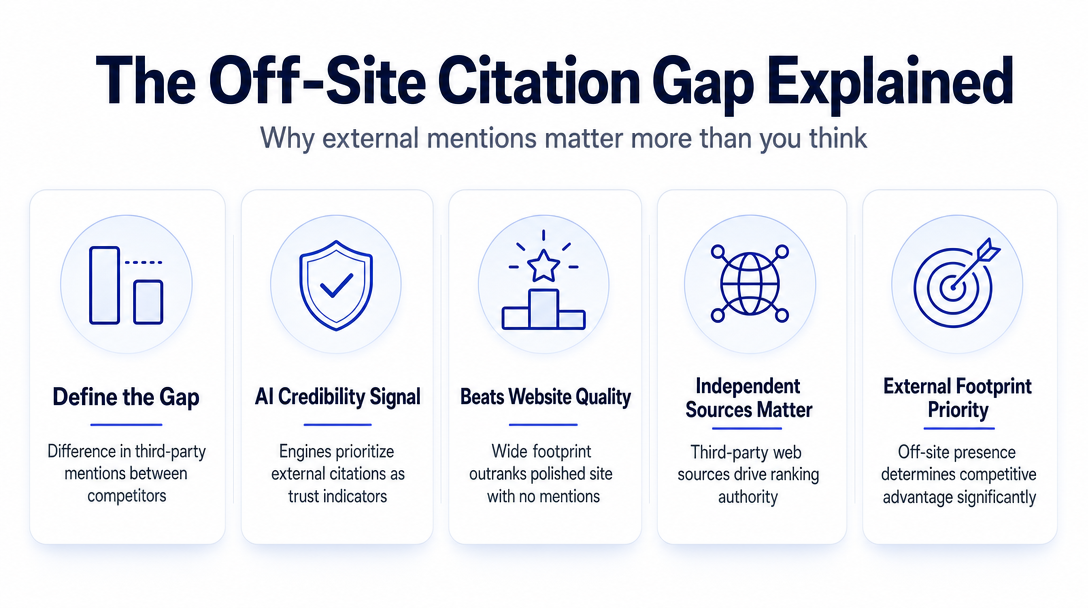
Before the six reasons: there's a single underlying concept worth naming. Call it the Off-Site Citation Gap - the measurable difference between the number of independent, third-party web sources that mention your competitor versus the number that mention you. AI engines treat that gap as a credibility signal. A competitor with a mediocre website but a wide off-site footprint will be cited over a business with a polished site and almost no external mentions. Every reason below is a specific version of this gap.
Reason 1: Their Digital Footprint Is Wider - AI Looks Far Beyond Your Website
AI platforms - ChatGPT, Perplexity, Google AI Overviews, and Gemini - don't evaluate your website in isolation. They synthesise signals from across the web: third-party review sites, business directories, Reddit threads, local news articles, and industry listicles. A competitor listed on five Australian directories with 40 Google reviews and a handful of Reddit mentions creates a much denser signal web than a business with a great website and nothing else pointing to it.
According to Omni Eclipse's AI Search Visibility Report, only 12.3% of Australian businesses appear in ChatGPT recommendations at all - meaning 88.1% of businesses checked were completely invisible regardless of their website quality.
Social media profiles also contribute: AI engines aggregate public LinkedIn pages, Facebook business profiles, and Instagram accounts as part of the overall entity picture.
Your fix: Search "[competitor name]" site:yellowpages.com.au, then try the same for True Local, Oneflare, and any industry-specific directories relevant to your sector (Houzz for trades and interiors, for example). Every platform they appear on that you don't is a gap to close this week.
Reason 2: Their Business Name, Address and Category Are Consistent Everywhere - Yours Aren't
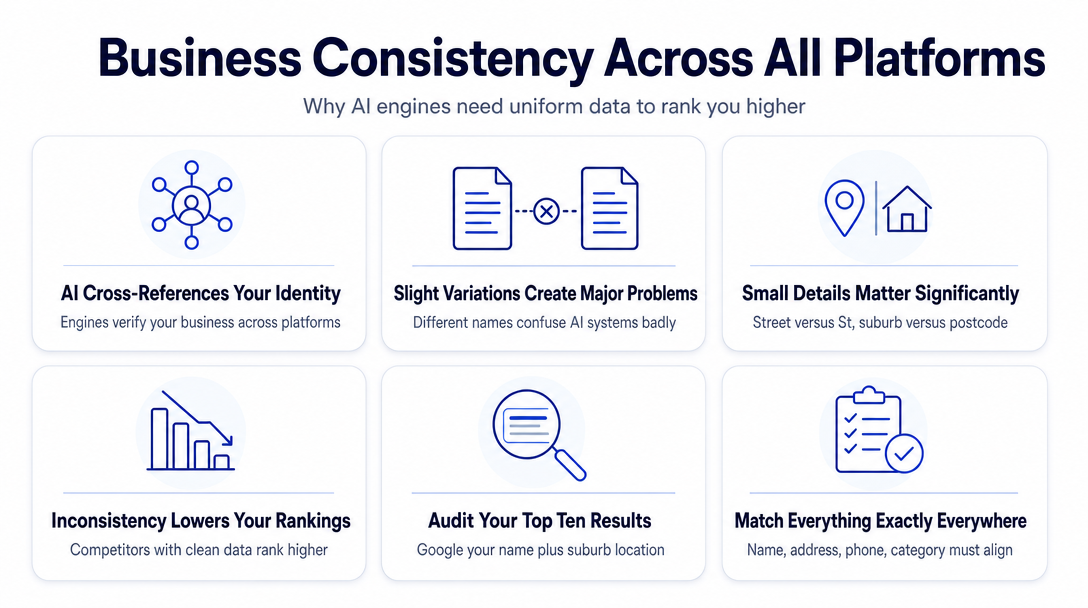
AI engines cross-reference your business identity across every platform where you appear. If your ABN listing says "Smith Plumbing Pty Ltd," your Google Business Profile says "Smith Plumbing," and your Yellow Pages entry has an old mobile number, the AI encounters three slightly different entities and can't confidently resolve them as one trustworthy business. That ambiguity - sometimes called an entity recognition problem - causes AI systems to deprioritise you in favour of a competitor whose data is clean and consistent everywhere.
Even small discrepancies carry weight: "St" versus "Street," a suburb name versus a postcode, "trades" versus "plumbing services" as your category. These are not cosmetic. They're the reason an AI can't build a confident, unified picture of who you are.
Your fix: Google your business name plus your suburb. Open the top ten results. Verify that your trading name, address (formatted identically), phone number, and primary service category match exactly across each one. Fix the inconsistencies before you do anything else.
Reason 3: They Have Schema Markup Telling AI What Their Business Does - You Don't
Schema markup is structured data embedded in a website's code that tells AI engines - in plain, machine-readable language - exactly what a business is, what it offers, where it operates, who runs it, and what customers say about it. Without schema, AI has to infer all of that from your page text. Competitors with schema are handing AI a complete briefing document. Businesses without it are leaving AI to guess.
The schema types that matter most for AI citations are:
- LocalBusiness - name, address, phone, category, opening hours
- Service - specific services offered, with descriptions
- FAQPage - your most-asked customer questions, answered directly on the page
- Person - the founder or key practitioner (reinforces E-E-A-T, the expertise signals AI values)
- AggregateRating - pulls your review score into the structured record
Your fix: Run Google's free Rich Results Test on your own homepage, then on your competitor's. If they have schema types you don't, that's a documented gap. Most website platforms - WordPress, Squarespace, Wix - have plugins or built-in tools to add schema without touching code.
Reason 4: They're Mentioned by Third Parties - AI Treats Consensus as Credibility
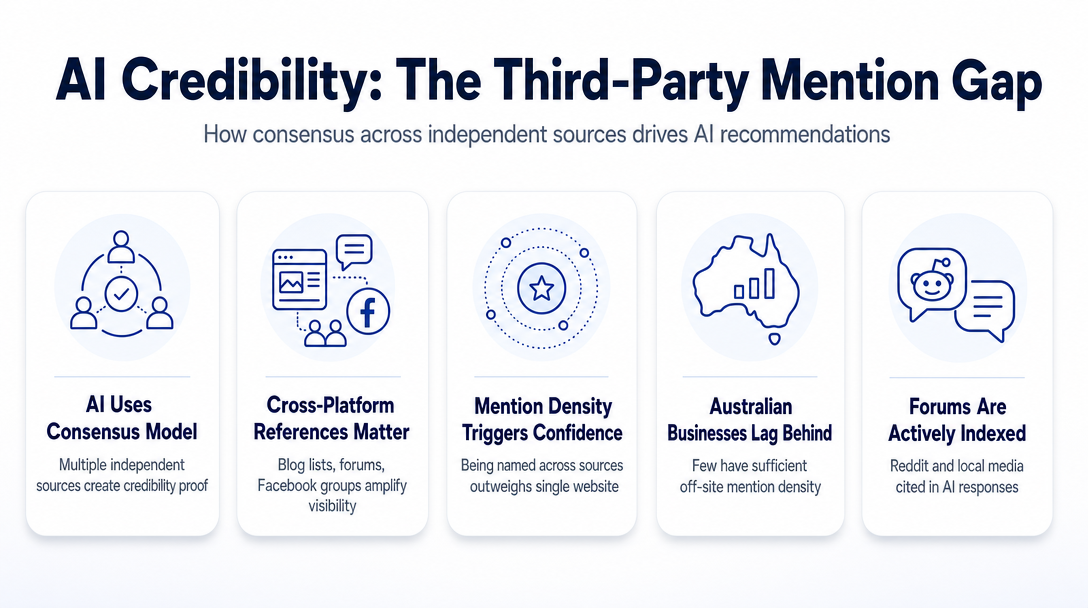
This is the single biggest gap between what small business owners think matters and what AI actually uses to make recommendations.
AI engines operate on a consensus model. When multiple independent sources - a "best electricians in Melbourne" blog list, a thread on r/melbourne recommending local tradespeople, a suburb-focused Facebook group post, a local media article - all reference the same business, the AI reads that convergence as credibility proof. Your competitor being named across ten independent sources creates a web of references no single well-written website page can replicate.
A 3P Digital study of 1,033 AI assistant answers found that 58% of AI recommendations named no Australian business at all when asked who to hire - partly because so few AU businesses have the off-site mention density that triggers AI confidence.
Australian forums including r/brisbane, r/sydney, and r/melbourne are actively indexed by AI engines and cited in responses. Local media (state newspaper small business sections, regional news sites) carry real weight. Being mentioned in one genuine, relevant community thread does more for your AI visibility than rewriting your homepage.
Your fix: Identify three to five places your competitor is mentioned that you are not. Pick one and act: pitch a local blog for inclusion in a roundup, answer a relevant question on a local subreddit genuinely and helpfully, or reach out to a local journalist with a real story hook.
Reason 5: Their Google Business Profile Is Complete and Active - Yours Is Bare or Stale
For local queries, Google AI Overviews draw heavily from Google Business Profile data. As visualweb.com.au notes: "If your business is not in the top three Google Maps results for your category, you will not appear in the AI summary."
A competitor with a fully completed GBP - correct primary and secondary categories, services listed with descriptions, photos updated in the last 90 days, a business description written in customer language, and a consistent flow of recent Google Reviews with responses - is exactly the type of entity AI Overviews are built to surface. A bare profile, an unclaimed listing, or one with a photo from 2021 and no reviews since 2023 signals low trust and low relevance.
Your fix: Log into your GBP and audit it against this list: primary category (specific, not generic), at least two secondary categories, every service listed with a description, photos added in the past 90 days, every recent review responded to, and a business description that uses the actual language your customers search with - not industry jargon.
Reason 6: Their Content Directly Answers the Questions AI Is Being Asked - Yours Doesn't
AI engines select citations by matching a user's question to a source that answers it clearly, completely, and in the first paragraph. If someone asks ChatGPT "best bookkeeper for small business in Perth" and your competitor's services page opens with "We are a Perth bookkeeping firm helping small business owners stay on top of their tax and cash flow" - followed by FAQ-style Q&A content - that page is a strong citation candidate. If your equivalent page opens with "We offer comprehensive financial solutions tailored to your needs," AI can't confidently match it to that query.
This isn't about keyword stuffing. It's about answer-matching: your content has to directly state what you do, where you do it, and for whom - in plain language, early on the page.
What makes content AI-citable: Direct answers in the opening sentence, not after three paragraphs of scene-setting. Specific over generic ("Melbourne café owners" not "hospitality businesses"). FAQ structure that mirrors how customers actually phrase questions. Your location stated explicitly on every relevant page.
Your fix: Write down the five questions a potential customer is most likely to ask an AI engine about your type of business. Check whether your website answers each one directly, in plain language, in the first paragraph of the relevant page. If it doesn't, that's your writing task for this week - no new pages needed, just better openings on existing ones.
How to Check What Your Competitor Has That You Don't: A 5-Minute Diagnostic
Run this comparison right now - no tools required:
- Ask ChatGPT and Perplexity: "Who are the best [your service] in [your city]?" Note whether your competitor appears. Note whether you do.
- Count off-site mentions: Search
"[competitor name]" -site:[their domain]in Google. Count the third-party results. Do the same for your business name. The difference is your Off-Site Citation Gap. - Check their Google Business Profile: Search their business name. Look at their GBP - review count, recency, photo freshness, services listed. Compare it to yours.
- Run the Rich Results Test: Use Google's Rich Results Test on their homepage, then yours. See what schema they have that you don't.
- Check Australian directory presence: Search their name on True Local, Yellow Pages AU, and one industry-specific directory. Are they listed with complete information? Are you?
The pattern across all five checks will tell you exactly which of the six reasons above is costing you the most citations.
Only 16% of Australian marketing teams are taking an integrated approach to AI visibility - which means the businesses closing these gaps right now are establishing a lead that will be harder to close in 12 months than it is today.
This is exactly the diagnostic Fulcrum AI runs automatically - scoring your site and your competitors' across the signals AI engines actually use, then surfacing the specific gaps to close, ranked by the ones most likely to move the needle.
Frequently Asked Questions
Why does my competitor appear in ChatGPT but my business doesn't?
The most common cause is a wider off-site footprint - your competitor is mentioned by more independent third-party sources (directories, review sites, local forums, blog lists) than you are. AI engines treat multi-source consensus as credibility. A business with a strong website but few external mentions will consistently lose citations to a competitor with broader independent coverage, even if that competitor's website is weaker.
Does ranking number one on Google mean I'll appear in AI search results?
No. Omni Eclipse's research found that 77% of businesses ranking on Google's first page do not appear in ChatGPT. AI search uses a different scoring model that weights off-site mentions, structured data, entity consistency, and Google Business Profile strength - not just organic search ranking.
Does schema markup actually help with AI search visibility?
Yes. Schema markup gives AI engines a machine-readable summary of your business - what it is, what it offers, where it operates, who runs it, and what customers say. Businesses with LocalBusiness, FAQPage, Service, and Person schema provide AI with a complete briefing; businesses without it require AI to guess from plain text, which reduces citation confidence.
How does my Google Business Profile affect AI recommendations?
For local queries, heavily. Google AI Overviews pull directly from GBP data, and businesses outside the top three Google Maps results for their category are unlikely to appear in the AI summary. A complete, active GBP - with current photos, services listed, recent reviews, and a specific category - is one of the highest-leverage fixes for local AI visibility.
What is NAP consistency and why does it matter for AI search?
NAP stands for Name, Address, Phone number. AI engines cross-reference your business details across every platform where you appear. Even minor inconsistencies - "Street" versus "St," an old phone number on one directory, a slightly different trading name - create entity ambiguity that causes AI systems to deprioritise your business in favour of competitors whose data is clean and consistent everywhere.
Can I check what my competitor has that I don't without any paid tools?
Yes. Ask ChatGPT and Perplexity to recommend businesses in your category and city. Search your competitor's name with -site:[their domain] to count their third-party mentions. Check their Google Business Profile publicly. Run Google's free Rich Results Test on both your homepage and theirs. These five checks take about five minutes and will identify your most urgent gaps.
Find Out Exactly Which Signals Your Competitor Has That You Don't
Fulcrum AI crawls your website and your competitors', scores both across the signals AI engines actually use - including off-site citation footprint, structured data completeness, and Google Business Profile strength - then shows you the exact gaps to close, ranked by impact. No agency retainer. No guesswork. Built in Australia for SMB budgets, starting with a free preview and a full plan at $99/month AUD.
See Your Free AI Visibility Preview → fulcrumai.com.au