How Australian Cafés and Hospitality Businesses Can Improve Their AI Search Visibility With a GEO Audit
Your café might make the best flat white in the suburb. But if someone asks ChatGPT or Google AI Overviews for "a dog-friendly café with oat milk near…
How Australian Cafés and Hospitality Businesses Can Improve Their AI Search Visibility With a GEO Audit
Your café might make the best flat white in the suburb. But if someone asks ChatGPT or Google AI Overviews for "a dog-friendly café with oat milk near [your suburb]," you probably won't appear - not because you're unknown, but because the information AI needs to cite you confidently isn't findable on your website. Whitespark's research found AI Overviews appear in 68% of local business queries. This guide gives you a specific, ordered checklist - the Café Citation Stack - to fix that this week.
Why AI Engines Struggle to Recommend Most Australian Cafés (Even Great Ones)
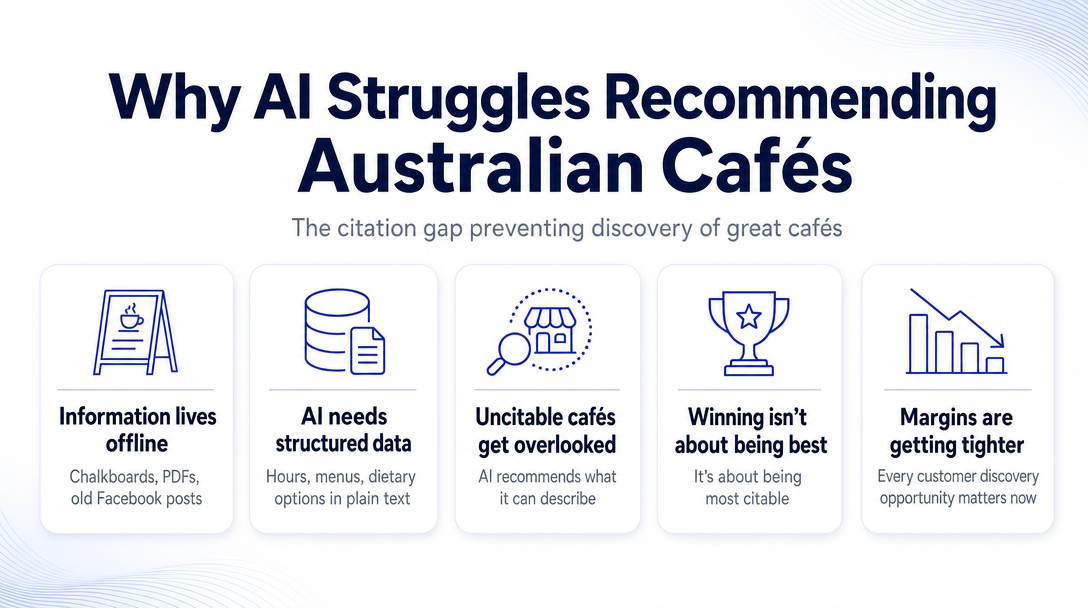
With QSR Media reporting that 10.4% of Australian food service businesses closed in 2025, margins are thin and every customer counts. The cafés that are winning the next wave of discovery aren't necessarily the best - they're the most citable.
The citation gap no one told café owners about
Cafés are information-rich environments: seasonal menus, dietary options, ambience, trading hours, parking. But almost all of that information lives on a chalkboard, a PDF, or a Facebook post from 2022. AI engines - ChatGPT, Perplexity, Google AI Overviews - pull from structured, crawlable, consistent data sources. If an AI can't find your opening hours, menu items, and dietary options in plain text on your website, it can't confidently recommend you. It recommends whoever it can describe.
If you want a primer on what generative engine optimisation (GEO) means and how it differs from traditional SEO, Fulcrum AI's prior guides cover that ground - this article assumes you accept GEO matters and jumps straight to the café-specific fixes.
What AI actually reads (hint: not your Instagram)
An AI engine doesn't browse Instagram to build its answer. It draws from indexed web pages, structured data (JSON-LD schema), authoritative third-party mentions, and Google Business Profile data. Beautiful feed content, a loyal following, and strong foot traffic are invisible to an AI unless there's a parallel layer of structured, text-based, crawlable information on your website and across your directory listings.
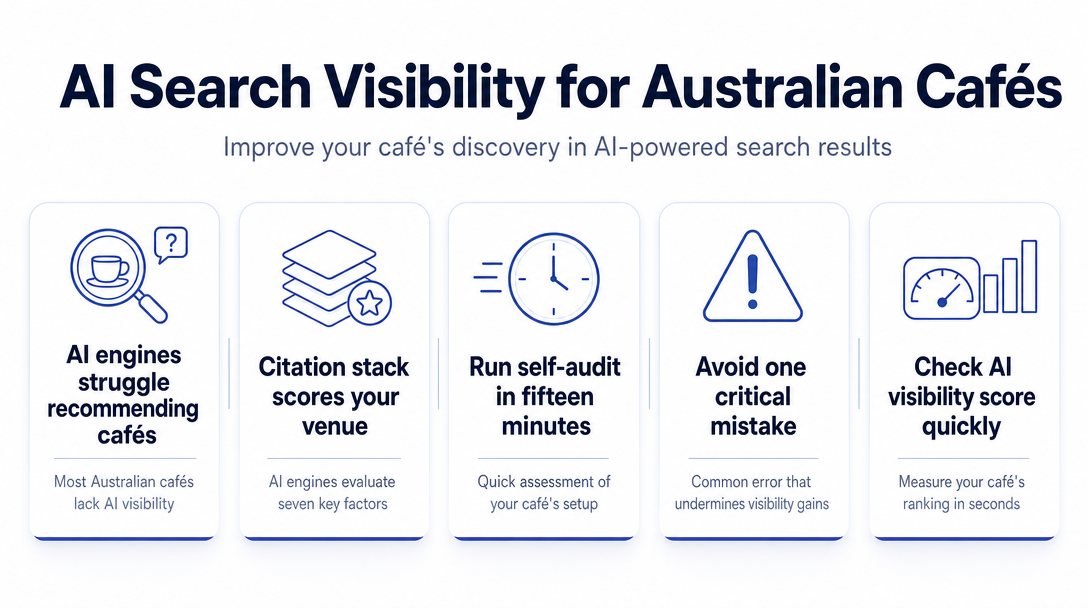
The Café Citation Stack: 7 Things AI Engines Score Your Venue On
This is the core framework. The Café Citation Stack names the seven specific signals AI engines use to decide whether to recommend a local café - ordered from foundational to advanced. Work through them in sequence. The first three must exist before the later ones have any effect.
The foundational layer (Stack Items 1-3)
1. Google Business Profile completeness
Your GBP is the single most-read data source AI engines consult for local venues. Without it fully populated, nothing else in this stack matters. Check all eight core signals: primary category (use both "Café" AND "Coffee Shop"), a keyword-rich business description, accurate trading hours (including public holidays), at least 10 photos updated within the last 90 days, a direct menu link, services listed, your website URL, and an active Q&A section where you've pre-answered common questions. A sparse GBP tells every AI engine you're not worth citing confidently.
2. NAP consistency
NAP stands for Name, Address, Phone number. These three fields must be character-for-character identical across every platform: your GBP, your website footer, TripAdvisor, Yelp, Zomato, and any local directory listing. Even a difference as small as "St" versus "Street" or a missing area code creates entity confusion - the AI isn't sure whether the listing on TripAdvisor and the listing on your website refer to the same business. Inconsistency is enough to make it hedge rather than recommend you.
3. CafeOrCoffeeShop JSON-LD schema on your homepage
This is the fix most cafés have never heard of. The CafeOrCoffeeShop schema type is a specific classification in the schema.org vocabulary that extends both FoodEstablishment and LocalBusiness. Adding a small JSON-LD block to your homepage <head> tells every AI engine and search crawler exactly what your business is. The fields that carry the most weight: name, address, openingHoursSpecification, hasMenu (linking to your menu page URL), servesCuisine, priceRange, telephone, and url. Most Australian café websites have none of this. Adding it takes roughly an hour for a developer, or less with a plugin - and it is the highest-impact single fix in the stack.
The content layer (Stack Items 4-5)
4. A live, text-based menu page
If your menu is a PDF file or an image, AI engines cannot reliably read it. That means every query like "best gluten-free café in Fitzroy" or "vegan breakfast Brunswick" returns results from cafés whose menus are crawlable HTML pages. Converting your menu to a live web page is free and takes an afternoon. When you do, include dietary tags in plain text next to each item - "vegan," "gluten-free," "dairy-free," "nut-free." These aren't just helpful for customers: they're the exact strings AI engines match against dietary-specific queries. A café whose menu page contains the word "vegan" in text next to its dishes becomes citable for every "best vegan café near me" query in its suburb. A café with a PDF menu is not.
5. A FAQ page targeting conversational queries
AI engines are built to answer questions. A dedicated FAQ page on your website that answers the questions your customers actually ask gives AI a clean, direct source to cite. Good café FAQ targets include: "Is [Café Name] dog-friendly?", "Does [Café Name] have parking?", "Does [Café Name] take bookings?", "What are [Café Name]'s hours on public holidays?", and "Does [Café Name] cater for group events?" Mark up the page with FAQPage JSON-LD schema - it signals to every AI engine and search crawler that this page is structured question-and-answer content, which directly increases the likelihood of being pulled into an AI response. This is exactly the format this article uses at the end, for the same reason.
The authority layer (Stack Items 6-7)
6. Review volume AND recency on Google
Google reviews are a trust signal for AI engines, but the variable that matters most is recency, not volume. A café with 80 reviews spread across the last six months outperforms one with 400 reviews all posted before 2023. An easy way to maintain recency: a QR code at the register linking directly to your Google review page, and a short line on your printed receipt. Weekly prompting keeps your review stream active without any awkward asks.
7. Third-party citations on authoritative Australian sources
When an AI sees your café named, located, and described on Time Out Melbourne, Broadsheet Sydney, or a well-read local food blog, it gains independent confirmation of your entity's existence and credibility. A mention in Time Out Australia with your name, suburb, and cuisine type is worth more to AI citation than a dozen generic directory listings. If you haven't been featured, pitch a brief to local food media, respond to journalist callouts, and make sure your existing listings on these platforms are accurate and complete.
How to Run a 15-Minute Self-Audit Right Now
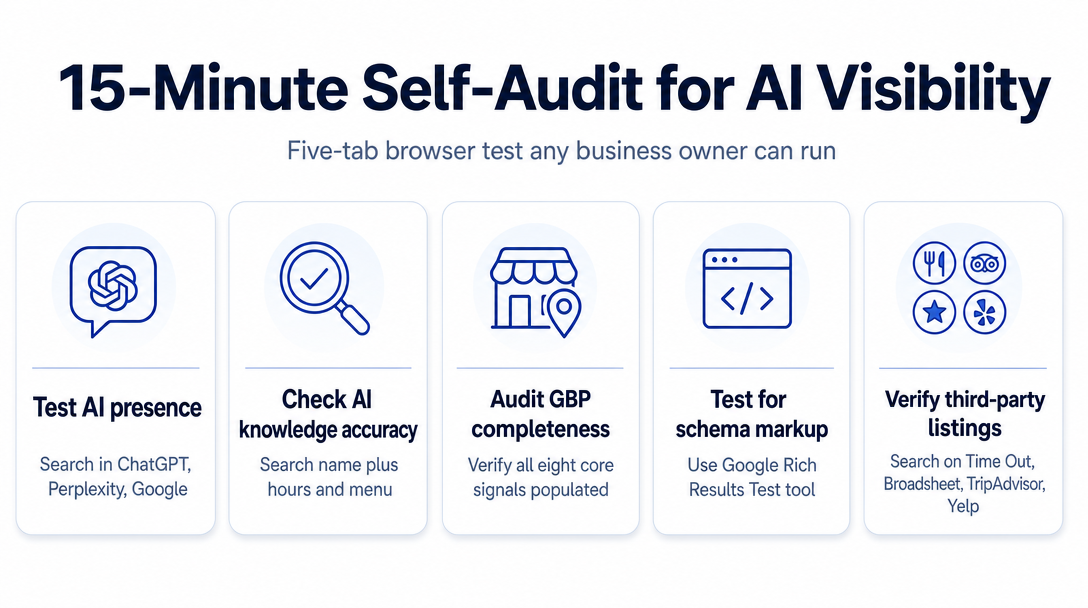
The five-tab browser test any owner can run in 15 minutes
You don't need a tool to get a baseline picture of your AI visibility today.
- Test your AI presence. Open ChatGPT, Perplexity, and Google (check for an AI Overview at the top). Type "best [your cuisine type] café in [your suburb]." Screenshot what appears. Does your name show up? If a competitor appears and you don't, their Citation Stack is more complete than yours.
- Check what AI knows about you. Search your café name plus "hours" and your café name plus "menu." Does Google surface accurate structured information, or is it guessing from GBP alone?
- Audit your GBP. Are all eight core signals populated? Missing even one - say, no menu link - leaves a gap an AI can't fill.
- Check for schema. Paste your homepage URL into Google's Rich Results Test. If the result shows no structured data, you have zero schema. Fix this first.
- Audit your third-party listings. Search your business name on Time Out, Broadsheet, TripAdvisor, and Yelp. Are you listed? Is the information accurate and consistent with your GBP?
This manual check tells you where you stand. Fulcrum AI automates the same process across all seven dimensions of the Citation Stack, scores your venue, and generates ranked copy-paste fixes - including drafted FAQ content and schema recommendations you can apply without touching the live site until you're ready. See what your café's score looks like at fulcrumai.com.au.
The One Mistake That Undoes Everything (And How to Avoid It)
The most common way cafés self-sabotage their AI visibility is conflicting information across channels.
Here's a realistic scenario: "Espresso Corner" has its GBP showing Sunday hours as 7am-3pm, its website footer showing 8am-2pm, and its Facebook page still listing "closed Sundays" from a post three years ago. A customer asks ChatGPT "is Espresso Corner open Sunday morning?" The AI encounters three contradictory signals. Rather than give a confident answer, it either cites the wrong hours or deflects with "I'd recommend checking directly" - and sends the customer toward a venue it CAN answer about confidently.
The fix is a consistency audit across six surfaces in a single session: GBP, your website, Facebook, Instagram bio, TripAdvisor, and Yelp. Every field - name, address, phone, hours, menu link - must match. Set a quarterly calendar reminder to repeat it. Any time your hours change, update all six at once.
Frequently Asked Questions
How long until AI starts recommending my café after I make these changes?
Structural changes like schema markup and GBP updates can be indexed within days in most cases. AI engines that draw from live web data - Perplexity and Google AI Overviews - tend to reflect changes faster than those using periodic training snapshots. Allow 4-8 weeks before you consistently see yourself appearing in live AI queries.
My café is already on TripAdvisor and Yelp. Isn't that enough?
Directory listings are a corroborating signal, not a foundation. AI engines still need your website to have structured data and a crawlable text menu to cite you confidently for specific queries - dietary requirements, accessibility, trading hours. Think of TripAdvisor and Yelp as confirmation of an entity that your website must first define clearly.
Do I need a developer to add schema markup to my café website?
Not necessarily. If your site runs on WordPress, plugins like Rank Math or Yoast SEO have local schema tools built in. For a custom site, a JSON-LD block added to your homepage <head> is typically under an hour of developer work. Fulcrum AI generates the exact schema recommendation and flags it as a ranked fix - you or a developer simply apply it.
I have 400 Google reviews. Why am I still not being recommended by ChatGPT?
Review volume is only one signal in the stack. If your website has no structured data, your menu is a PDF, and there are no authoritative third-party citations from sources like Broadsheet or Time Out, the AI knows you're trusted but can't describe what you serve or whether you suit a specific query. High reviews without the rest of the Café Citation Stack produces exactly this outcome.
Can a café with no marketing budget improve its AI visibility?
Yes - the first four items in the Café Citation Stack cost nothing but time. Completing your GBP, fixing NAP consistency, converting your menu to an HTML page, and building a FAQ page are all free. Schema markup has a small one-time developer cost on custom sites, but on WordPress it's free with an existing plugin. The authority layer (reviews, third-party citations) builds naturally once the foundation is in place.
See Your Café's AI Visibility Score in Under 60 Seconds
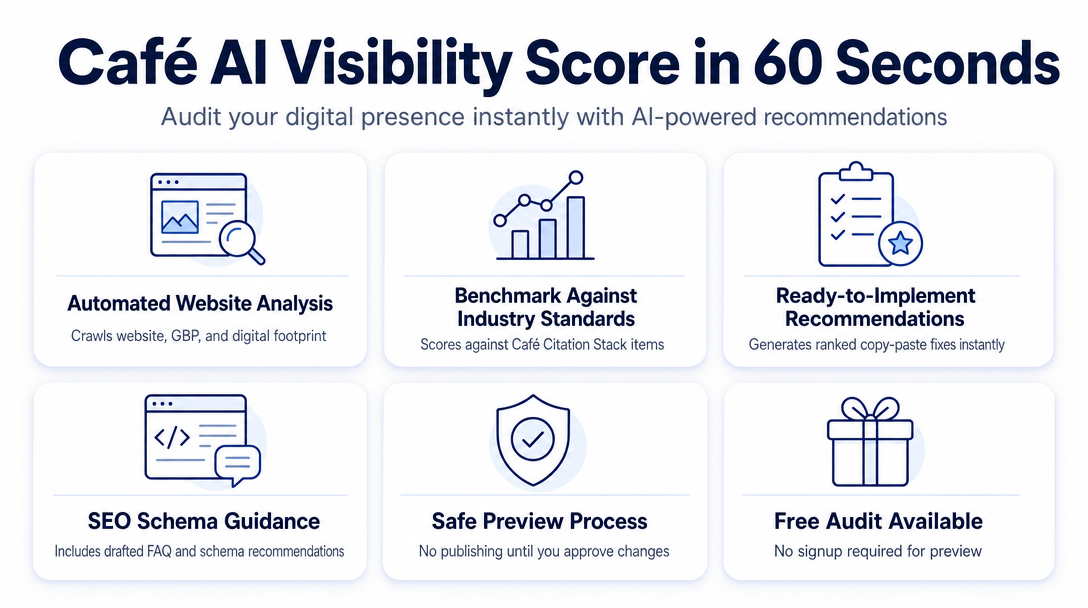
Fulcrum AI crawls your venue's website, GBP, and digital footprint, scores it against every item in the Café Citation Stack, and generates ranked copy-paste fixes - including drafted FAQ content and schema recommendations - without publishing anything to your live site until you approve it. Built in Australia by founder Cory Nathan, it is designed specifically for time-poor hospitality operators at $99/month AUD, with a free preview that requires no signup.
Get your free café GEO audit at fulcrumai.com.au