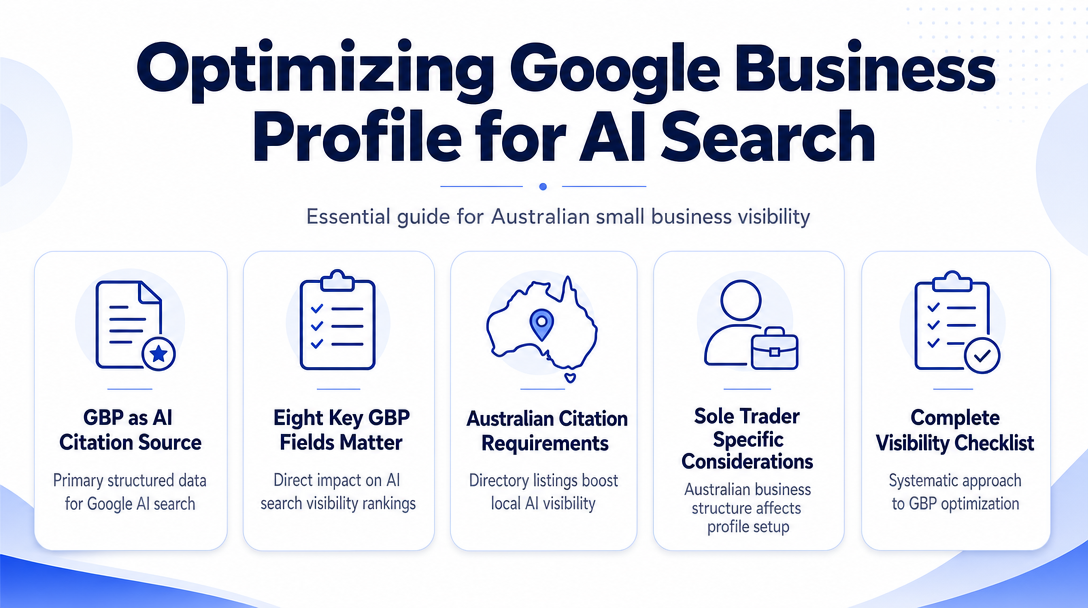
How to Improve Your Google Business Profile for AI Search Visibility - A Guide for Australian Small Businesses
Your Google Business Profile is no longer just a map pin. In 2026, it is one of the primary structured data sources Google's AI draws on when…
How to Improve Your Google Business Profile for AI Search Visibility - A Guide for Australian Small Businesses
Your Google Business Profile is no longer just a map pin. In 2026, it is one of the primary structured data sources Google's AI draws on when constructing AI Overview answers for local queries. If your profile is incomplete, inconsistent, or missing key fields, AI engines simply skip you - not because your business is irrelevant, but because your data doesn't give them enough confidence to cite you.
Whitespark's Q1 2025 research found AI Overviews appeared in an average of 68% of local search queries tested. That means for the majority of searches a potential customer in your area runs, an AI-generated answer appears above the map pack - and the businesses cited in that answer aren't necessarily the closest or the most established. They're the ones whose GBP data is complete, consistent, and corroborated.
This guide walks you through exactly which GBP fields AI engines read, how to fill them in for maximum AI citation potential, and what Australian small businesses and sole traders need to do that generic guides miss entirely.
Why Your Google Business Profile Is Now an AI Citation Source
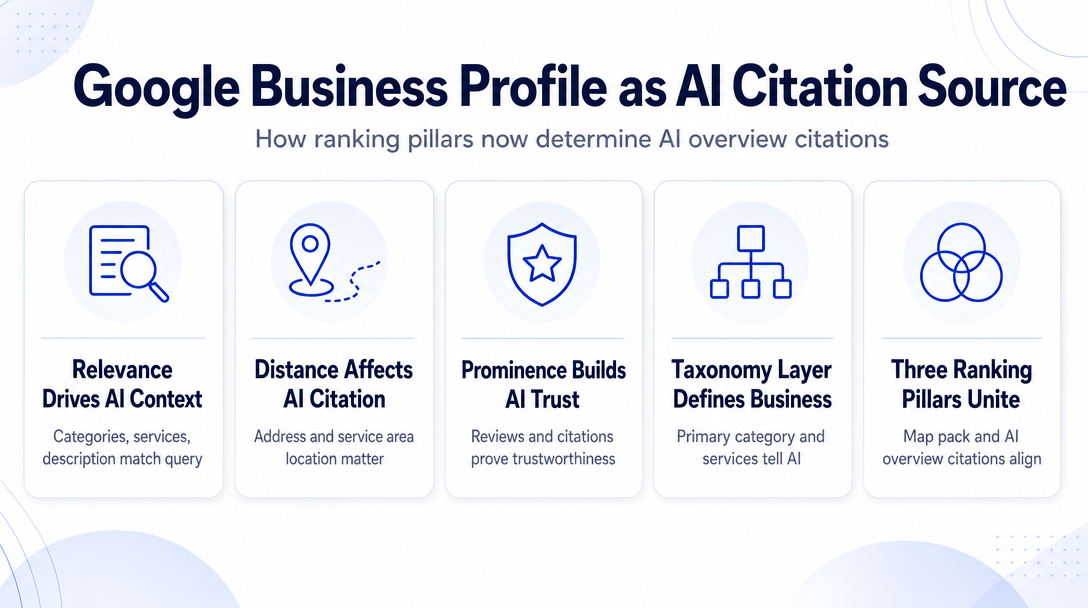
Google's official local ranking documentation identifies three ranking pillars: Relevance, Distance, and Prominence. These originally explained why businesses appeared in the map pack. In 2026, they also map directly to whether AI Overviews cite you.
- Relevance - how well your categories, services, and description match the query. AI reads these fields to assign topical context.
- Distance - your address or service area relative to the searcher. AI respects service-area settings for businesses without a fixed location.
- Prominence - your reviews, external citations, and overall web presence. This is the "proof layer" AI uses to assess trustworthiness before quoting you.
The GBP AI Readability Stack
A useful model for thinking about your profile is the GBP AI Readability Stack - four layers AI engines process when evaluating whether to cite your business:
- Taxonomy Layer - primary category + services tab. Tells AI what you do.
- Description Layer - business description + attributes. Tells AI who you serve and how.
- Proof Layer - reviews + photos. Tells AI whether to trust you.
- Corroboration Layer - NAP consistency + external directory citations. Tells AI whether the rest of the web agrees with what your GBP claims.
Think of each layer as a gate. If the Taxonomy Layer is vague, AI can't place you. If the Proof Layer is thin, AI won't cite you even if the top layers are strong. Every step below builds one of these four layers.
Why a Half-Complete Profile Reads as Low-Confidence to AI
Google's own guidance states: "Make sure your business info is as complete as possible in your Business Profile. This helps customers know what you do, where you are, and when they can visit." AI engines extend this logic further - a sparse profile isn't just unhelpful to human readers, it's a low-confidence signal to an AI constructing a local answer. A blank services tab, no photos, and three reviews from 2022 tells the AI: this business may no longer be operating, or may not be relevant enough to cite.
The 8 GBP Fields That Directly Feed AI Search Visibility
Step 1 - Primary Category (Precision Beats Breadth)
Choose the single most specific primary category that matches your core service. AI treats primary category as the dominant topical signal. "Electrician" outperforms "Home Services" for every electrical query because it's unambiguous. Add two to three relevant secondary categories, but let your primary category own the AI context. Broad primary categories dilute relevance and push you down in AI matching.
Step 2 - Business Description (Write for AI, Not Just Humans)
Your 750-character business description is one of the few free-text fields AI reads for topical context. It's also one of the most neglected. Use this formula:
[What you do] + [Who you serve] + [Where you operate] + [One differentiator]
Example for a plumber: "Licenced plumber serving homes and small businesses across Sydney's Inner West and Northern Beaches. Specialising in emergency repairs, hot water systems, and bathroom renovations. Same-day bookings available."
Write in natural language - the kind customers use in voice searches and conversational queries. Keyword stuffing reads poorly to both humans and AI. Aim for clarity over density.
Step 3 - Services Tab (Your Keyword Layer)
The Services tab is a structured data layer that AI uses to answer what researchers call "query fan-out" - when an AI constructs an answer, it fires multiple sub-queries simultaneously (for example, a query for "best emergency plumber in Brisbane" pulls results matching "emergency plumbing", "plumber Brisbane", and "24-hour plumber"). Your Services tab feeds each of those sub-queries independently.
List every specific service with its own name and a one-to-two sentence description. Use the language customers use - "hot water system repair" rather than "HWS remediation". Services written in natural, conversational language also perform better in voice search, where queries are longer and more specific.
Step 4 - Attributes (Machine-Readable Structured Signals)
Attributes are pre-formatted signals Google provides - things like "Women-owned", "Wheelchair accessible", "Outdoor seating", "LGBTQ+ friendly". Their value for AI visibility is underestimated: because they're structured and machine-readable, AI engines don't have to infer these facts from your description - they read them directly. Tick every attribute that accurately describes your business. Leaving them blank isn't neutral; it's missing data AI would otherwise have confidence in.
Step 5 - Photos (Google's AI Now Reads Image Content)
By 2026, Google's AI analyses photo subjects to assess relevance - it doesn't just display images as thumbnails. A café with photos of its interior, menu items, and outdoor seating communicates more about its offerings than a café with only a logo.
Practical guidance:
- Upload photos with descriptive filenames before uploading (e.g.,
tiling-bathroom-renovation-sydney.jpgrather thanIMG_4829.jpg) - Complete all four GBP photo categories: exterior, interior, work in progress/team, and product or service
- Upload photos consistently - an active photo history signals an operating business
Step 6 - Reviews (The Proof Layer AI Trusts Most)
Reviews sit at the heart of the Proof Layer and are the strongest Prominence signal in AI citation decisions. Two things AI reads in your reviews - not just your star rating and volume, but the actual keywords customers use in their review text.
A review that says "great service" tells AI almost nothing. A review that says "fixed our blocked drain in Newtown on a Sunday afternoon, very professional" gives AI a service keyword ("blocked drain"), a location signal ("Newtown"), a timing signal ("Sunday"), and a quality signal ("professional") - all indexable.
How to encourage useful review text: When following up with satisfied customers, suggest they mention the specific service and suburb. Don't script them; simply say "If you're happy to leave a review, it really helps if you mention what we did and where." Also respond to every review you receive - owner responses add keyword-rich text that AI can read, and they signal active profile management, which supports E-E-A-T (Experience, Expertise, Authoritativeness, Trustworthiness) signals Google's AI weighs when deciding citation confidence.
Step 7 - GBP Posts (The Underused Weekly Signal)
GBP Posts are indexed content - they show recency and topical depth. Yet most small business profiles haven't posted in months. For AI visibility, regular posts signal two things: the business is currently operating, and it is actively relevant to the services it lists.
Post at minimum once per week. Each post should include a clear service mention and a location reference. Good content types: completed project highlights ("Just finished a deck build in Manly - available for quotes across the Northern Beaches"), seasonal service reminders, offers, or practical tips. Note that standard GBP Posts expire after seven days - set a recurring calendar reminder so your profile never goes dark.
Step 8 - Q&A Section (Seed Your Own Knowledge Layer)
The GBP Q&A section is almost entirely unused by Australian small businesses - which makes it a significant competitive gap. AI engines can surface Q&A content when answering informational queries, and unlike reviews, you control what questions appear.
The strategy: post five to eight questions yourself (using your personal Google account as a customer would), then answer them thoroughly as the business owner. Cover your most common customer queries. Examples:
- "Do you service the Hills District and Parramatta area?" - Answer with a suburb list.
- "Are you available for emergency callouts on weekends?" - Answer with availability details.
- "Do you provide written quotes before starting work?" - Answer with your quoting process.
This turns a neglected field into a structured knowledge layer AI can read and cite.
The Australian-Specific Layer - Citations, Directories, and Sole Traders
What NAP Consistency Means and the One Mistake That Tanks AI Citations
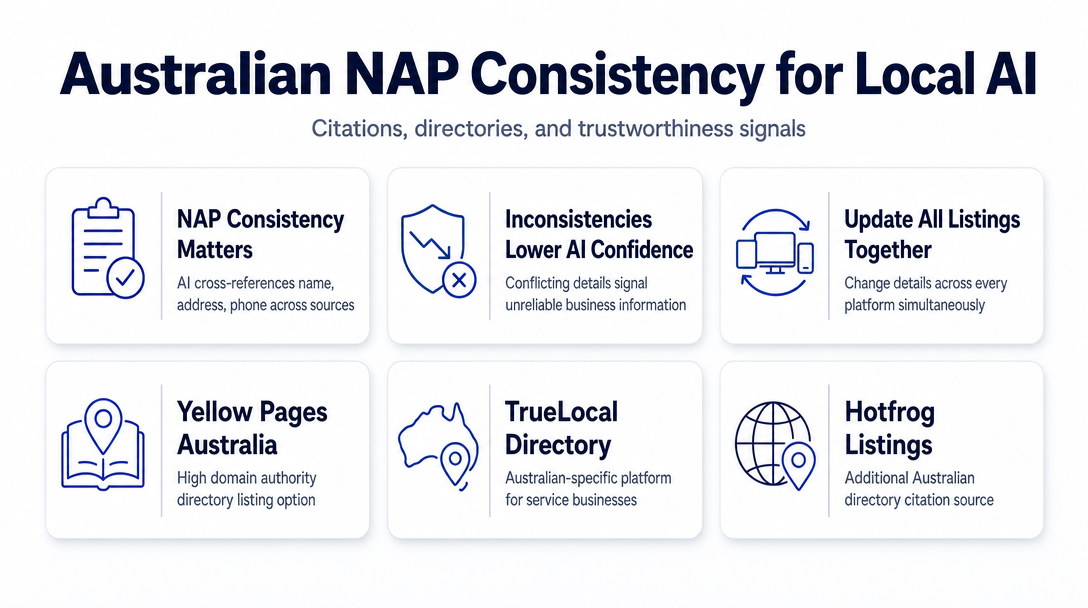
NAP stands for Name, Address, and Phone number. AI engines don't just read your GBP in isolation - they cross-reference it against external sources to assess whether the information is trustworthy. If your business name appears as "Smith's Plumbing" on GBP but "Smiths Plumbing Services" on a directory listing, and your phone number differs across three platforms, those inconsistencies lower AI's confidence in your data.
The single most common mistake: updating your phone number or moving premises and only changing it on Google. Every listing where the old details persist becomes a contradiction signal. Audit all external listings whenever your core details change.
Australian Directories Worth Listing On
These are the Australian directory platforms where consistent NAP citations still carry weight for local AI search prominence:
- Yellow Pages Australia (yellowpages.com.au) - high domain authority, widely indexed
- TrueLocal (truelocal.com.au) - Australian-specific, good for service businesses
- Hotfrog Australia (hotfrog.com.au) - free listings, frequently crawled
- Yelp Australia (yelp.com.au) - review platform with citation value
- StartLocal (startlocal.com.au) - smaller but Australian-specific
Quality over quantity: five accurate, consistent listings outperform fifty inconsistent ones. And note: Google Search Central's May 2025 guidance specifically identifies "structured data matching visible content" as a top signal for AI performance - which means your website should also carry LocalBusiness JSON-LD schema that matches the details on your GBP exactly. If you've already read Fulcrum AI's GEO audit framework article, you'll recognise this as part of the community footprint dimension.
Sole Traders and Service-Area Businesses - AI Visibility Without a Fixed Address
A large share of Australia's small business population - tradies, consultants, therapists, mobile service providers - operates without a shopfront. The good news: Google explicitly supports service-area business (SAB) setup, and AI Overviews respect it.
How to set it up:
- In your GBP, choose "I deliver goods and services to my customers" during setup (or edit this in your existing profile under "Business location")
- Hide your home address - you are not required to display it
- Set your service area by suburb, postcode, or region - be specific. Setting "All of Australia" does not help AI match you to localised queries. Set the suburbs or regions you actually service.
Once configured, your profile will appear in AI local results for queries within your service area without exposing your personal address.
Your GBP AI Visibility Checklist
| GBP Field or Action | Done? |
|---|---|
| Primary category set to most specific match | - |
| 2-3 relevant secondary categories added | - |
| Business description written (services + location + differentiator, natural language) | - |
| Services tab completed (every service named with a description) | - |
| All accurate attributes ticked | - |
| Minimum 10 photos uploaded (exterior, interior, work, team/product) | - |
| Photos uploaded with descriptive filenames | - |
| 10+ recent reviews (with specific service and location mentions) | - |
| Owner responses written for every review | - |
| GBP Post published within the last 7 days | - |
| Q&A section seeded with 5+ owner-written questions and full answers | - |
| NAP identical across GBP and all directory listings | - |
| Listed on top 5 Australian directories (Yellow Pages AU, TrueLocal, Hotfrog, Yelp AU, StartLocal) | - |
| Website carries LocalBusiness JSON-LD matching GBP details | - |
Each unchecked row is a field AI engines read as "unknown". The GBP AI Readability Stack only works when all four layers are complete - gaps in the Taxonomy Layer mean AI can't classify you; gaps in the Proof Layer mean AI won't trust you; gaps in the Corroboration Layer mean AI can't verify you.
Frequently Asked Questions
Does having a Google Business Profile guarantee I'll appear in AI Overviews?
No. A claimed and verified profile is the entry requirement, not a guarantee of citation. AI Overviews cite businesses whose GBP data is complete, consistent, and corroborated by external sources and reviews. A sparse or inconsistent profile is functionally invisible to AI even if it ranks adequately in the traditional map pack.
How many Google reviews do I need to show up in AI search results?
There is no published minimum from Google. Review volume and recency are both Prominence signals, but the content of reviews matters as much as the count. Businesses with reviews that include specific service names and location references appear more frequently in AI local citations. Focus on getting real, specific reviews rather than chasing a particular number.
Do GBP Posts help with AI search visibility?
Yes. GBP Posts are indexed content that AI can read when assessing recency and topical relevance. Posting at least once per week signals an active, operating business and adds keyword-rich text to your profile's overall footprint.
I'm a sole trader with no office address. Can I still appear in AI local results?
Yes. Set up your GBP as a service-area business, hide your home address, and define your service regions by specific suburbs or postcodes. Google and AI engines respect SAB settings when matching businesses to location-based queries. Avoid setting an overly broad service area - specificity improves your match rate.
What's the difference between the Local Pack and AI Overviews for local businesses?
The Local Pack (the map and three business cards beneath it) is driven primarily by proximity and GBP completeness. AI Overviews are more content-driven - they synthesise answers from GBP data, your website content, and external citations. Optimising for one does not automatically optimise for the other. Whitespark's Q1 2025 research found AI Overviews appeared in an average of 68% of local search queries tested, making AI Overview optimisation a priority alongside traditional local SEO.
How long does it take for GBP changes to affect AI search visibility?
Changes to core fields like categories, description, and services are typically indexed within days, though noticeable shifts in AI citation frequency may take several weeks to appear. Photo uploads and new posts can show an effect more quickly, particularly in signalling profile activity. Consistency over time matters more than any single update.
Not sure which GBP fields are actually limiting your AI visibility right now? Fulcrum AI's free preview scans your Google Business Profile and website across seven dimensions - including the GEO/AI-search visibility score and the community footprint audit that maps exactly where your profile's Corroboration Layer is breaking down. You'll get a ranked list of what to fix, with the copy-paste edits ready to go, before you spend a dollar. Get your free preview at Fulcrum AI.