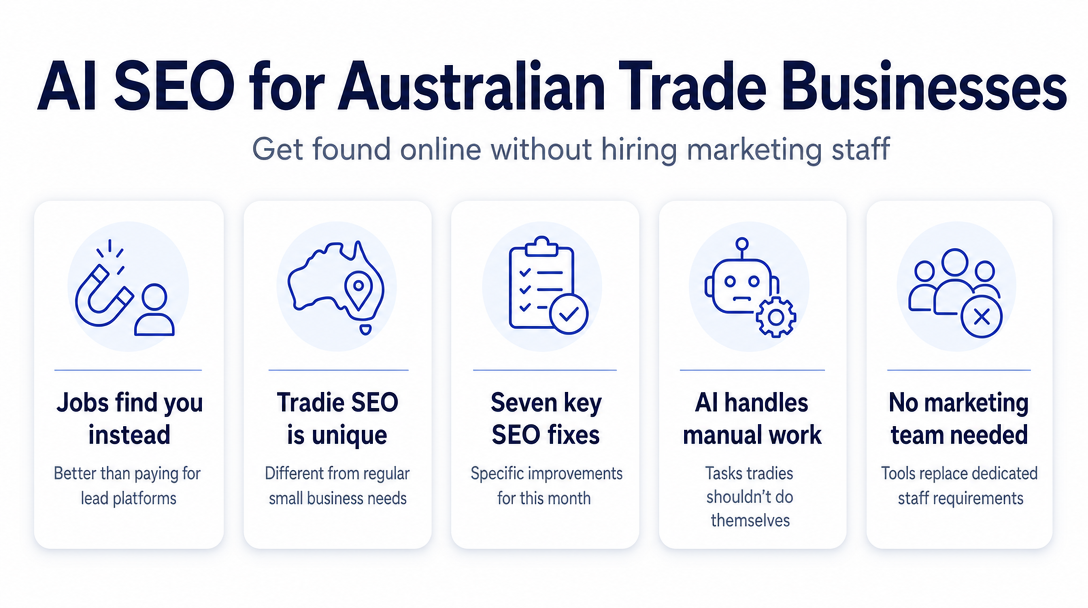
How Australian Tradies and Trade Businesses Can Use AI SEO to Get Found Online Without a Marketing Team
A tradie's best source of new work is a job that finds them - not one they paid $40 to chase on a lead platform. AI SEO tools make that possible by…
How Australian Tradies and Trade Businesses Can Use AI SEO to Get Found Online Without a Marketing Team
A tradie's best source of new work is a job that finds them - not one they paid $40 to chase on a lead platform. AI SEO tools make that possible by fixing the website and search signals that determine whether Google, ChatGPT, and Google AI Overviews recommend your business when someone nearby searches for your trade. No marketing degree required.
Why Tradie SEO Is a Different Problem to Regular Small Business SEO
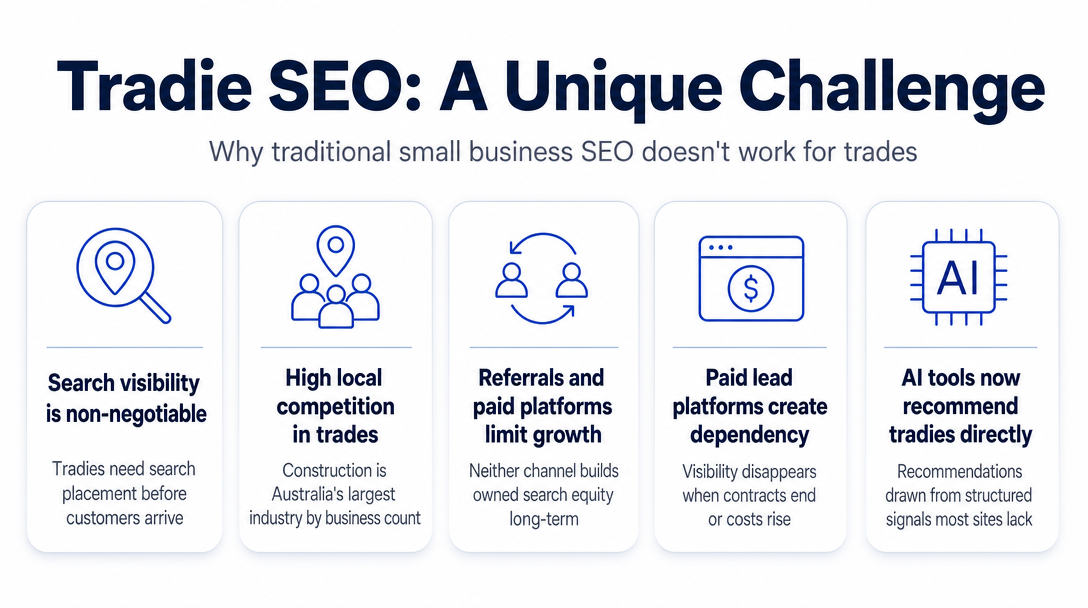
A cafe gets walk-in customers. A tradie gets nothing unless they show up in search first.
That asymmetry matters. Construction is Australia's largest industry by number of businesses, and it grew again in 2024-25, contributing 7% of GDP and employing around 1.3 million people. That means the local competitive density for any given trade - plumbers, electricians, builders, tilers - in any given suburb is high and getting higher.
Add to that: most tradies have historically relied on two acquisition channels. Referrals (which don't scale) and paid lead platforms like hipages, Oneflare, or ServiceSeeking (which stop the moment you stop paying). Neither channel builds owned search equity. When a hipages contract ends or the per-lead price climbs, visibility disappears overnight.
Meanwhile, AI tools - ChatGPT, Google AI Overviews, Perplexity, Google Gemini - now answer "who's the best electrician in [suburb]?" directly. Those recommendations are drawn from structured signals most tradie websites don't have. The gap between a tradie who is found and one who isn't comes down to a short, specific list of fixes.
We call the three layers a tradie needs to own search visibility the Tradie Visibility Stack:
- Layer 1 - Claimed: Google Business Profile complete, NAP consistent, reviews active
- Layer 2 - Structured: Service pages built, suburb pages live, LocalBusiness schema in place
- Layer 3 - Cited: Regular content published, AI engines finding and citing the business
The seven fixes below build those layers in order.
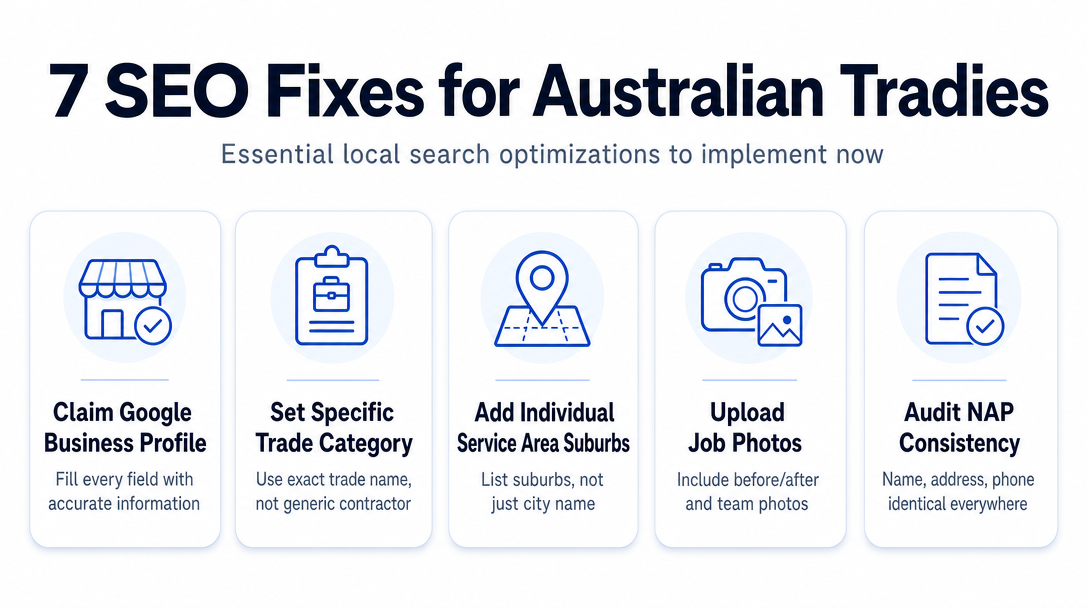
The 7 SEO Fixes Australian Tradies Should Make This Month
Fix 1 - Claim and Complete Your Google Business Profile (Every Field)
Your Google Business Profile (GBP) is the single highest-leverage SEO action available to a tradie. For service-area businesses with no physical shopfront, it often matters more than the website itself for appearing in the Google Local 3-Pack - the three business listings that show at the top of local search results.
What to do: Fill every field. Set your primary category to a specific trade (use "Electrician" not "Contractor"). Add individual suburbs to your service areas - not just the city name. List every service you offer. Set accurate hours. Upload at least five photos of completed jobs, plus team and equipment photos. Completed-job photos (before and after, where relevant) signal active, local work to Google's local ranking algorithm.
One thing to avoid: do not list a PO Box as your address if you operate as a service-area business. Use the service-area setting instead, or Google may suppress your listing.
Fix 2 - Audit Your NAP: Name, Address, Phone Must Be Identical Everywhere
NAP inconsistency is the invisible SEO killer most tradies don't know about. If your business appears as "Smith Electrical" on your website, "Smith Electrical Services" on your GBP, and "S. Smith Electrician" on hipages, Google cannot confidently treat these as a single business entity. Neither can AI engines like ChatGPT or Perplexity, which rely on consistent entity signals to make local recommendations.
What to do: Check and match your exact business name, address format, and phone number across every platform where your business appears - your website, GBP, hipages, Oneflare, ServiceSeeking profiles, Facebook, Yellow Pages, and True Local. The format must be identical, not just similar.
Fix 3 - Build a Dedicated Service Page for Each Trade You Offer
One generic "Services" page does not rank. Google needs a dedicated page for each core service to match specific search intent. "Switchboard Upgrades," "Safety Inspections," "Hot Water System Installation" - each deserves its own page.
What to do: Create one page per major service. The service name should appear in the H1 heading and the page title tag. Include at least 300 words of plain-English description, a short FAQ block relevant to that service, and a clear call-to-action with your phone number or a quote form. This is where an AI SEO tool earns its keep immediately - it can draft these service pages from a crawl of your existing site without you writing a word from scratch.
Fix 4 - Create Suburb-Specific Landing Pages for Your Service Area
A plumber who works across eight suburbs but has only one location page is invisible to anyone searching "plumber [suburb name]" in seven of those suburbs. This is one of the highest-ROI SEO tactics for any trade business - and the one almost no informational guide aimed at tradies has ever spelled out clearly.
What to do: Build a dedicated page for each primary service area. "Plumber North Lakes," "Plumber Kallangur," "Electrician Chermside." The critical point: each page needs genuinely unique content, not a copy-paste with the suburb name swapped. Include local references, mention nearby landmarks where relevant, and embed a Google Maps iframe showing the area. Duplicate suburb pages can hurt rather than help.
Fix 5 - Add LocalBusiness Schema Markup to Your Website
Schema markup is structured data that tells Google and AI engines not just what your page says, but what your business is - its type, location, service area, phone number, and hours. Without it, AI engines cannot reliably classify and cite your trade business as the answer to a location-specific query.
What to do: Add schema to your homepage and service pages. Google recognises specific trade subtypes - Electrician, Plumber, HVACBusiness, Locksmith, RoofingContractor, GeneralContractor - not just the generic LocalBusiness type. At minimum, your schema should include your business name, address, telephone, areaServed, url, and openingHours. Including your trade licence number and insurance details in your site content (even outside schema) also strengthens your entity profile for AI-generated recommendations.
For a deeper look at schema implementation and AI search visibility, the Fulcrum AI article on schema markup for Australian businesses covers the technical side.
Fix 6 - Build a Review Acquisition System (Not a One-Off Review Request)
Google reviews are a ranking factor for the Local 3-Pack. Volume matters, recency matters, and how you respond matters. A tradie with 4 reviews from 2021 will lose the local pack to a competitor with 22 reviews from the last six months.
What to do: Create a standing SMS template that sends your GBP review link immediately after a job is complete - not three days later, when the moment has passed. Aim for one review per completed job as an ongoing habit. Respond to every review, positive or negative, within 48 hours. Responses signal active business management to Google's local algorithm.
An AI SEO platform can draft personalised review-response copy for each review - useful when you have 30 to respond to and a full day of jobs ahead.
Fix 7 - Publish At Least One Piece of Local, Trade-Specific Content Per Month
A single-page website with a contact form is a near-invisible site to Google's crawlers. Regular content tells Google the site is active and that you know your trade. For tradies, informational content works because homeowners search before they book.
What to do: One article of 400-600 words per month is enough. Topics that match how homeowners search: "How to know if your switchboard needs upgrading," "What does a bathroom renovation cost in Brisbane?", "How long does a hot water system installation take?" These answer real pre-booking questions and pull in relevant traffic before a customer even knows which tradie they'll call.
Fulcrum AI drafts these articles from your existing website. See how it works. You review and approve before anything goes live.
What an AI SEO Tool Does That a Tradie Can't (and Honestly Shouldn't Have To) Do Manually
A two-person trade business has a full calendar of jobs, quotes to write, and invoices to chase. The seven fixes above are achievable - but only if the work actually happens. That's the gap an AI SEO platform closes.
Operational tools like ServiceM8 and Jobber handle the job management side well. This article is about the marketing side - the website signals, content, and structured data that determine whether new customers find you at all.
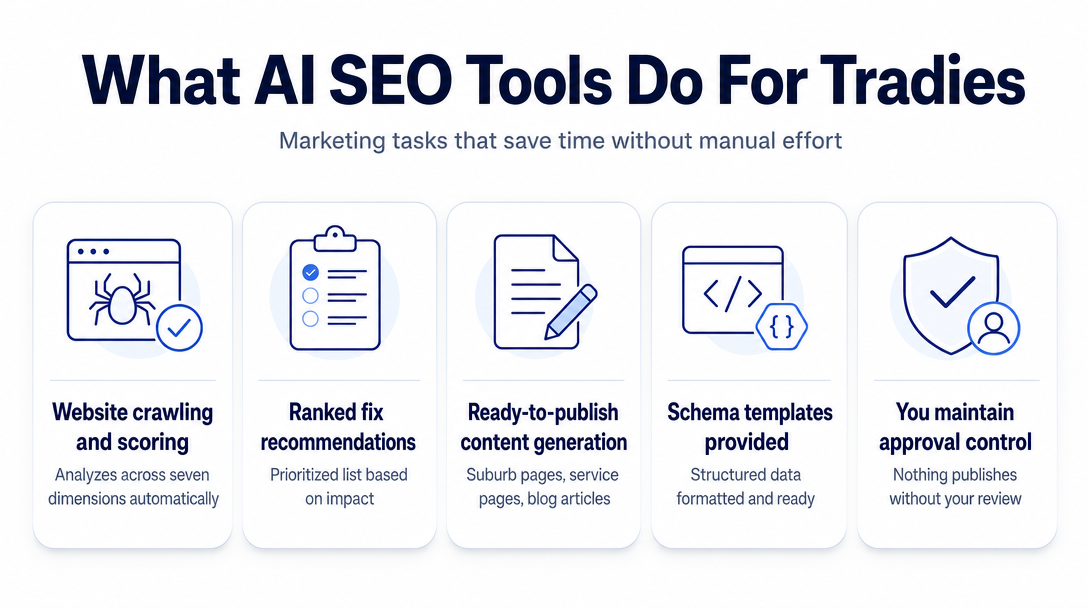
Fulcrum AI crawls your website, scores it across seven dimensions (including on-page SEO, technical health, AI-search visibility, competitor positioning, and content gaps), then generates a ranked list of fixes along with ready-to-publish copy - suburb pages, service pages, blog articles, and schema templates. Built in Australia for SMB budgets, it costs $99/month AUD with a free preview available - no credit card, no agency retainer.
The key rule: nothing publishes without your approval. The AI removes the bottleneck of finding the time to write. You stay in control of what goes live.
Frequently Asked Questions - AI SEO for Australian Tradies
Is SEO worth it for a one-person trade business?
Yes - particularly for sole traders. Every job that comes through organic Google search costs nothing in platform fees, unlike paid lead platforms where each accepted lead carries a direct cost. Once a page ranks, it keeps working without ongoing spend. The compounding effect is what makes SEO worth starting early even on a tight budget.
How long does SEO take to work for a tradie?
A well-optimised Google Business Profile can show improvement in local pack visibility within four to eight weeks. Website pages targeting suburb-specific keywords typically take three to six months to rank meaningfully. Starting earlier means you compound sooner - which is why waiting until you "need more work" is the wrong time to start.
Do I need a website, or is a Google Business Profile enough?
For the Local 3-Pack, a strong GBP can rank without a website in some cases. But a website is essential for service-specific and suburb-specific organic rankings, and for appearing in AI-generated answers from ChatGPT, Google AI Overviews, and Perplexity. You need both for full visibility across traditional and AI search.
What's the difference between owning my SEO and paying for leads on hipages?
Paid lead platforms give you rented visibility - stop paying and it stops. Organic SEO and a strong GBP build equity that compounds over time and reduces your cost-per-job as rankings grow. Most trade businesses benefit from both channels in the early stages, but building owned search presence progressively reduces dependence on platforms that set their own prices.
Can AI tools write my service pages and suburb pages for me?
Yes. A platform like Fulcrum AI crawls your existing site, identifies which pages are missing, and drafts ready-to-publish service and suburb pages based on your trade, location, and current content. You review and approve before anything goes live - the tool removes the writing work without removing your judgement from the process.
Does my trade licence number help with SEO?
Not directly as a ranking signal, but including your licence number, insurance details, and trade certifications on your website and GBP builds the trust signals and entity completeness that AI engines use when deciding which business to recommend. It also reduces quote-stage friction for customers comparing multiple tradies.
Your trade business is competing in every suburb you work in - but most tradie websites are invisible to Google, Google Maps, and AI tools like ChatGPT. Fulcrum AI crawls your site, scores it across seven dimensions, and drafts the suburb pages, service pages, and fixes your business needs - without publishing anything until you approve it. Start with a free preview: no credit card, no agency retainer.
Get My Free SEO Preview at fulcrumai.com.au
Related reading
- What Is Schema Markup and Why Does It Make Australian Small Business Websites More Visible to AI Search?
- How to Improve Your Google Business Profile for AI Search Visibility - A Guide for Australian Small Businesses
- How to Get Your Australian Small Business Cited in ChatGPT and Perplexity (Step-by-Step)