How to Run a Competitor SEO and GEO Analysis for Your Australian Small Business (Without Paying an Agency)
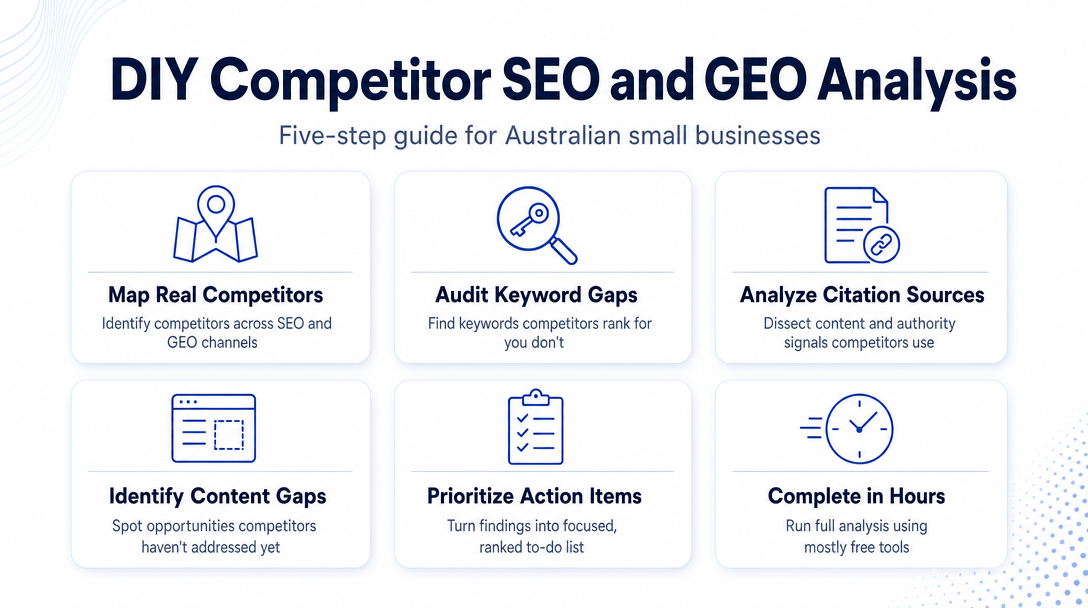
You can run a solid competitor SEO and GEO analysis yourself in 2-3 hours using mostly free tools. The process has five steps: map your competitors…
How to Run a Competitor SEO and GEO Analysis for Your Australian Small Business (Without Paying an Agency)
You can run a solid competitor SEO and GEO analysis yourself in 2-3 hours using mostly free tools. The process has five steps: map your competitors across Google and AI search, identify keyword gaps, diagnose why competitors get cited in AI answers, find content gaps they haven't filled, then build a prioritised fix list. No agency, no enterprise software subscription required.
Most Australian small business owners check their Google rankings occasionally. Almost none of them check where their competitors appear when a potential customer asks ChatGPT, Perplexity, or Google AI Overviews the same question. That blind spot is the Dual Scorecard problem - and it's costing businesses customers they never know they lost.
This guide walks through the same five-step competitor analysis process that Fulcrum AI automates. You can run it manually right now, or use it to understand exactly what the platform's competitor agent is surfacing when you run a free preview.
Why Running Both Scorecards Matters More Than Ever
Most competitor audits measure one thing: Google rankings. But a growing share of discovery now happens before a customer ever clicks a search result.
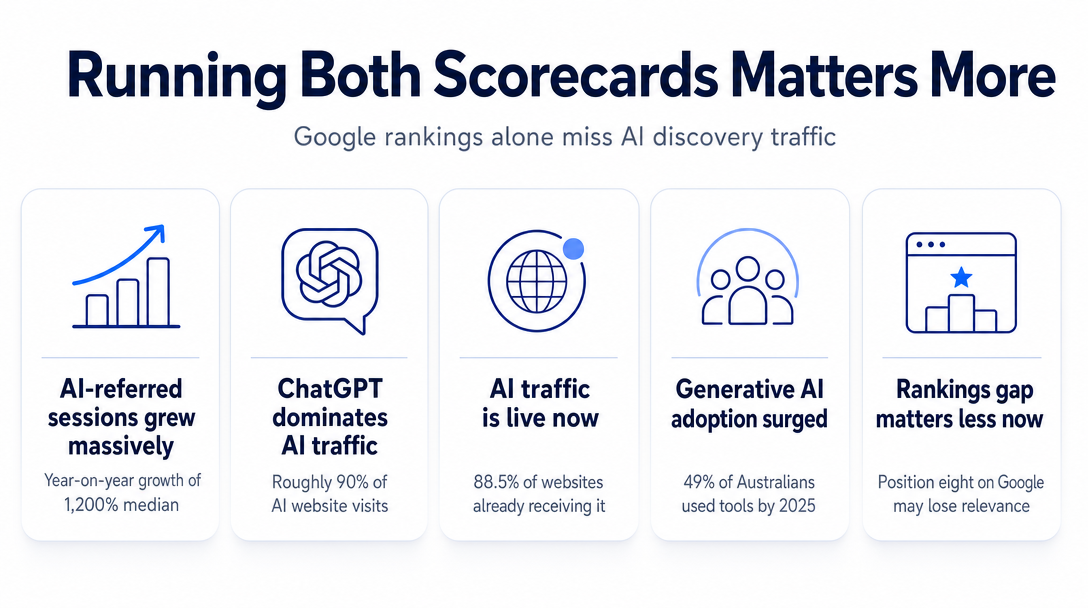
A study by Optimising.com.au covering 115 Australian businesses, reported in SmartCompany, found that AI-referred sessions grew +1,200% year-on-year (median), with ChatGPT alone driving roughly 90% of those AI website visits. In the same study, 88.5% of websites tracked were already receiving AI-referred traffic - meaning this channel is not hypothetical, it is live and measurable right now. Meanwhile, a Google/Ipsos survey cited by Searchscope.com.au found that 49% of Australians used a generative AI tool in the year to early 2025, up from 38% in 2023.
Your competitor might sit at position eight on Google and still be the first name a customer hears when they ask ChatGPT who to call. That is the gap this analysis closes.
For a deeper look at what GEO visibility means and how AI engines decide what to cite, the Fulcrum AI article ["GEO vs SEO: Why Australian Small Businesses Need Both in 2026"](https://fulcrumai.com.au) covers that foundation. This guide assumes you are already sold on the "why" and need the "how" - right now, step by step.
Step 1 - Map Your Real Competitors Across Both Channels (Not Just Google)
What you accomplish here: A shortlist of three competitors - the ones you actually need to analyse - drawn from both Google results and AI search answers.
Your business competitors (the ones you pitch against in proposals) are not always your search competitors. For this analysis, you want the businesses occupying your digital real estate, which means searching the way your customers search.
Google channel: Open Chrome in incognito mode. Search your top three to five service keywords - for example, "emergency electrician Melbourne" or "family law solicitor Brisbane." List the top five organic results for each. These are your Google search competitors.
AI channel - the step most guides skip: Open ChatGPT, Perplexity, and Google AI Overviews (if available in your region). Run the same service keywords as natural-language questions:
- "Who are some trusted electricians in Melbourne I can call today?"
- "What are the best family law solicitors in Brisbane?"
- "Can you recommend a [service type] near [suburb]?"
Note every business name that appears. These are your AI search competitors. They are often completely different from your Google top five - a business ranking eighth on Google may be the only name three AI platforms all mention.
Building Your Competitor Shortlist in 20 Minutes
Cap your analysis cohort at three businesses:
- The competitor ranking highest in Google organic results for your main keyword
- The competitor mentioned most often across ChatGPT, Perplexity, and Google AI Overviews
- One business appearing on both lists (this is your most dangerous competitor)
Capture everything in a simple Google Sheet with columns: Keyword | Google Position (Competitor) | ChatGPT Mention | Perplexity Mention | Google AIO Mention. You will build on this table through every step that follows.
Step 2 - Audit What Your Competitors Rank For That You Don't (Keyword Gap)
What you accomplish here: A list of keywords and AI-search prompts your shortlisted competitors own that your site does not appear for.
Free tools for the Google keyword gap:
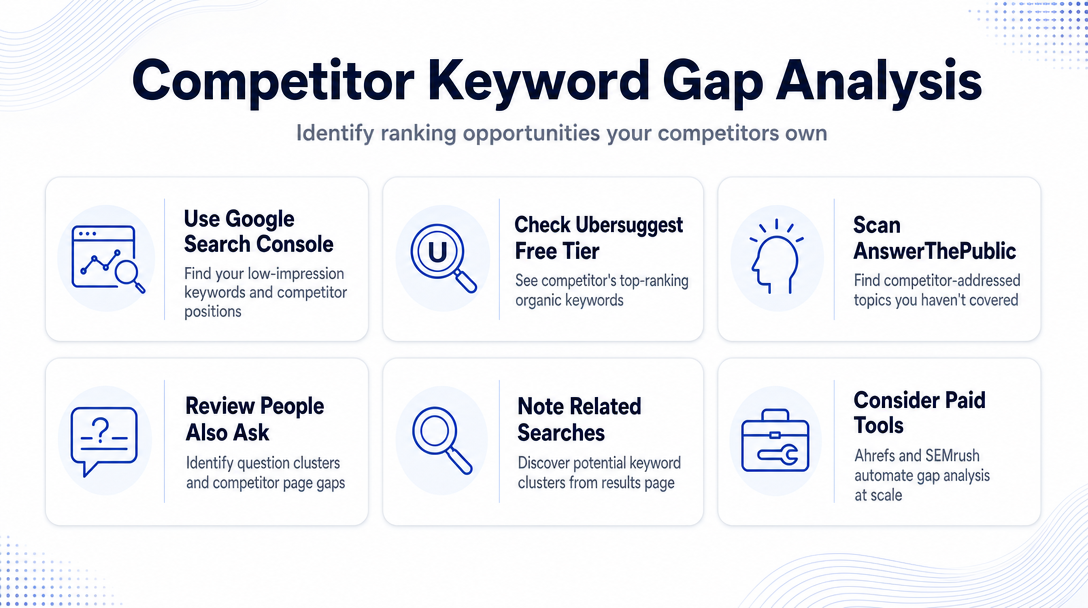
- Google Search Console (free) - your baseline. Check which of your keywords have low impressions or zero clicks. Run incognito searches for those terms to confirm which competitors take the positions you don't.
- Ubersuggest free tier - enter a competitor's domain to see their top-ranking organic keywords. The free tier has daily limits, so use it strategically on your top competitor first.
- AnswerThePublic (limited free searches) - enter your industry keyword and scan the question map for topics your competitor has addressed that you haven't.
- Google's "People Also Ask" and "Related Searches" - scroll the results page for your main keyword. Every sub-question in the PAA box is a potential keyword cluster. If your competitor has a page answering that question and you don't, that is a gap.
Paid tools like Ahrefs and SEMrush run automated gap reports at scale, but they typically cost hundreds of dollars per month - outside most sole trader budgets. The free stack above covers the core methodology.
The 10-Prompt AI Gap Test (Do This Right Now)
This is the dimension no competitor analysis guide covers. Copy these prompt templates, fill in your service type and location, and run each through ChatGPT and Perplexity. Also check Google AI Overviews and Gemini if you have access.
- "What is the best [service type] in [suburb/city] in Australia?"
- "Who are some trusted [service type] businesses I can contact in [city]?"
- "What should I look for when choosing a [service type] in Australia?"
- "Can you recommend any [service type] businesses in [state]?"
- "How much does [service type] typically cost in [city]?"
For each prompt: if a competitor's name appears and yours does not, record it in your Sheet as a GEO gap. If neither of you appears, that is a blue-ocean opportunity - an AI search position nobody has claimed yet.
A practical example: a plumber in Brisbane might rank at position five on Google for "emergency plumber Brisbane" but never appear in ChatGPT's answer to "Who should I call for a burst pipe in Brisbane at night?" That is a GEO keyword gap worth closing before a competitor does.
Step 3 - Dissect Why Your Competitors Get Cited (Content and Authority Signals)
What you accomplish here: You understand specifically why your shortlisted competitors appear in AI answers - and what they have that you don't.
Knowing which competitors are appearing is only half the story. The more useful question is why AI engines cite them over you. Three signals explain most of it:
1. Structured content Do they have dedicated service pages with clear heading hierarchies? Do those pages explicitly answer questions - with a question as a heading and a direct answer in the first sentence? AI engines extract content that is easy to parse. A page with well-structured headings and full-sentence answers is easier to cite than a wall of paragraph text.
2. Schema markup / structured data This is the signal the top-ranking competitor guides all miss. FAQ Schema tells AI engines "this section is a question-answer pair, structured for retrieval." LocalBusiness Schema tells them your location, category, and contact details. A competitor with FAQ Schema on their service pages has given every AI engine a machine-readable road map to their content. You can check any competitor's schema in under two minutes.
Free tool: Use Google's Rich Results Test - paste any competitor's URL and it instantly shows every piece of structured data on that page. If they have FAQ Schema and you have none, that structural advantage is likely a significant reason they appear in AI-generated answers and you don't.
3. Third-party citations AI engines do not just read websites - they weigh authority signals from across the web. For Australian small businesses, this means: Are they listed in True Local, Yellow Pages, or .com.au directories? Are they mentioned in state government small business portals? Have they been cited in an article on SmartCompany.com.au or a trade publication? A competitor mentioned in multiple credible Australian sources has an authority signal your site may lack entirely.
The 5-Minute Manual Authority Check
For each of your three shortlisted competitors, run these three free checks:
- Rich Results Test (rich results test URL above) - are they using FAQ, LocalBusiness, or Service Schema?
- Google
site:competitor.com.au- paste this search into Google to see how many pages they have indexed. A site with 200 indexed pages vs. your 15 has more surface area to be cited. - Ubersuggest domain overview (free) - check their domain authority score as a rough proxy for how many external sites link to them.
Record the results in your Sheet. By the end of this step, you will have a clear picture of the specific structural and authority advantages each competitor holds.
Step 4 - Spot the Content Gaps Your Competitors Haven't Filled
What you accomplish here: A prioritised list of topics and questions you should publish - including opportunities neither you nor your competitors own yet.
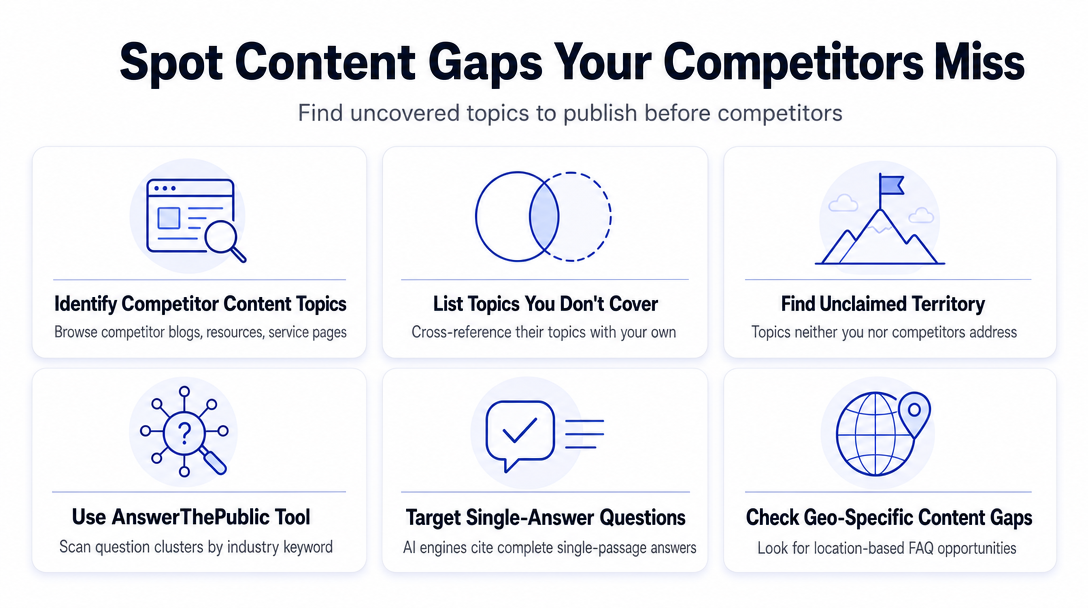
A content gap is any topic your competitor ranks or gets cited for that your site does not address. There is also a second, often-overlooked type: topics neither of you covers - open territory waiting for whoever publishes first.
Manual content gap method (free): Browse your top competitor's site - their blog, resources section, and service page structure. List every distinct topic they cover. Cross off anything you also publish. What remains is your gap list.
AnswerThePublic makes this faster: enter your industry keyword and scan the question clusters. Any question your competitor has a dedicated page for that you don't is an immediate gap.
The GEO content gap - what most guides miss entirely:
AI engines cite content that directly and completely answers a specific question in a single readable passage. A competitor with a 400-word FAQ entry for "How long does a [service] take in Australia?" has given AI engines an extractable, citable answer. If your site does not address that question at all, there is no passage to extract - you simply cannot appear in that AI-generated answer, regardless of your overall domain strength.
Think of it as question-answer density: the number of specific customer questions your site answers fully per equivalent amount of content, compared to your competitor's ratio. A competitor with higher question-answer density across their service pages will consistently outperform you in AI search, even if your Google rankings are comparable.
Use Google's People Also Ask boxes for your main keywords. For every sub-question that appears: does your competitor have a page or section addressing it? If yes, write it. If neither of you does, write it first.
Step 5 - Turn Findings Into a Prioritised Fix List (Not an Endless To-Do)
What you accomplish here: A three-tier action plan calibrated to a sole trader's actual time availability - not a 47-item backlog that never gets started.
The step every competitor analysis guide skips is telling you what to do first. Here is a practical three-tier system:
Tier 1 - Quick wins (under 2 hours each):
- Add FAQ Schema to your existing service pages using Google's free Structured Data Markup Helper - no developer required
- Claim or update your Google Business Profile with your current services, hours, and service area
- Add your business to three high-authority .com.au directories your shortlisted competitors already appear in (True Local, Yellow Pages, your state's small business directory)
Tier 2 - Content fixes (1-3 days each):
- Write one 400-600 word Q&A page for each high-traffic question your competitor answers that you don't
- Update your existing service pages to open with a direct one-sentence answer to the "People Also Ask" questions visible for your keyword - this is the single most efficient GEO improvement most sites can make
Tier 3 - Authority building (ongoing):
- Seek mentions in industry associations, credible Australian trade publications, and local business directories - these third-party citations are what AI engines use to validate a business's credibility before citing them
Start at Tier 1. Most sole traders who complete Tier 1 for their top service page see measurable changes in their AI search appearances within four to eight weeks.
If building this gap list manually sounds like more time than you have, Fulcrum AI runs the same competitor positioning, content gap, and GEO visibility analysis automatically - scoring your site across seven dimensions and delivering ranked copy-paste fixes, starting free.
Frequently Asked Questions About DIY Competitor SEO and GEO Analysis
How long does a DIY competitor SEO and GEO analysis take?
Allow 2-3 hours for a focused first pass: roughly 30 minutes to map competitors across Google and AI search, 45 minutes for keyword gap work using free tools, 45 minutes to audit competitor content and schema signals, and 30 minutes to build your priority fix list. After the first time, a monthly refresh takes under an hour because your Sheet is already built.
Do I need paid tools like Ahrefs or SEMrush to do this?
No. Google Search Console, the free tier of Ubersuggest, AnswerThePublic, Google's Rich Results Test, and manual prompts through ChatGPT and Perplexity cover the core analysis at zero cost. Paid tools add speed and volume for larger-scale analysis, but the five-step methodology in this guide works without them.
What is the difference between an SEO gap and a GEO gap?
An SEO gap is a keyword your competitor ranks for in Google's traditional results that your site does not appear for. A GEO gap is a question your competitor gets cited for in AI-generated answers - through ChatGPT, Perplexity, or Google AI Overviews - while your business is absent. GEO gaps often exist because a competitor has structured content, FAQ Schema, or third-party directory citations that your site currently lacks.
How often should I run this analysis?
Quarterly is the practical minimum for most small businesses. AI search is shifting quickly - competitors can gain or lose AI visibility within weeks of publishing new content or earning new directory citations. If you are in a competitive local service category, a quick AI prompt check monthly (Step 2's 10-prompt test) takes under 20 minutes and flags any significant changes between full quarterly audits.
Does this process work for a local service business in a small regional Australian city?
Yes - and local and regional businesses often find the biggest opportunity here. AI tools frequently return thin or inaccurate results for smaller cities and suburbs, which means the first local business to structure its content for AI citation often becomes the default answer for that location. Run every prompt in Step 2 with your suburb and city name included, and you may find you are competing against nobody yet.
Running this Dual Scorecard analysis manually every quarter is entirely achievable with the steps above. If you would rather have it done in minutes instead of hours, Fulcrum AI crawls your site and your competitors' sites, scores your GEO and SEO positioning across seven dimensions, and delivers a ranked list of copy-paste fixes - for $99/month AUD, or free to preview. Get your free preview at fulcrumai.com.au