SEO vs. GEO: What's the Difference and Why Australian Small Businesses Need Both in 2026
Australian small businesses now face two distinct search visibility problems that require two different types of auditing - but almost every tool on…
SEO vs. GEO: What's the Difference and Why Australian Small Businesses Need Both in 2026
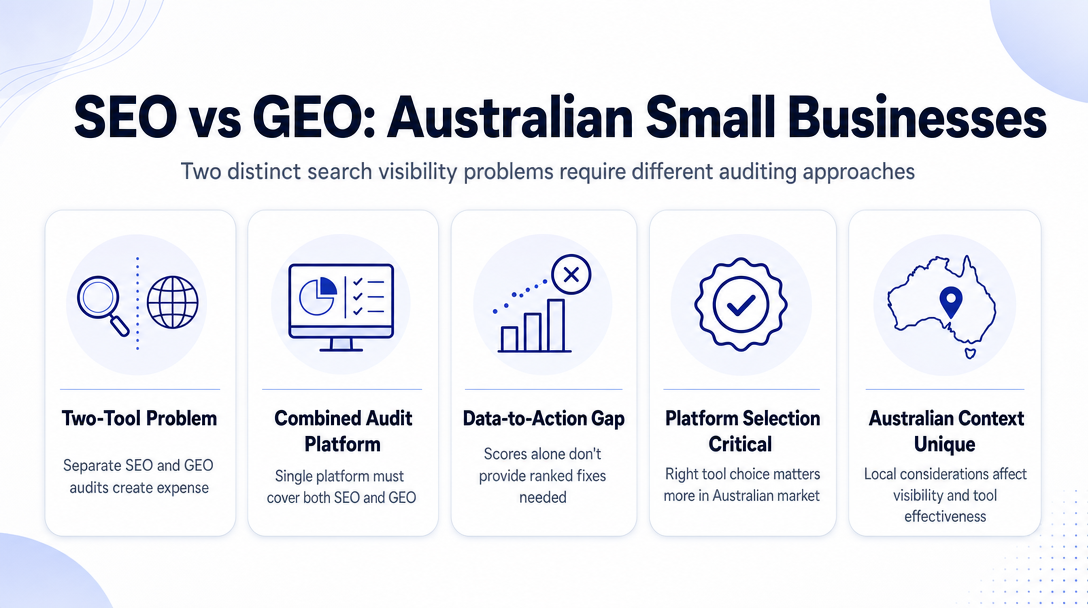
Australian small businesses now face two distinct search visibility problems that require two different types of auditing - but almost every tool on the market was built to solve only one of them. Traditional SEO platforms audit your technical health and on-page signals. GEO platforms track whether ChatGPT, Gemini, or Google AI Overviews cite your business. Buying both means two subscriptions, two dashboards, and no single ranked list telling you what to fix first. This is the practical buying guide for Australian sole traders, small business owners, and lean in-house teams asking: which platform actually covers both, what does it cost in real money, and is there anything built for businesses that aren't agencies?
If you're still weighing whether you need SEO and GEO coverage at all, the case for running both is covered here. This article starts one step further along - at the platform selection decision.
Why the "Two-Tool Problem" Is Getting Expensive for Australian SMBs
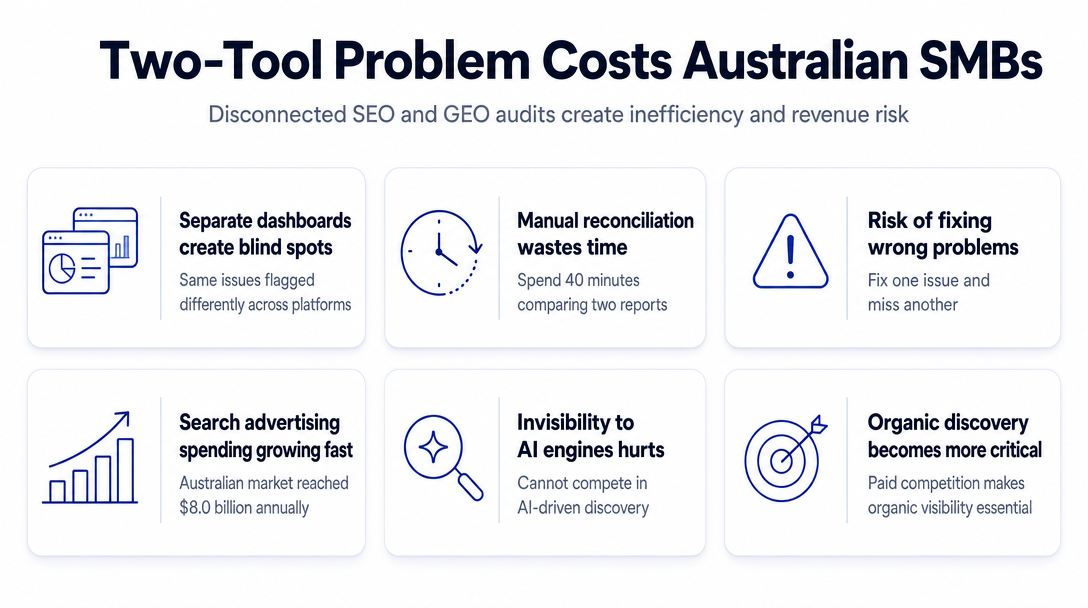
The two-tool problem is straightforward: when SEO and GEO audits live in separate dashboards, you get disconnected findings with no unified priority ranking.
A technical SEO audit might flag a slow-loading service page. A separate GEO audit might flag the same page as uncrawlable by AI engines. Without an integrated platform, there is a real chance you fix one issue and miss the other - or spend 40 minutes reconciling two reports to decide which problem costs you more revenue.
Australian search advertising reached $8.0 billion in CY2025, growing 11.5% year-on-year - a new annual high, according to IAB Australia. That level of paid competition makes organic and AI-driven discovery more valuable, not less. Businesses that cannot be found in traditional search AND are invisible to AI engines are competing at a structural disadvantage.
The Three Specific Costs of Running Disconnected Audits
- Conflicting fix priorities. Each tool generates its own recommendations. Without integration, there is no single answer to "what do I fix first?"
- No combined score. You cannot show a client, a co-founder, or yourself a single visibility number that captures the whole picture.
- Subscription stacking. A capable traditional SEO tool plus a capable GEO visibility tool plus a content gap tool adds up quickly - before you have paid for the time to actually use them.
What a Genuine Combined SEO + GEO Audit Platform Must Cover
Not every tool that mentions "AI visibility" qualifies as a combined platform. Before comparing options, it helps to define what seven functional dimensions a true combined platform should assess.
Fulcrum AI frames this as a Seven-Dimension Audit Standard - the argument that a platform covering fewer than these seven areas is, by definition, leaving part of your visibility blind:
- Technical SEO health - crawlability, Core Web Vitals, HTTPS, mobile rendering, and structured data / schema markup that affects both Google indexing and AI citation
- On-page SEO scoring - title tags, meta descriptions, heading hierarchy, internal linking, and keyword alignment
- GEO / AI visibility scoring - whether and how the business appears in ChatGPT, Gemini, Google AI Overviews, and Perplexity
- Competitor positioning - how the business ranks against named rivals in both traditional and AI search
- Content gap identification - topics and questions competitors answer that the business does not yet address
- Social presence - whether social signals reinforce or undermine the brand entity signals that AI engines use to evaluate authority
- Community footprint - directory listings, citations, Knowledge Graph consistency, and brand entity optimisation signals that affect AI recommendation
E-E-A-T signals, topical authority, and AEO (Answer Engine Optimisation) principles sit across dimensions 3, 6, and 7 - they are not separate categories but cross-cutting quality signals a combined platform should surface.
The platforms in the comparison below are rated against this standard.
Platform Comparison: SEO + GEO Audit Tools Available to Australian Businesses in 2026
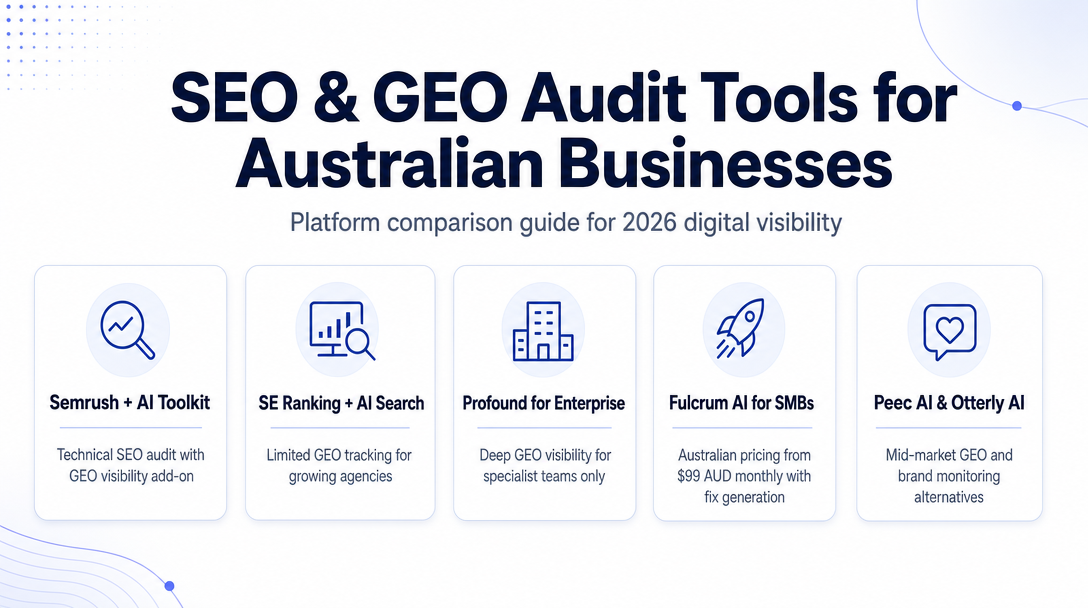
| Platform | Technical SEO Audit | GEO / AI Visibility | Fix Generation | Human Approval Gate | Price | Best For |
|---|---|---|---|---|---|---|
| Semrush + AI Visibility Toolkit | Yes | Yes (add-on) | No - data and signals only | No | USD $117.33-$139.95/mo base + USD $99/mo add-on | Agencies and experienced marketers |
| SE Ranking + AI Search | Yes | Limited (add-on) | No - data only | No | From USD $129/mo | Growing agencies with SEO knowledge |
| Profound | No | Yes (deep) | No | No | From USD $499/mo* | Enterprise GEO specialists |
| Peec AI | No | Yes | No | No | Mid-market - check current pricing | Mid-market GEO tracking |
| Otterly AI | No | Yes (brand monitoring) | No | No | Check current pricing | Brand monitoring across AI engines |
| Ahrefs Brand Radar | Partial | Limited | No | No | Check Ahrefs pricing | SEO-first teams adding AI layer |
| Fulcrum AI | Yes (all 7 dimensions) | Yes (built-in) | Yes - ranked copy-paste fixes | Yes | From $99 AUD/mo | Australian SMBs, sole traders |
Profound pricing per third-party source; verify at Profound's site before committing.
Semrush + AI Visibility Toolkit - Powerful, but Priced and Scoped for Agencies
Semrush is the most capable traditional SEO audit platform in this comparison. Its site audit, keyword tracking, and backlink analysis tools are genuinely comprehensive.
The AI visibility layer is a separate add-on: the AI Visibility Toolkit costs USD $99/month per domain (billed annually) and covers brand performance monitoring, 25 tracked prompts with daily AI rankings, and competitor analysis across ChatGPT, Gemini, and Google AI Overviews. The Starter tier at USD $199/month extends to 50 tracked prompts and 500 keywords.
The base Pro plan runs USD $139.95/month billed monthly, or $117.33/month billed annually. Add the AI Visibility Toolkit and you are spending roughly USD $217-$239/month - at mid-2026 AUD exchange rates, that sits well above $300/month AUD for a business with a single domain.
The more significant issue for sole traders is not the price alone - it is the expertise requirement. Semrush surfaces data and technical signals; implementing fixes requires the user's own interpretation and action. A sole trader who has not spent time inside Semrush will spend their first several hours learning the platform before they fix a single thing.
SMB verdict: Excellent tool for agencies and marketers with existing SEO literacy. Cost and complexity make it hard to justify for a one- or two-person business.
SE Ranking - A Mid-Market Bridge With an Emerging AI Layer
SE Ranking offers a full traditional SEO audit suite and has added AI search tracking ("SE Visible") as a relatively recent capability. At from USD $129/month for the Core plan, it is meaningfully cheaper than Semrush at comparable usage levels.
The AI visibility layer is narrower than Semrush's add-on and significantly narrower than a purpose-built GEO tool. Like Semrush, it delivers data without generating ranked fixes or drafting implementation-ready copy.
SMB verdict: Better value than Semrush for small businesses with some SEO knowledge. Still requires interpretation and manual action on findings. No combined scoring across both SEO and GEO dimensions.
Profound, Peec AI, and Otterly - GEO Specialists That Leave SEO Uncovered
These three platforms are purpose-built for AI visibility tracking - and they do it well. Profound provides enterprise-depth analysis of how brands appear across AI engines. Peec AI tracks prompt-level visibility for mid-market teams. Otterly monitors brand mentions and citations across AI-generated results.
The critical gap: none of them audits traditional SEO. A business using Profound to track its ChatGPT citations while its site has crawl errors, slow Core Web Vitals, and missing schema markup is solving half the problem.
Profound starts at USD $499/month (third-party cited figure - verify at Profound's current pricing page). Peec AI and Otterly are aimed at mid-market teams - check their current pricing pages before committing, as no fetched figures were available at the time of research.
SMB verdict: Excellent tools for enterprise marketing teams that already run a separate SEO stack. Not designed for SMB budgets or solo use, and do not cover traditional technical SEO.
Ahrefs Brand Radar - Tracking AI Visibility Alongside an Established SEO Tool
Ahrefs has introduced AI visibility tracking through Brand Radar as an extension of its traditional SEO capability. For businesses already in the Ahrefs ecosystem, it is worth exploring. Check Ahrefs' current pricing page for details - no fetched pricing figures were available for this feature at the time of research, and making claims about a competitor's features without verified sourcing would not be accurate or fair.
Fulcrum AI - The Combined Audit Platform Built for Australian Small Businesses
Fulcrum AI is the one platform in this comparison that covers all seven dimensions of the Seven-Dimension Audit Standard in a single crawl - on-page SEO, technical health, GEO / AI-search visibility, competitor positioning, content gaps, social presence, and community footprint.
The differentiation from every other platform in this list is not just coverage - it is what happens after the audit. Fulcrum AI generates ranked, copy-paste fixes and draft assets (articles, social posts, ad creatives) ready for the business owner to review. Nothing publishes to the live site without explicit human approval - a meaningful protection for a sole trader who cannot afford to have AI-generated errors appear on their website without a second look.
Founded by Cory Nathan and built in Australia, Fulcrum AI is priced at $99/month AUD with a free preview to start - less than Semrush's base plan alone, before any AI visibility add-on.
For how the GEO audit methodology inside the platform works, see the GEO audit framework article here.
The Score-to-Action Gap: Why Data Without Ranked Fixes Leaves SMBs Stuck
This is the content gap that no competitor article in this SERP addresses: what happens after the audit?
Most platforms hand over a score or a list of issues. A business gets "technical SEO: 48/100" and "AI visibility: 22/100." The sole trader now faces a second, equally hard problem: which of these 34 flagged issues do I tackle first? Do I prioritise the slow-loading homepage or the missing schema markup? The unindexed service page or the competitor knowledge gap?
Without ranked fixes, the audit report becomes one more document to file and forget.
What "Ranked Copy-Paste Fixes" Actually Means in Practice
A platform that generates ranked fixes does two things a data-only tool does not:
- It prioritises by impact. Rather than listing every issue found, it surfaces the changes that will move the needle most - weighted across both traditional SEO signals and AI visibility signals at the same time.
- It drafts the actual change. Instead of "your H1 tag is underoptimised," it produces: "Replace your current H1 with: [suggested H1 text]." The business owner reads it, approves it or edits it, and implements it - without needing to interpret an audit finding into an action.
The human approval gate is not just a safety feature. It is the design choice that makes a combined platform usable by a business owner rather than requiring an agency to interpret findings on their behalf.
How to Choose the Right Platform for Your Australian Business
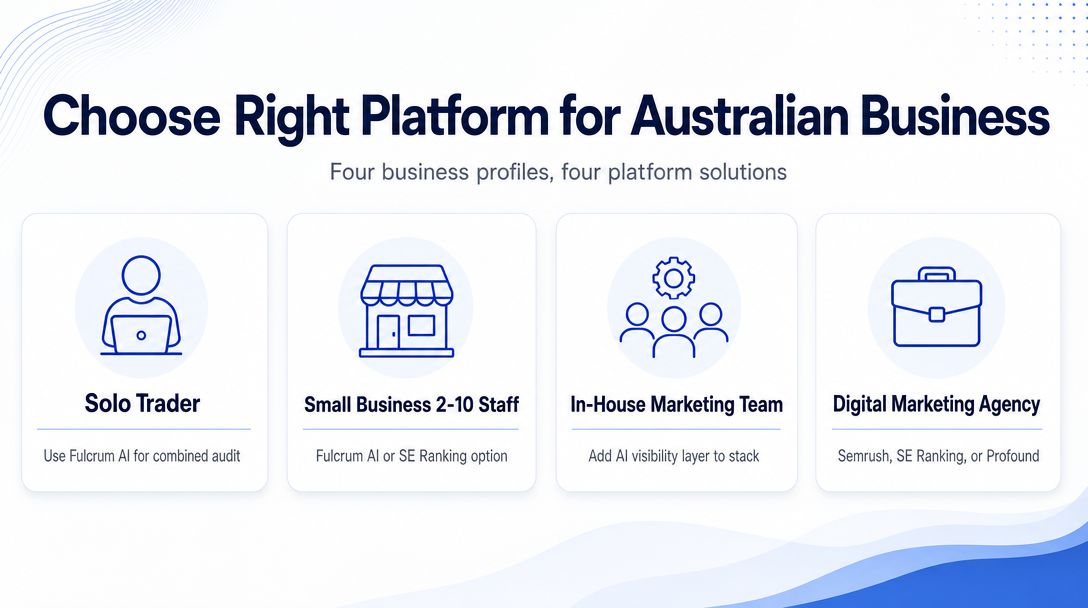
This is a buyer's decision, not a methodology question. Four profiles, four answers:
Solo trader / single-person business Needs: combined audit, fix generation, no specialist knowledge required, low monthly cost. Recommended platform: Fulcrum AI.
Small business with 2-10 staff and a part-time or junior marketer Needs: combined audit coverage, some flexibility to explore data, moderate price. Recommended platform: Fulcrum AI for the full combined view, or SE Ranking if the marketer has existing SEO tool experience and the AI visibility gap is acceptable.
In-house marketing team (5-20 people) with existing SEO tools already in place Needs: add an AI visibility layer to an existing stack rather than replace it. Recommended platform: Semrush AI Visibility Toolkit add-on if already on Semrush; evaluate Profound if budget allows and GEO depth is the primary gap.
Digital marketing agency managing multiple client accounts Needs: multi-site, multi-client reporting, deep data access. Recommended platform: Semrush, SE Ranking, or Profound + a separate SEO stack. Agency use cases are outside the SMB-focused scope of this comparison.
Five Questions to Ask Before You Commit to Any Platform
- Does it audit both technical SEO and GEO / AI visibility in one crawl, or do I need to buy and reconcile two separate tools?
- Does it generate ranked, specific fixes - or does it hand me a score and expect me to figure out the rest?
- Does anything go live on my website without my explicit approval?
- Is it priced for a single business, or am I paying agency-scale pricing for features I'll never use?
- Does it account for Australian search behaviour and Australian competitors - or is the data defaulting to US markets?
The Australian Context: Why Tool Choice Matters More Here Than You Might Expect
Per Statcounter data cited by SearchScope, Google holds 88-91% of Australian search engine market share. That dominance makes traditional SEO non-negotiable. At the same time, Perplexity, ChatGPT, and Gemini are seeing genuine growth as research and comparison tools for Australian consumers - meaning AI visibility is not a future concern, it is a present one.
Most enterprise GEO platforms were built for and priced in USD for US or global markets. Their default prompt libraries and competitor tracking sets reflect US business categories and US competitors. An Australian tradie, accountant, or local service provider auditing their AI visibility against American prompts is not getting useful data.
Australian search advertising at $8.0 billion in CY2025 means paid competition for Australian keywords is at an all-time high. The businesses that will hold ground organically and in AI-generated results are the ones whose combined SEO and GEO foundations are solid - and who have a platform actively surfacing the next ranked fix, rather than a report sitting unread on a dashboard.
Frequently Asked Questions
Can one platform run both an SEO audit and a GEO audit, or do I need two separate subscriptions?
One platform can cover both, but most tools on the market today are built for one or the other. Semrush offers traditional SEO auditing and a separate AI Visibility Toolkit add-on that must be purchased in addition to the base plan. Platforms like Profound are GEO-only and do not audit traditional SEO at all. Fulcrum AI is designed from the ground up to cover both in a single crawl across seven audit dimensions, without requiring two separate subscriptions.
What does a combined SEO and GEO audit platform actually check?
A genuine combined platform should assess technical SEO health (crawlability, Core Web Vitals, schema markup), on-page SEO signals (titles, headings, keyword usage), GEO / AI visibility (how the site appears in ChatGPT, Gemini, Google AI Overviews, and Perplexity), competitor positioning in both traditional and AI search, content gaps, social presence, and community footprint / brand entity signals.
How much does a combined SEO and GEO audit platform cost for an Australian small business?
Costs vary widely. Semrush's base Pro plan runs USD $117.33-$139.95/month, and the AI Visibility Toolkit add-on is an additional USD $99/month - totalling over $300 AUD/month at mid-2026 exchange rates. SE Ranking starts at USD $129/month for its Core plan. Profound starts at USD $499/month (third-party cited figure). Fulcrum AI's full plan is $99/month AUD, with a free preview available.
What is the difference between a platform that gives me a score and one that tells me what to fix?
A scoring platform identifies issues and quantifies them - for example, "your AI visibility score is 22/100." A fix-generation platform goes further: it ranks those issues by likely impact and drafts the specific change for you, such as a revised H1 or a restructured meta description, ready for you to review and approve. For sole traders and small teams without in-house SEO expertise, fix generation is what makes an audit actually actionable.
Is there an Australian-built option that doesn't require agency expertise to use?
Yes. Fulcrum AI was built in Australia by founder Cory Nathan and is specifically designed for sole traders, small businesses, and lean teams without specialist marketing knowledge. It generates ranked copy-paste fixes and draft content assets, and nothing publishes to the live site without the business owner's approval.
Does Semrush cover GEO auditing now?
Semrush does offer AI visibility tracking through its AI Visibility Toolkit, which covers brand monitoring, competitor analysis, and prompt tracking across ChatGPT, Gemini, and Google AI Overviews. It is a paid add-on to any base Semrush plan, not included by default. It surfaces data and technical signals; implementing fixes requires the user's own interpretation and action.
Ready to run a combined SEO and GEO audit on your Australian business - without stitching together three separate tools or paying agency rates? Fulcrum AI's seven-dimension audit covers technical health, on-page SEO, AI visibility, competitor positioning, content gaps, social presence, and community footprint in a single platform, then generates ranked copy-paste fixes you approve before anything changes. Start with a free preview at fulcrumai.com.au - no agency required.