The 7 Dimensions of a Proper AI SEO Audit - and Why Most Basic Site Checkers Only Cover 2
You ran the audit. Now you're staring at a dashboard with seven different coloured scores, and your first question is: "Which of these actually…
The 7 Dimensions of a Proper AI SEO Audit - and Why Most Basic Site Checkers Only Cover 2
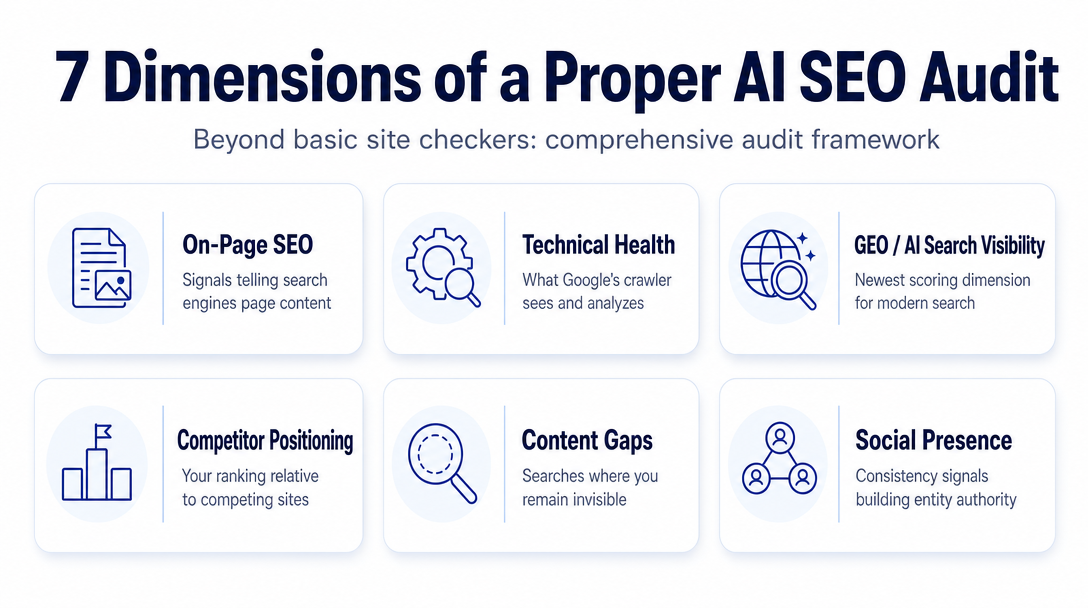
You ran the audit. Now you're staring at a dashboard with seven different coloured scores, and your first question is: "Which of these actually matters?" The answer is all of them - but for different reasons, at different times. A complete AI SEO audit doesn't hand you one number. It hands you seven: what Fulcrum AI calls the Seven-Dimension Audit Stack - each one measuring a different way your business can be invisible, outranked, or simply ignored online. This article explains what each dimension checks, what a low score costs you, and which one to fix first.
If you're new to AI search visibility and GEO strategy, start with our GEO audit framework primer before continuing here.
Dimension 1 - On-Page SEO: The Signals That Tell Search Engines What Your Page Is About
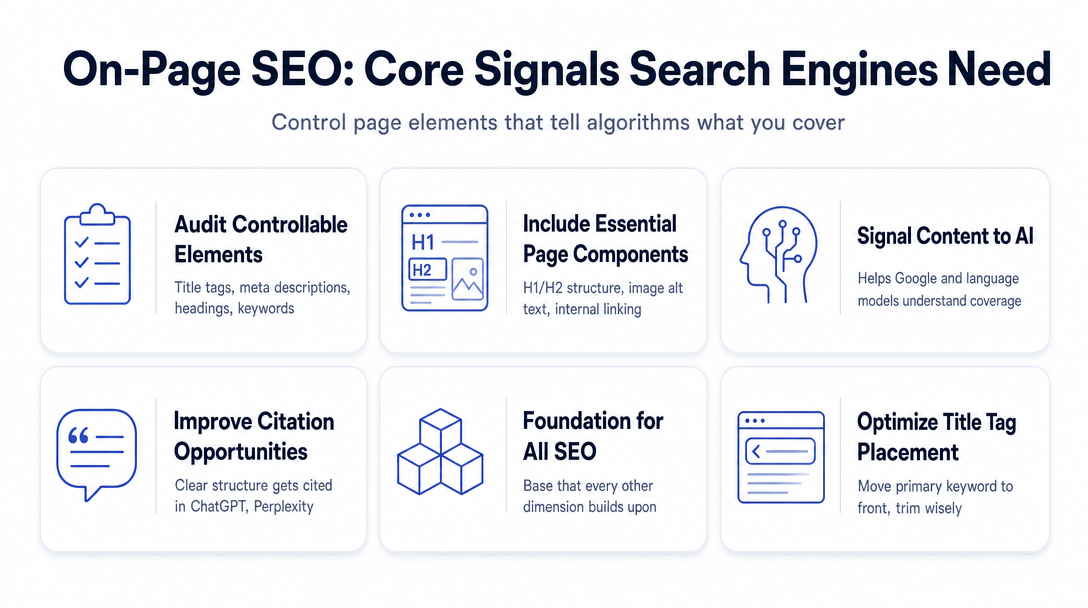
On-page SEO audits the elements you control directly on each page: title tags, meta descriptions, H1/H2 heading structure, keyword placement, image alt text, and internal linking. These are the signals both Google and large language models use to understand what a page covers.
A low on-page score in 2026 carries a consequence most small business owners don't expect: it's not just Google rankings you lose. A page without a clear H1 or a title tag that matches the page's actual content is harder for an AI engine to extract a clean answer from - so it doesn't get cited in ChatGPT or Perplexity responses either. On-page SEO is the foundation that every other dimension builds on.
Example fix a good audit surfaces: "Your title tag is 78 characters - trim it to 60 and move the primary keyword to the front."
Dimension 2 - Technical Health: What Google's Crawler Sees That You Can't
Technical health covers everything that affects how search engines crawl and render your site: Core Web Vitals, mobile friendliness, indexation errors, broken links, HTTPS status, and redirect chains.
The metric that kills the most small business rankings is LCP (Largest Contentful Paint) - the time until the largest visible element on a page fully loads. A slow LCP on mobile is enough to lose ranking positions even when your on-page SEO is perfect, because Google's mobile-first index penalises the slow experience directly. Google Search Console gives you a free baseline view of what's already broken, but it doesn't tell you which issues to prioritise or what fixing them is worth. Tools like SEOptimer can flag surface-level errors; fixing the right ones in the right order requires a ranked output.
Technical issues block everything else. They're typically the first dimension to address if your score is critically low.
Example fix: "Your LCP is 4.2s on mobile - compress the hero image from 2.4MB to under 200KB."
Dimension 3 - GEO / AI Search Visibility: The Newest Score on Your Dashboard
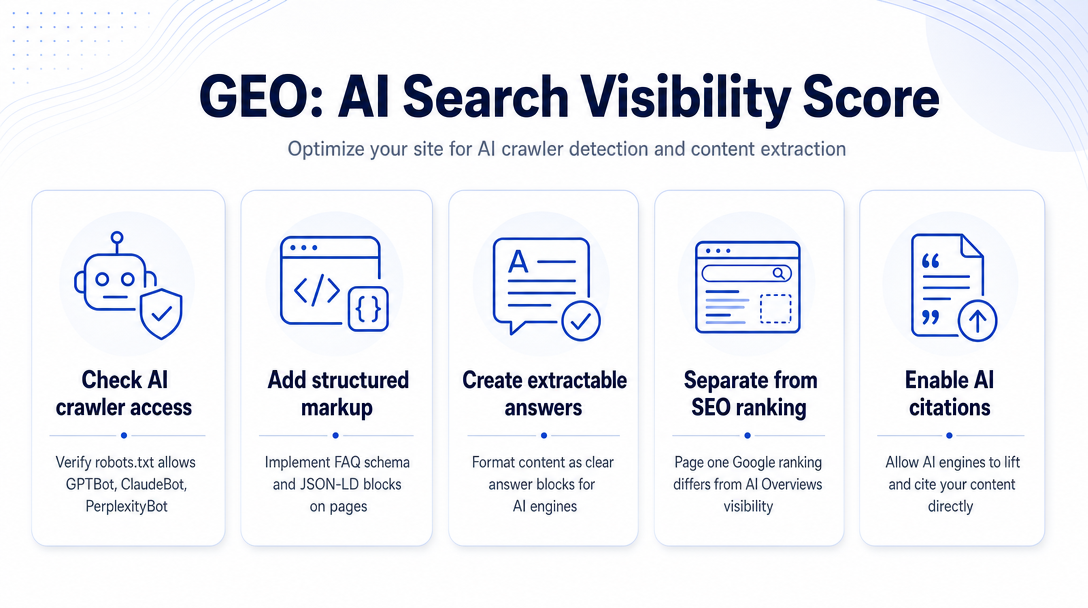
This dimension checks whether your site is readable by AI crawlers - GPTBot, ClaudeBot, PerplexityBot - and whether your content is structured for extraction. Specifically, it looks at whether your robots.txt is blocking AI bots, whether you have FAQ schema or other structured markup, and whether your content contains clean "answer blocks" that an AI engine can lift and cite directly.
This is not the same question as "is my SEO good?" You can rank on page one in Google and still never appear in a ChatGPT or Google AI Overviews response, because AI engines pull from sites with clear, extractable answers - not just high domain authority. The GEO score measures that second layer of visibility.
Example fix: "Add FAQ schema to your service pages - the JSON-LD block can be generated and pasted into your page header without touching your site's design."
For a deeper look at GEO strategy specifically, see our guide to the GEO audit framework.
Dimension 4 - Competitor Positioning: Where You Stand Relative to the Field
Competitor positioning checks which keywords your top local or niche competitors rank for that you don't, how your domain authority compares to theirs, and which topics they've covered that you haven't. This is deliberately distinct from a content gap audit - competitor positioning is about ranking overlap and market share, not just missing topics.
Without this dimension, you can optimise your site perfectly against itself while a competitor quietly captures the majority of searches in your category. Tools like Semrush (Pro plans from $117.33/month billed annually) or Ahrefs (Starter plan from $29/month) provide competitor gap analysis, but they're standalone tools that require you to interpret the data and connect it to the rest of your audit picture. Screaming Frog, by contrast, is a powerful technical crawler - but it looks inward at your own site and cannot tell you what competitors are ranking for.
Example fix: "Your nearest competitor ranks for 'emergency plumber [suburb]' - you have no page targeting that keyword."
Dimension 5 - Content Gaps: The Searches You're Invisible For
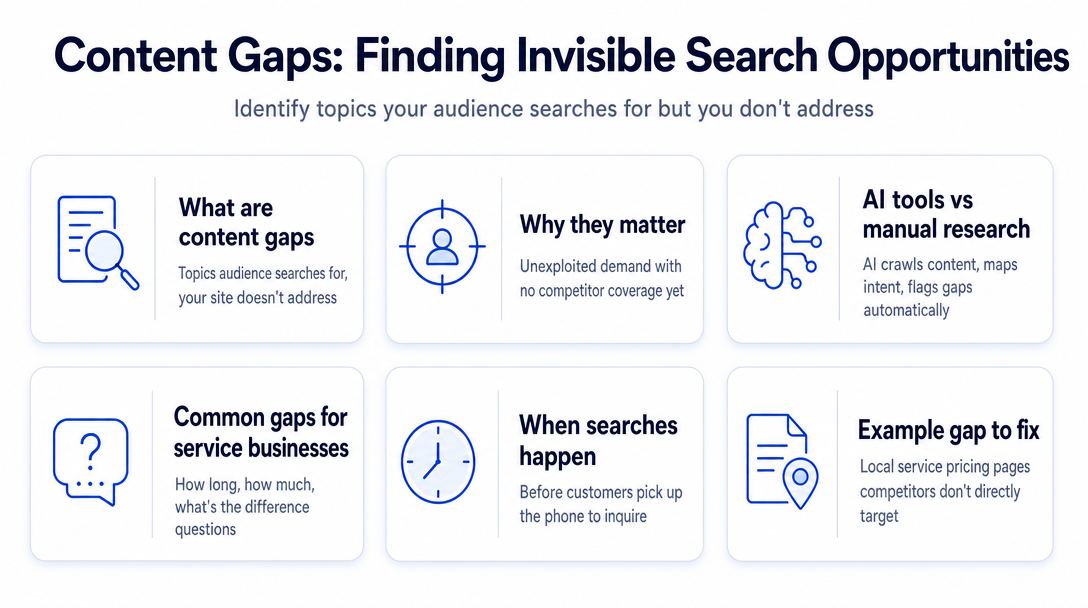
Content gaps identifies topics and keywords your target audience is actively searching for that your site has no page or post addressing. Unlike competitor positioning, these gaps may not be covered by anyone in your niche - they're unexploited demand sitting on the table.
AI audit tools surface content gaps more efficiently than manual keyword research because they crawl your existing content, map it against search intent clusters, and flag the whitespace automatically. For a tradie or local service business, the most common gaps are informational searches that feed buying decisions - "how long does X take," "how much does X cost," "what's the difference between X and Y." These searches happen before someone picks up the phone.
Example fix: "You have no page addressing 'how much does a bathroom renovation cost in [city]' - this keyword has no direct competitor targeting it in your local area."
Dimension 6 - Social Presence: The Consistency Signals That Build Entity Authority
This dimension checks whether your business has active, consistent profiles on relevant social platforms, whether your NAP (Name, Address, Phone number) is identical across every profile, whether your social content links back to your website, and basic engagement signals.
Social presence appears in an SEO audit - not just a social media audit - because Google uses social consistency as a trust and legitimacy signal. Inconsistent business names or missing profiles reduce your E-E-A-T (Experience, Expertise, Authoritativeness, Trustworthiness) score in Google's eyes. Critically, this dimension is not about follower counts or reach. A business with 47 followers and a consistent NAP across five platforms scores better than one with 2,000 followers whose business name is spelled three different ways.
Example fix: "Your Google Business Profile lists you as 'Smith Plumbing' but your Facebook page says 'Smith's Plumbing Services' - standardise to one exact name across every platform."
Dimension 7 - Community Footprint: The Off-Site Trust Signals Most Tools Miss
Community footprint audits your off-site presence: local directory listings, industry body citations, forum mentions, local media coverage, review platform presence, and backlink diversity from community sources. This is different from a raw backlink count - it specifically measures locally and topically relevant off-site mentions.
AI engines and Google's local algorithm treat citations from trusted community sources as authority signals. A business mentioned in a local newspaper, a trade directory, or a peak-body website is treated as more credible than one with identical on-page SEO but no third-party presence. For Australian businesses, this means platforms like True Local, Yellow Pages Australia, and ProductReview.com.au carry real weight - as do listings in relevant industry association directories.
Example fix: "You have 3 directory listings. Your top competitor has 47. Start with Google Business Profile, True Local, and your relevant industry association directory."
Which Dimension Do You Fix First?
The most common mistake small business owners make after seeing their audit results is trying to fix everything simultaneously, which leads to paralysis or random patching that moves no needles.
A useful starting point: Technical Health tends to block everything else. A crawlable, fast, mobile-friendly site is the prerequisite for every other dimension delivering value. From there, On-Page SEO typically delivers the fastest ranking improvement because the fixes are direct and immediate. Competitor Positioning and Content Gaps drive growth once the foundation is solid. Social Presence and Community Footprint build sustained authority over weeks and months. GEO/AI Search Visibility layers on top once the underlying content is well-structured.
That said, the right order depends entirely on your current scores. If Technical Health is already at 90/100 but your Community Footprint is at 15/100, start where the gap is largest. A properly built AI audit tool doesn't just score each dimension - it ranks which specific fixes will move the needle most given your current baseline, so you're always working on the highest-leverage problem first.
One question worth asking about any AI audit tool: does it auto-publish changes, or does it require your approval before anything touches your live site? The answer matters. The Seven-Dimension Audit Stack is only useful if the fixes it generates are reviewed by a human before they go live - automated publishing without oversight is a genuine risk for small business websites.
Frequently Asked Questions
Why does an AI SEO audit give seven separate scores instead of one overall number? Because each dimension catches a completely different failure mode. A perfect technical score doesn't protect you from missing content gaps, and strong social presence doesn't compensate for an AI-invisible site structure. One overall score would hide which specific problem is costing you - the seven-dimension breakdown tells you exactly where to act.
Does an AI SEO audit tool actually look at my social media profiles? Yes - but not to measure follower counts or engagement rates. The social presence dimension checks whether your business profiles exist on relevant platforms, whether your business name and contact details are consistent across all of them, and whether those profiles link back to your site. These are legitimacy signals that affect your search authority, not vanity metrics.
What is community footprint and why is it part of an SEO audit? Community footprint measures your off-site presence in locally and topically relevant sources - directories like True Local and Yellow Pages Australia, industry body listings, review platforms like ProductReview.com.au, and local media mentions. Search engines and AI engines treat these third-party citations as trust signals. A business with a strong community footprint wins local and AI-search citations over a competitor with identical on-page SEO but no off-site presence.
Can an AI audit tool publish fixes to my website automatically? Some tools can, but this is a risk worth understanding before you connect any tool to your live site. A tool that generates ranked, copy-paste fixes for you to review and implement yourself - rather than auto-publishing - gives you oversight over every change before it affects real visitors and rankings.
How is an AI SEO audit different from hiring an SEO agency? An AI audit tool delivers a scored report with specific, actionable fixes in minutes rather than weeks, at a fraction of agency retainer costs. For most small businesses, it handles the ongoing monitoring, gap identification, and copy generation that would otherwise require a consultant. Where specialists still add value is in complex technical migrations, PR strategy, and high-stakes campaigns where context and judgment matter more than automation.
Which dimension should a small business owner fix first? Start with Technical Health if your score there is critically low - crawlability issues block every other improvement from working. If technical is solid, move to On-Page SEO for fastest ranking gains, then Competitor Positioning and Content Gaps for growth, then Social Presence and Community Footprint for authority, with GEO/AI Visibility layered throughout as you improve content structure.
Ready to See Your Seven-Dimension Audit Stack Score?
Fulcrum AI is an Australian-built platform that crawls your website, scores it across all seven dimensions, and hands you ranked, copy-paste fixes - nothing published to your live site without your approval, no developer required. Built specifically for small businesses, sole traders, and lean marketing teams, with pricing that starts with a free preview and a full report from $99/month AUD.
Start your free preview at fulcrumai.com.au
Related reading
- How the Fulcrum Free Audit Preview Works: What You'll See in 8 Minutes and What It Costs to Go Further
- How to Get Your Australian Small Business Cited in ChatGPT and Perplexity (Step-by-Step)
- Competitor Gap Analysis for Australian Small Business SEO: How to Find the Keywords and Citations You're Missing