How an AI SEO Tool Helps Small Businesses Get Found Online
An AI SEO tool is software that uses artificial intelligence to crawl your website, identify what is holding you back in search results, and produce…
How an AI SEO Tool Helps Small Businesses Get Found Online
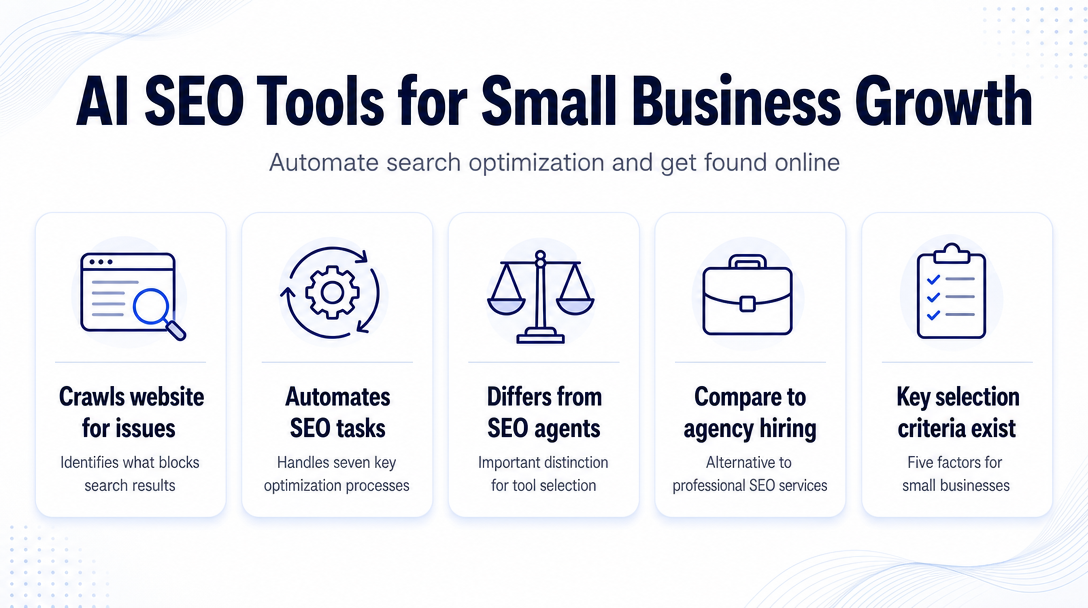
An AI SEO tool is software that uses artificial intelligence to crawl your website, identify what is holding you back in search results, and produce ready-to-use fixes and content - all without requiring you to be an SEO expert. For Australian small businesses and sole traders, it is the difference between knowing you have a problem and actually knowing what to do about it.
The best of these platforms follow what you can call the Crawl-Score-Draft-Approve loop: the tool spiders your live site, scores it against ranking signals, drafts copy-paste fixes and content assets, then queues everything for your review before a single word touches your live site. That four-step sequence is what separates a genuinely useful agentic platform from yet another dashboard full of numbers you cannot act on.
AI SEO Tool: The 30-Second Explanation
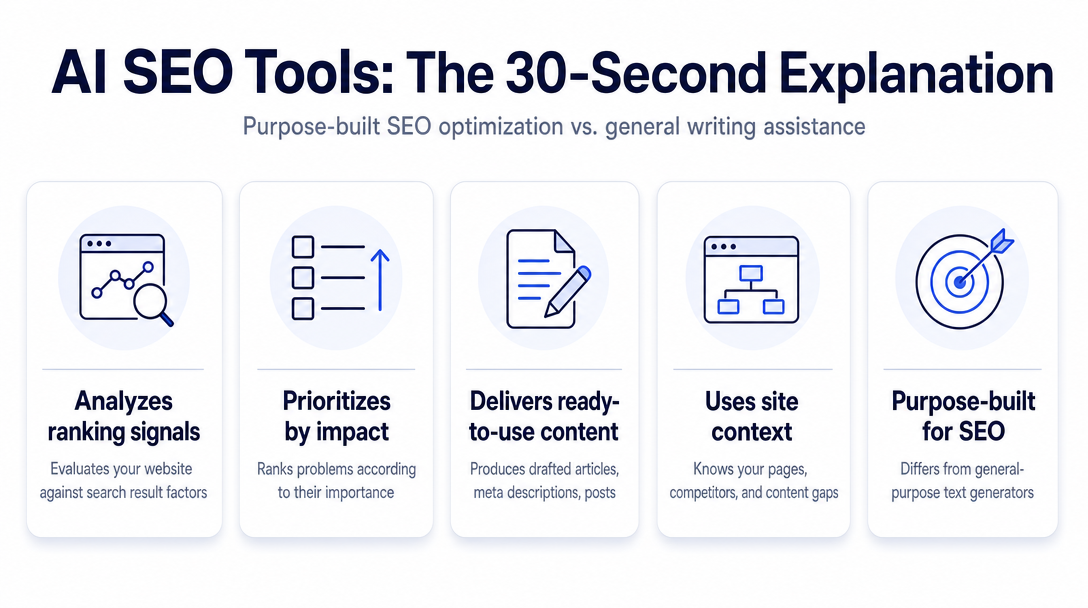
An AI SEO tool analyses your website against the signals that determine where you appear in search results, then tells you exactly what to fix and hands you the draft content to fix it. It is not a general-purpose AI writing assistant like a standalone text generator - it is purpose-built to evaluate your site in context, rank your problems by impact, and produce outputs you can use immediately.
AI SEO tool vs. general AI writing tool - what is the difference?
| AI SEO tool | General AI writing tool | |
|---|---|---|
| What it does | Crawls your site, scores ranking signals, outputs ranked fixes | Generates text on demand with no site context |
| What it knows about you | Your actual pages, your competitors, your gaps | Only what you type into the prompt |
| Output | Prioritised fix list, drafted articles, meta descriptions, social posts | Whatever text you requested |
7 Tasks an AI SEO Tool Can Automate Right Now
1. Website crawl and technical health check
The tool spiders every page on your site and flags issues that prevent Google from reading or ranking your content - broken links, missing meta descriptions, pages that are not being indexed, and load-speed problems. Output: a prioritised list of technical issues with severity scores, so you fix what matters most first rather than guessing.
2. On-page SEO scoring
Every page is evaluated for title tag structure, heading hierarchy, keyword placement, and internal linking. This is the layer that Google Search Console surfaces as raw performance data but does not interpret for you - an AI SEO tool goes further by turning that data into per-page scores with copy-paste fixes attached.
Output: page-level scores with exact rewrites ready to implement, ranked from highest to lowest impact on your rankings.
3. Keyword gap and content gap analysis
The tool compares what your site currently covers against what your competitors are ranking for, then surfaces the topics you are missing. Imagine a plumber in Brisbane whose site has no content about "emergency hot water repairs" - that gap shows up as a ranked, actionable item with a suggested article title and angle.
Output: a prioritised list of missing topics with suggested titles, so your next piece of content addresses a proven gap rather than a hunch.
4. Competitor positioning intelligence
Rather than analysing your site in isolation, a capable AI SEO tool crawls competitor sites in parallel and shows you exactly where they outrank you and why. This context transforms a generic fix list into a targeted competitive strategy.
Output: a side-by-side gap summary that shows which competitor owns which topic and what it would take to close the distance.
5. Drafted content ready for your review
This is where an AI SEO tool earns its keep for time-poor owners. Using the audit findings as its brief, the tool generates full article drafts, meta descriptions, and social posts - not generic templates, but content anchored to your specific gaps and your site's actual context.
Output: review-ready drafts that you read, approve, and publish on your own schedule. Nothing is written to your live site without your sign-off.
6. AI search visibility assessment
Traditional Google ranking is no longer the whole picture. ChatGPT, Perplexity, and Google AI Overviews now answer questions directly - and they pull from a different set of signals than a standard Google search. A modern AI SEO tool evaluates whether your site is structured to be cited by those AI engines, not just to rank on page one of Google. For more on how this works, read the GEO audit framework for Australian businesses.
Output: a GEO visibility score alongside your traditional SEO score, with specific fixes for each.
7. Ad creative and social post generation
The audit findings do not have to stop at your website. A platform built for small business owners turns the same gap analysis into platform-ready ad copy and social content - so the work done to understand your positioning feeds your entire digital presence, not just one channel.
Output: copy-paste social posts and ad creatives generated from the same data that produced your SEO fix list.
AI SEO Tool vs. AI SEO Agent: Why the Distinction Matters
Not all AI SEO tools work the same way, and the difference matters for how much time you actually save.
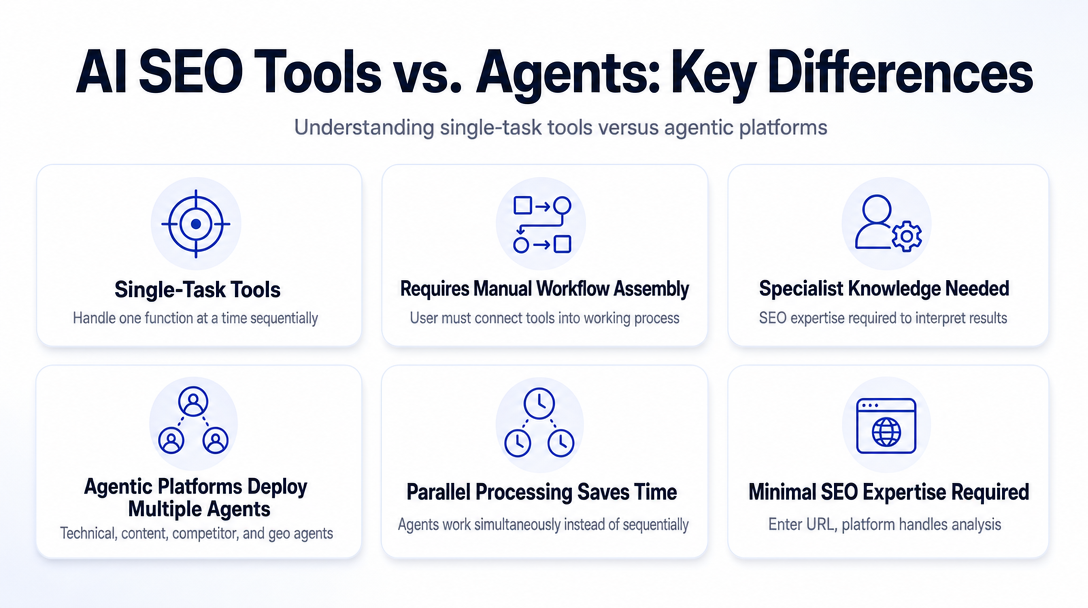
At one end of the spectrum are single-task tools: Surfer SEO optimises content against a target keyword, Clearscope scores your copy against NLP-based keyword signals, Frase generates content briefs, and Ahrefs covers keyword research and backlink analysis. These are powerful in the hands of someone who knows how to assemble them into a workflow - typically a specialist or an in-house SEO.
At the other end are agentic platforms. Instead of running one task at a time, an agentic AI SEO tool deploys multiple specialised agents simultaneously - one focused on technical health, another on content gaps, another on competitor positioning, another on GEO signals - and coordinates their findings into a single ranked output. You enter a URL; the platform handles the rest. No stitching tools together. No SEO expertise required to read the results.
The multi-agent architecture is what makes this possible at speed: because separate agents work in parallel rather than in sequence, a full site audit that would take an agency team days to compile is ready in hours.
The human-approval gate: why it matters for small business owners
A common and entirely reasonable concern is whether an AI platform will start changing your website without your knowledge. With a properly built agentic platform, the answer is no. Every fix, every drafted article, every meta description sits in a review queue. You read it, approve it, and only then does it move toward your live site. This is not a limitation - it is the feature that makes the system safe for owners who are not technical enough to quickly undo an unwanted change. Control stays with you throughout.
AI SEO Tool vs. Hiring an SEO Agency: An Honest Comparison
This is the question most small business owners are really asking when they search for an AI SEO tool: do I need this, or should I just hire someone?
| Factor | Traditional SEO agency | AI SEO tool (agentic) |
|---|---|---|
| Monthly cost | Internationally, small businesses typically pay $1,500-$3,000+ per month | From $99/month AUD (e.g., Fulcrum AI) |
| Time to first output | Weeks (onboarding, strategy, kickoff) | Hours to first scored audit |
| Covers GEO / AI search visibility | Varies - many agencies are still adapting their offer | Built into modern agentic platforms |
| Drafts content | Yes, but usually billed separately | Included in the audit workflow |
| Publishes without your approval | No | No - human-approval gate required |
| Best suited for | Businesses needing link building at scale, PR, and fully managed execution | Owners who want to see the work, control what goes live, and handle their own content calendar |
For most Australian sole traders and lean marketing teams, the tool handles the diagnostic and content-production load that used to require an agency retainer - at a fraction of the cost. Fulcrum AI, built in Australia and priced for SMB budgets, starts at $99/month AUD with a free preview that requires no signup.
When you still need a human SEO specialist
An AI SEO tool does not replace every specialist function. Link building at scale, digital PR, complex technical migrations (such as moving a large site to a new platform), and high-stakes campaigns that require relationship management still benefit from human expertise. The honest position is that a capable agentic tool replaces the diagnostic layer and content-production layer - the work most SMBs were either paying agencies for or simply not doing at all.
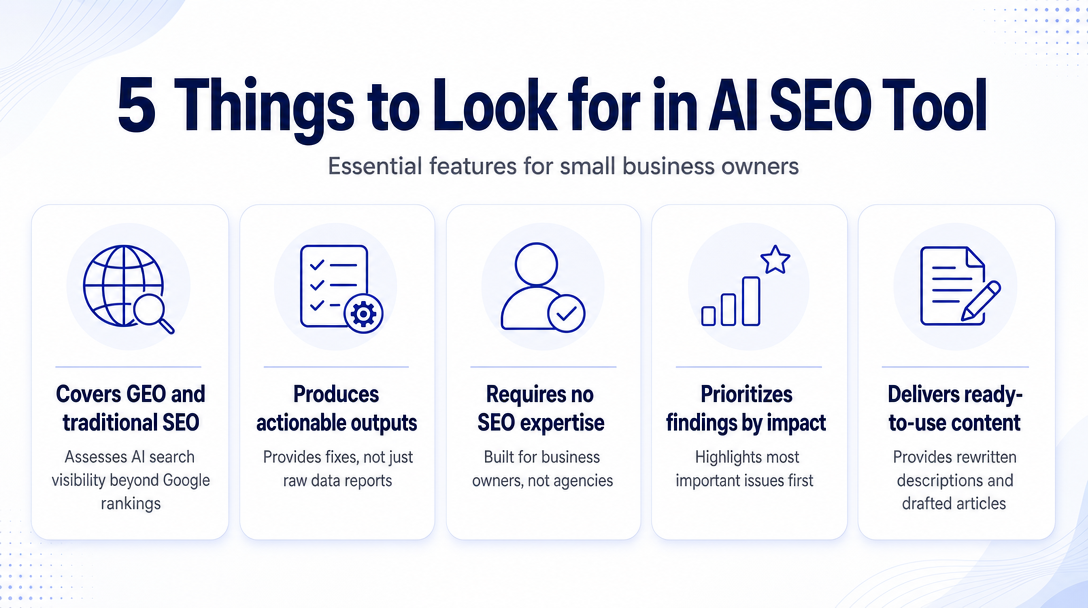
5 Things to Look for in an AI SEO Tool for a Small Business
1. Does it cover GEO as well as traditional SEO?
A tool built before AI-generated search answers became mainstream may score you only against Google's traditional ranking signals. In 2026, being cited by ChatGPT, Perplexity, or Google AI Overviews requires a different set of content and structure signals. If a tool does not assess your AI search visibility, you are only getting half the picture. (For a deeper look at why both matter, see GEO vs SEO: Why Australian Small Businesses Need Both in 2026.)
2. Does it produce outputs you can act on - not just reports to interpret?
A dashboard showing hundreds of flagged issues with no priority order is not useful to a busy owner. The right tool ranks its findings by impact and hands you the fix - a rewritten meta description, a drafted article, a revised heading - not a raw data export that requires another specialist to interpret.
3. Does it require SEO expertise to operate?
If understanding the tool's findings requires you to know what a canonical tag or a crawl budget is, it was built for agencies and in-house SEO teams, not for owners. Look for platforms that translate findings into plain-English recommendations and ranked actions.
4. Does it keep you in control before anything goes live?
Auto-publishing without your approval is not a feature - it is a liability. Any AI SEO tool worth using routes every piece of content and every site change through a human-approval step. Ask this question directly before committing to any platform.
5. Is the pricing designed for an SMB budget?
Enterprise-grade tools with pricing built for agency teams can cost several hundred dollars per month in USD - a significant commitment for a sole trader or a small team. Look for platforms that offer a free preview tier so you can see what the tool finds on your site before spending anything. Fulcrum AI, for example, offers a free preview crawl with no signup required before you decide whether the $99/month AUD full plan is right for you.
Frequently Asked Questions About AI SEO Tools
What does an AI SEO tool actually do? An AI SEO tool crawls your website, scores it against search-ranking signals, and produces a prioritised list of fixes alongside drafted content - articles, meta descriptions, and social posts - all without requiring you to interpret raw SEO data yourself. The goal is to hand you something you can act on, not a report to decode.
Is an AI SEO tool the same as hiring an SEO agency? No - they serve different purposes. An AI SEO tool automates the diagnostic and content-production work that sits inside an agency's workflow, delivering it faster and at a fraction of the cost. Agencies still add value for link building at scale, PR, and complex managed campaigns that require human relationships and judgment.
Will an AI SEO tool publish to my website automatically? A responsibly built platform will not publish anything without your approval. Every fix, draft, and content asset goes through a human-review step before touching your live site. If a tool auto-publishes without your sign-off, that is a risk you should not accept.
How long does it take to get results from an AI SEO tool? Your first scored audit typically arrives within hours of entering your URL. Actual improvements in search rankings take longer - usually weeks to months depending on how quickly you implement the fixes and how competitive your market is. The tool speeds up the diagnostic phase; the ranking gains follow as changes go live.
What is the difference between an AI SEO tool and an AI SEO agent? A traditional AI SEO tool automates one task at a time - keyword research, content scoring, or brief generation. An AI SEO agent (or agentic platform) runs the full workflow autonomously: crawling your site, scoring it across multiple dimensions, prioritising fixes, and drafting content assets - all in one pass, without requiring you to stitch separate tools together.
Do AI SEO tools work for Australian businesses? Yes, though most tools available in this category are US-built and calibrated for US search behaviour. Australian-built platforms account for local search patterns, AU domain context, and the specific digital landscape that Australian sole traders and small businesses operate in. Fulcrum AI is built in Australia specifically for this market.
See What an AI SEO Tool Finds on Your Site
Fulcrum AI is an Australian-built platform that runs the full Crawl-Score-Draft-Approve loop for small businesses and sole traders who need results without an agency retainer. Enter your URL, and within hours you have a scored audit, a ranked fix list, and drafted content assets waiting for your review - nothing touches your live site until you approve it.
The free preview requires no signup. The full plan starts at $99/month AUD.
Run My Free Audit at fulcrumai.com.au