How Fulcrum's Monthly Re-Run Keeps Your SEO and GEO Scores Improving - Without Hiring a Marketing Manager
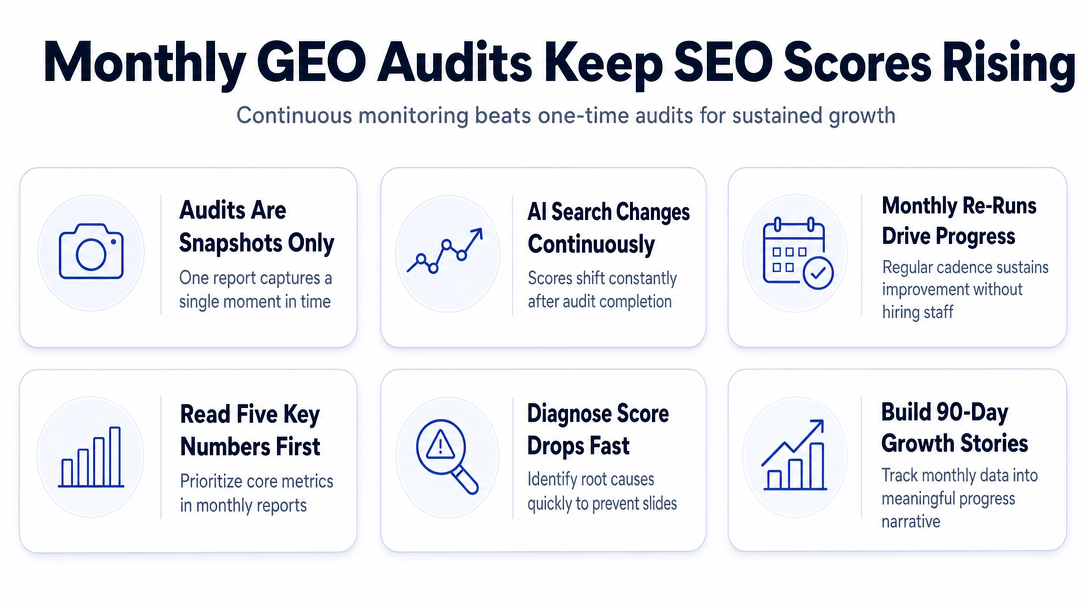
A GEO audit is a snapshot. AI search is a continuous feed. The moment you close your first report, three forces are already pushing your score in a new…
How Fulcrum's Monthly Re-Run Keeps Your SEO and GEO Scores Improving - Without Hiring a Marketing Manager
The short answer: A single GEO audit tells you where you stand today. A monthly re-run tells you whether you're winning or losing - and what to do about it. For Australian small businesses tracking AI search visibility, the cadence matters as much as the audit itself.
TL;DR
- GEO scores drift monthly even when you haven't touched your website - algorithm changes, competitor content, and content freshness decay are the three main causes.
- The Monthly Visibility Clock (CRAWL - COMPARE - PRIORITISE - ACT) gives small businesses a repeatable process for acting on re-run data without needing a marketing manager.
- Monthly is the right interval: weekly creates noise, quarterly lets problems compound.
- Fulcrum AI automates the full seven-dimension re-run as part of the $99/month plan, with ranked fixes ready to copy-paste and human approval required before anything goes live.
Why Monthly Re-Runs Matter More Than a One-Off Audit
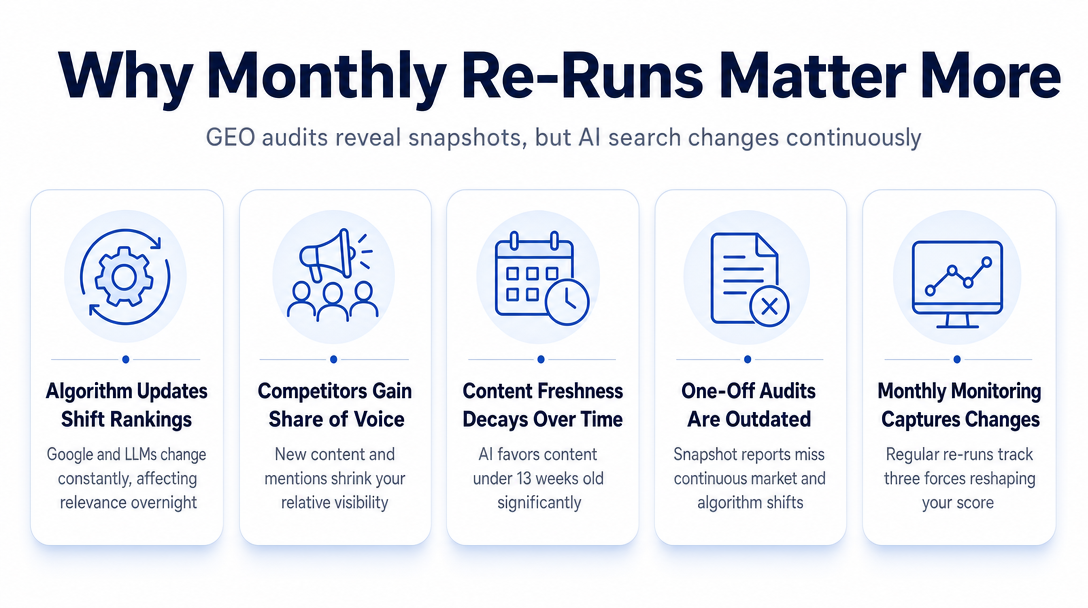
A GEO audit is a snapshot. AI search is a continuous feed. The moment you close your first report, three forces are already pushing your score in a new direction.
The three forces that change your score every month - without you doing anything:
1. Algorithm and model updates. Google makes thousands of ranking changes per year, and the large language models powering ChatGPT, Perplexity, and Gemini are retrained on rolling schedules. Your content's relevance to an AI answer can shift overnight based on changes you had no part in.
2. Competitor activity. A competitor publishes a new article, earns a mention in a local directory, or refreshes a product page. Their share of voice grows; yours shrinks relatively. You didn't lose ground by doing something wrong - they gained it by doing something right.
3. Content freshness decay. This is the one most businesses miss. Research into AI citation patterns shows that roughly 50% of AI-cited content is under 13 weeks old. AI engines actively favour recently published or updated material. Content you wrote eight months ago and never touched is steadily falling out of the citation window - regardless of how good it was when you wrote it.
All three forces operate continuously, which is why industry practitioners describe a point-in-time GEO audit as typically obsolete within 30 days.
For Australian businesses, the stakes of staying current are high. 13.6 million Australians - 58% of adults aged 14+ - used AI tools in an average month during Q1 2026. That is more than half the adult population actively consulting AI engines for answers, recommendations, and comparisons. A GEO score from three months ago doesn't reflect the competitive landscape those people are browsing today.
If you haven't done your first GEO audit yet, start with our GEO audit framework - this article picks up where that one ends, once your first scores are in hand.
The Monthly Visibility Clock - A Simple Re-Run Cadence for SMBs
The core problem with most tracking advice is that it tells you what to measure but not when or in what order. The Monthly Visibility Clock is a four-phase cadence designed specifically for small business owners and lean marketing teams who need a repeatable process they can complete in under an hour each month.
The four phases run in sequence: CRAWL - COMPARE - PRIORITISE - ACT.
CRAWL. Re-run the full seven-dimension audit: on-page SEO, technical health, GEO/AI-search visibility, competitor positioning, content gaps, social presence, and community footprint. Fulcrum runs this automatically at the start of each billing cycle - you don't need to remember to trigger it. See the full seven-dimension dashboard for what each score covers.
COMPARE. Look at score movement, not just score levels. A GEO visibility score of 61 carries different meaning depending on where it came from. If it moved from 48 to 61, you have momentum. If it fell from 74 to 61, you have a problem to diagnose. Absolute scores describe position; movement describes trajectory.
PRIORITISE. Apply one rule: fix the dimension with the steepest drop first, and continue investing in the dimension showing the best recent momentum. Don't spread effort across all seven at once - one dimension resolved properly beats three dimensions dabbled at.
ACT. Use the ranked fix list. Approve a content update for freshness. Don't launch new projects until last month's approved fixes are confirmed as done. Completion before expansion.
Why Weekly Is Too Noisy and Quarterly Is Too Slow
For a sole trader or small business owner, weekly re-runs create decision fatigue - normal fluctuation looks like a crisis. Quarterly re-runs are too slow: with content freshness decaying within 13 weeks, a quarterly audit misses an entire drift cycle before it catches the problem.
Monthly hits the practical middle ground. It's frequent enough to catch a competitor surge or a freshness drop before it compounds, and infrequent enough that scores reflect genuine trends rather than statistical noise.
Your Monthly Tracking Checklist
- Re-run all seven dimension scores
- Compare each score to last month's number (flag any drop greater than 5 points)
- Identify which AI engines are citing you and which aren't
- Check competitor score changes in the positioning dimension
- Approve at least one content update for freshness before the next cycle
- Confirm last month's top fix has been implemented
The Five Numbers to Read First in Your Monthly Report
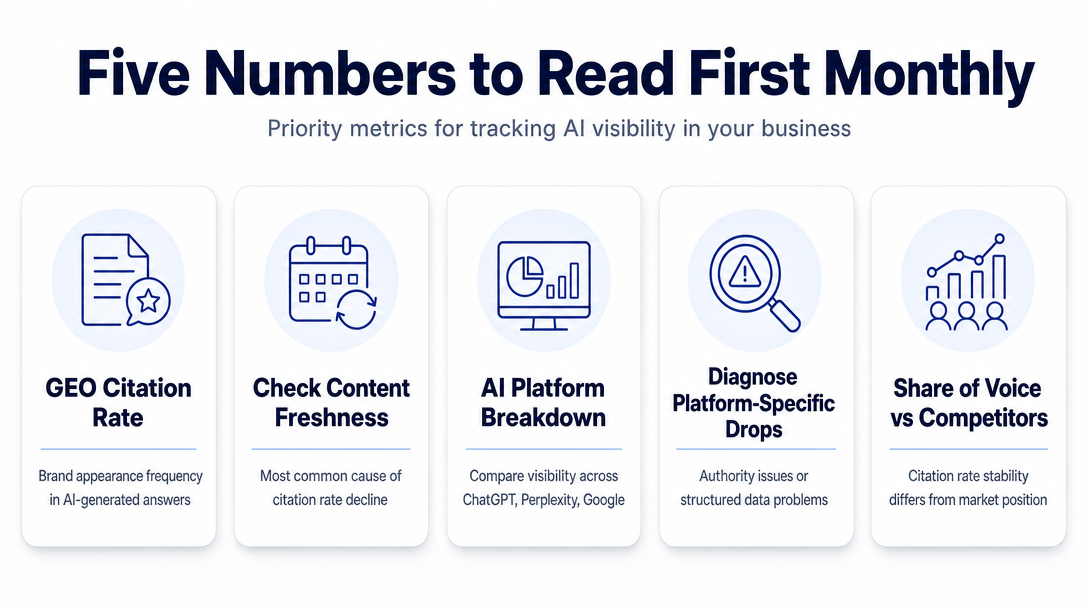
Most competitor guides tell you to "track AI visibility" without explaining which numbers to open first. Here is the priority order for a business owner reading a monthly re-run report.
1. GEO Citation Rate. How often does your brand or content appear in AI-generated answers for questions relevant to your product or service? This is your headline metric. If it dropped, the first question is: when was the affected page last updated? Content freshness decay is the most common cause of a citation rate decline.
2. AI Platform Breakdown. Are you appearing in ChatGPT but not in Perplexity? Cited in Google AI Overviews but absent from Gemini? Each platform uses different signals. A drop on one platform but stability on others narrows the diagnosis quickly - a Perplexity-specific drop often points to an authority or backlink issue; a Google AI Overviews drop often points to structured data or on-page signals.
3. Share of Voice vs. Competitors. Citation rate and share of voice are not the same metric. Your citation rate can hold steady while a competitor's rate climbs - which means your share of the available citations is shrinking. The competitor positioning dimension in Fulcrum's dashboard surfaces this. A flat score that hides a competitor surge is still a strategic problem.
4. Technical Health Score. This is the most controllable and fastest-to-fix dimension in any month. Broken links, missing schema markup, and slow page load times affect both traditional SEO and AI engine crawlability. Unlike GEO signals, technical issues have clear causes and clear fixes - the report tells you exactly what's broken.
5. Content Gap Score. Has a new topic emerged that competitors are being cited for, where you have no published content? This is your content brief for the month. Write the article Fulcrum flags - not an article you guessed might perform well. Alongside your traditional keyword data from Google Search Console, this gives you a complete picture of where you're missing.
What Causes a Score Drop - And How to Diagnose It Fast
The most-searched, least-answered question in AI search tracking: "My score went down. Why?"
Here are the four most common causes, each with a one-sentence diagnosis and a one-sentence fix.
Content freshness decay. Your content hasn't been updated recently, and AI engines are prioritising newer material. Fix: refresh the affected page with a new section, updated data, or a current date and republish it.
A competitor published new content. Their share of voice grew, so yours shrank relative to theirs. Fix: check which topic they covered; your content gap report will flag it so you can respond directly.
A technical issue appeared. A page went to noindex, a schema markup error appeared, or Core Web Vitals degraded after a site update. Fix: run the technical health fix list and resolve the top-ranked item before touching anything else.
An algorithm or model change occurred. Google updated AI Overviews behaviour, or an LLM was retrained on new data. Fix: the same foundations recover from this every time - authoritative, structured, fresh, locally relevant content. No emergency action needed; maintain the cadence.
The Australian context matters here. Website Planet research (reported by Mediaweek) shows AI Overviews now appear in 39% of Google searches. That penetration rate means changes to AI Overviews behaviour have an outsized impact on Australian businesses compared to global averages - which is a reason to track this dimension monthly rather than quarterly.
E-E-A-T signals - demonstrating experience, expertise, authoritativeness, and trustworthiness - remain the stable foundation that helps recover from any of these causes. They don't change with every model update; they compound over time.
A score drop is not always a crisis. Seasonal lulls, a temporary competitor exit, or a mid-month crawl schedule can explain short-term movement. The 90-day view in the next section is how you tell the difference.
Tracking Progress Over Time - Turning Monthly Data Into a 90-Day Story
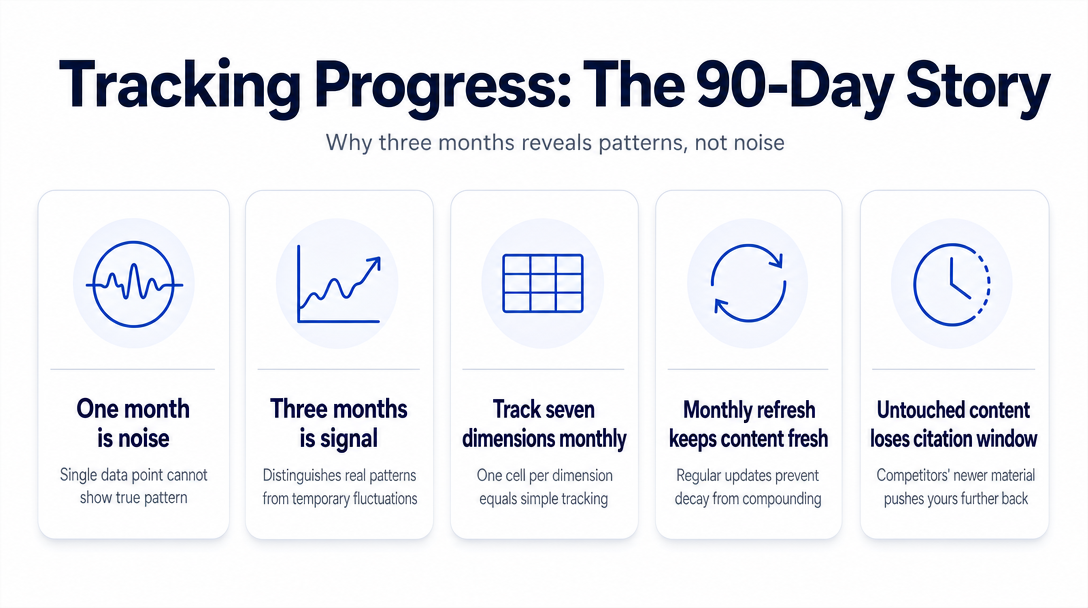
One month of re-run data is a data point. Three months is a story.
The 90-day proof cycle is the practical threshold for distinguishing noise from signal. A single month's dip could be a crawl timing issue or a temporary competitor spike. Three consecutive months of decline is a pattern that needs structural attention. Three consecutive months of improvement is a result worth documenting.
Fulcrum's dashboard stores historical scores across all seven dimensions, so the comparison is built in - you don't need a separate spreadsheet. For businesses that want a simple manual record alongside the platform, seven cells per month (one per dimension) is all the tracking infrastructure you need.
The connection between freshness and the 90-day cycle is direct. Content that gets reviewed and refreshed each month stays inside the citation window. Content left untouched for a quarter drops progressively further out of that window as newer material from competitors enters it. The monthly re-run isn't just a tracking mechanism - it's the reminder system that prevents decay from compounding before you notice it.
The most underused output of 90-day tracking is proof. When Fulcrum's dashboard shows a GEO visibility score moving from 48 to 64 across three months, that movement is concrete evidence that marketing activity is working. For a small business presenting to a lender, a business partner, or a board, a seven-dimension score trend across 90 days is a more credible performance record than a screenshot of a single report. No competitor articles cover this use case, but it's one of the most practical reasons to maintain a monthly cadence.
For context on tracking both SEO and GEO dimensions together, "GEO vs SEO: Why Australian Small Businesses Need Both in 2026" covers why both sets of signals should be improving in parallel - and what to do when they diverge.
Frequently Asked Questions
How often should a small business re-run its GEO audit?
Monthly is the recommended cadence for most Australian small businesses. AI search results shift continuously - content freshness decays within 13 weeks and competitor activity can change share of voice week to week. Monthly re-runs catch problems before they compound while remaining manageable for a sole trader or small team. Quarterly is too slow; weekly creates more noise than signal for most businesses at this scale.
What is GEO citation rate and why does it change monthly?
Citation rate is the percentage of relevant AI-generated answers that include your brand or content. It changes monthly because AI models are continuously updated, content freshness affects which material gets retrieved, and competitor publishing activity shifts the overall share of citations - all without you changing anything on your own site.
Can I track GEO and SEO scores without an agency?
Yes. Platforms like Fulcrum AI - Australian-built and priced from $99/month - automate the monthly re-run across seven dimensions: on-page SEO, technical health, GEO/AI-search visibility, competitor positioning, content gaps, social presence, and community footprint. Ranked fix lists are generated automatically, and nothing goes live without your approval. See Fulcrum's pricing for the full plan details. For complex technical migrations or high-stakes PR campaigns, a specialist is still worth engaging - but routine monthly tracking and content optimisation is well within what an automated platform handles.
What should I do if my GEO score drops month-on-month?
Check which specific dimension dropped, then match it to the most likely cause: content freshness decay (refresh the affected page), a competitor's new content (check the content gap report and respond), a technical error like broken schema markup or slow load speed (resolve the top fix in the technical health list), or a platform algorithm change (maintain quality fundamentals and don't panic). Resolve the top-ranked fix before starting anything new.
Does improving traditional SEO also improve my GEO score?
Usually yes, but not automatically. Technical health and on-page SEO improvements make content more crawlable by AI engines as well as traditional search bots. But GEO also requires content freshness, structured data, and authoritative signals that traditional SEO doesn't always prioritise equally. Monthly tracking of both dimensions shows where they diverge - and which dimension needs attention in any given month.
See Your First Monthly Re-Run for Free
Fulcrum AI crawls your website and scores it across all seven dimensions - on-page SEO, technical health, GEO/AI-search visibility, competitor positioning, content gaps, social presence, and community footprint - then delivers a ranked list of copy-paste fixes, drafted content updates, and social posts. Nothing touches your live site without your approval.
Start with a free preview at fulcrumai.com.au, then run your first monthly comparison the moment you're ready to track what's changing.