Social Media Posts From an SEO Audit: How AI Can Turn Your Website Gaps Into Ready-to-Post Content
You finished your SEO audit. The report landed in your inbox: a content gap score, a social presence rating of 4/10, a list of competitor topics you're…
Social Media Posts From an SEO Audit: How AI Can Turn Your Website Gaps Into Ready-to-Post Content
You finished your SEO audit. The report landed in your inbox: a content gap score, a social presence rating of 4/10, a list of competitor topics you're not covering. Now what? Most sole traders and lean marketing teams file that report and keep posting the same Tuesday motivational quote they've always posted.
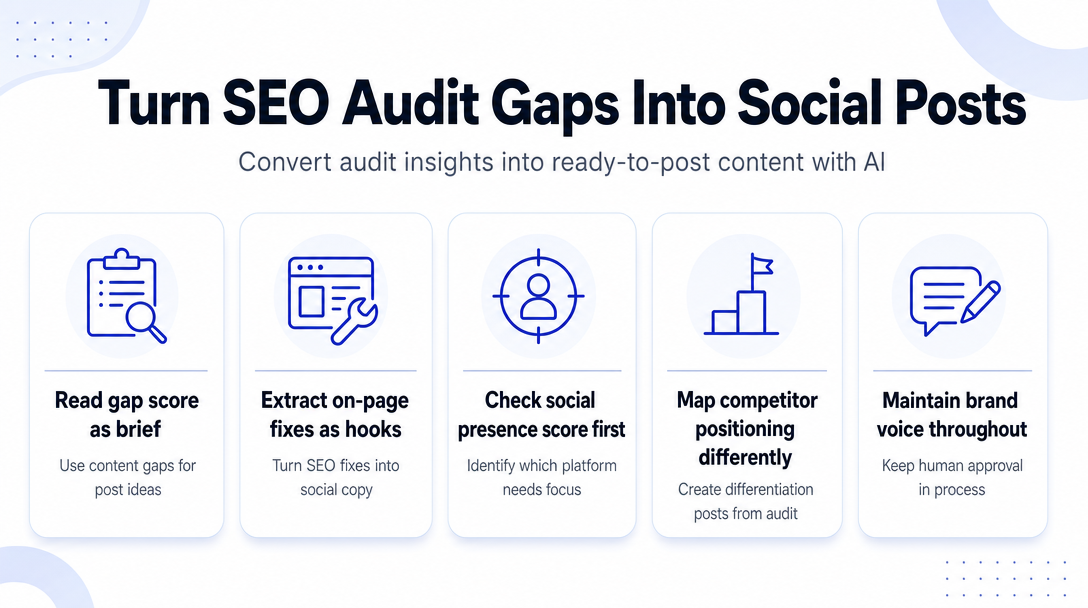
That's the gap this article addresses. Your audit findings are not just a to-do list for your website developer - they are already the brief for your next 30 days of social content. The process of translating audit data into ready-to-post content is what we call the Audit-to-Calendar Pipeline, and AI tools are now capable of running it for you.
Step 1 - Read Your Content Gap Score as a Social Post Brief
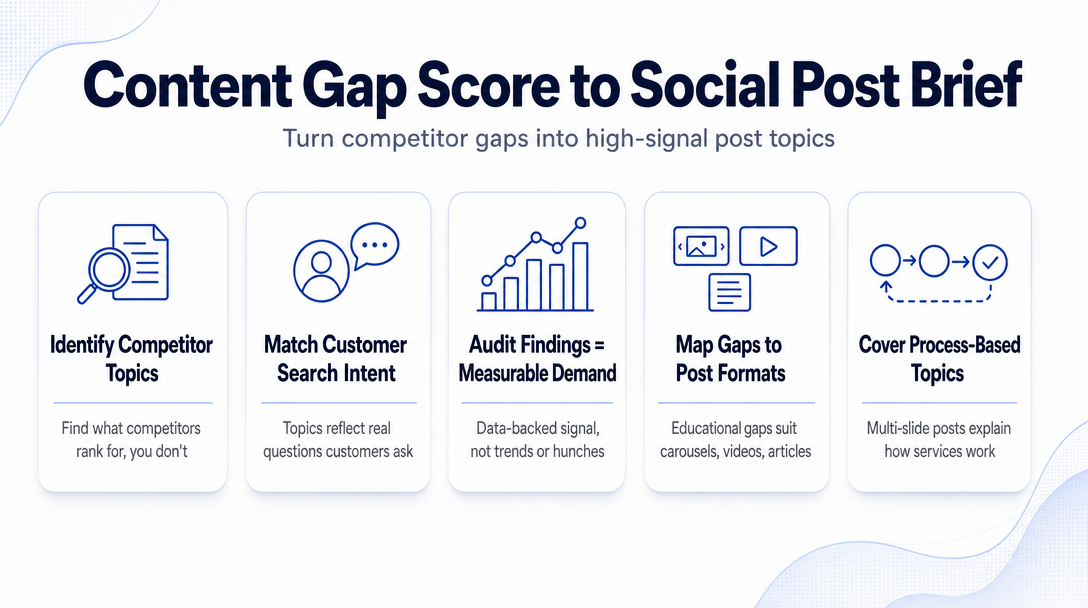
Your content gap analysis lists the topics your competitors rank for that your website doesn't address. These aren't just blogging ideas. They are the exact questions your potential customers are already typing into Google, ChatGPT, and Perplexity. If your audience is searching for those answers on AI engines and your site doesn't cover them, you're invisible - on search and on social.
The Audit-to-Calendar Pipeline starts here because content gaps are the highest-signal input available. Unlike a hunch or a trending audio clip, a gap identified by your audit represents documented, measurable demand.
Which audit findings translate directly to post topics
Each gap type maps to a post format:
- Content gap topics your competitors own - educational posts work best here: carousels walking through a process, short how-to videos, or LinkedIn articles. If a competitor ranks for "how [your service] works step by step" and your website doesn't cover it, a three-slide Instagram carousel on that exact topic serves double duty - social engagement now, topical authority over time.
- Competitor-dominated keywords - these fuel comparison and differentiation posts. Not "we're better" posts, but specific-angle posts: "Here's how we approach [specific process] differently" - grounded in what your audit surfaced.
- Unanswered FAQs from your audit - these translate directly into Q&A Stories, short-form Reels, or "quick tip" Facebook posts. Your audience is already asking; your audit just confirmed it.
Tools like Ahrefs and Semrush can surface content gaps too, but they require separate logins, manual export, and your own translation step into social post briefs. Screaming Frog crawls technical structure but doesn't generate post copy from what it finds. An AI audit platform built for SMBs handles that translation automatically - reading the gap, then drafting the post.
Google Search Console data feeds the same gap-identification process from the other direction: it shows what queries your site already appears for but doesn't fully answer - another source of post topics your audience has already voted on with their clicks.
Note on AI engines: because AI tools use natural language processing (NLP) to read your existing site copy and match it to what people are searching for, the posts they draft from your audit data reflect your own terminology - not generic template language.
The difference between posting about your business and posting about your customer's problem
Audit-driven social content answers real questions your market is already asking. Untethered social content - brainstormed without data - tends to talk about the business ("We're proud to announce...") rather than the customer's problem. The audit gives you permission to post about what your audience already wants to know, which is consistently what performs.
Step 2 - Use Your On-Page SEO Fixes as Copy-Paste Post Hooks
An SEO audit produces ranked copy fixes: rewrite this meta description, tighten this H1, add this missing phrase to your service page. Every one of those copy improvements is a social hook waiting to be extracted.
Here's the mechanic: if your audit flags that your homepage underuses the phrase "same-day bookkeeping in [suburb]," adding that phrase to your site is a website fix. But that same phrase - once your audit surfaces it - can fuel a short Facebook post ("We cover same-day turnaround for businesses in [suburb] - here's how it works"), a Google Business Profile update, or a paid ad headline.
The insight is that on-page copy suggestions and social post copy share the same source data: your own website and the audience demand it was measured against. An AI tool that reads your audit can draft both at once, keeping your message consistent across channels without you writing two separate briefs. Schema markup improvements flagged in your audit - adding structured data to your service pages, for example - can also be referenced in social posts to reinforce your authority in a specific topic area ("We just updated our [service] page with full pricing and FAQs - link in bio").
Nothing in this pipeline should go live automatically. The value is in moving from blank page to a workable draft in seconds, then spending a few minutes refining it - not in skipping your own judgement.
Three on-page fix types that make the strongest social hooks
- Meta description rewrites - these are already written to be punchy and character-limited. A rewritten meta description is one edit away from a caption.
- Missing keyword phrases - phrases your audit says your competitors use but you don't are ready-made for a search-aware hashtag and topic strategy on Instagram and LinkedIn.
- Thin service page content - if an audit flags a service page as under-developed, an "explainer" post series on that service seeds demand for the page you're about to expand.
Step 3 - Let Your Social Presence Score Tell You Which Platform to Focus On First
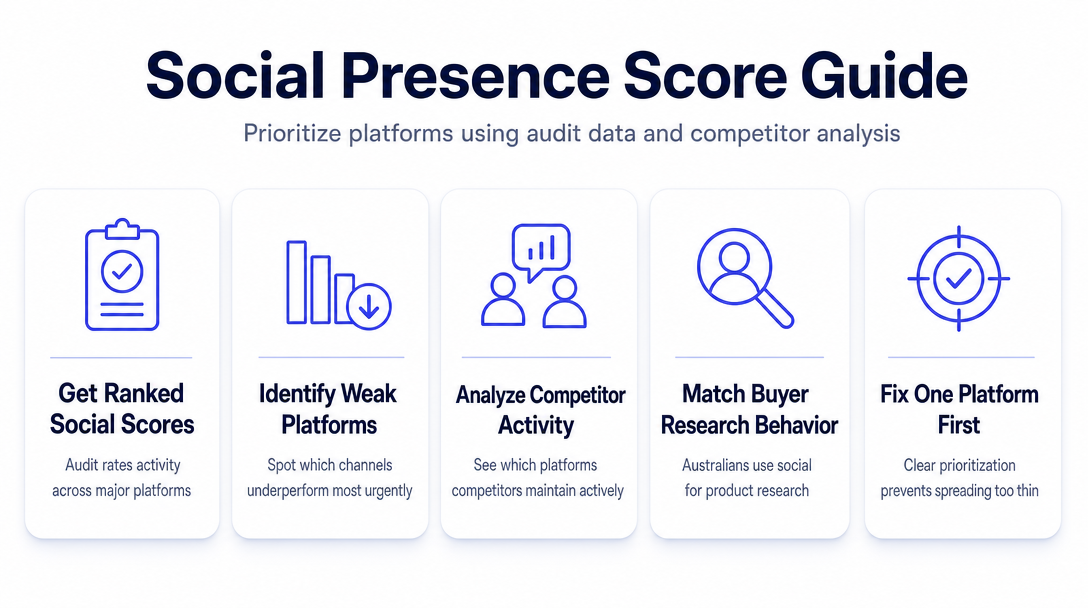
A multi-dimension SEO audit worth using scores your social presence - rating how consistently and actively your business appears across Facebook, Instagram, LinkedIn, and Google Business Profile. Most sole traders and lean teams already know they should be "doing more on social." What they don't have is a ranked instruction for which platform to fix first.
That's what the social presence score gives you. A weak score on LinkedIn and Instagram simultaneously means you're spread thin and underperforming on both. The audit identifies which platforms your direct competitors are active on - if every competitor has a well-maintained Facebook page and active Google reviews and your score lags on both, that's your prioritisation signal.
This matters practically: more than 58% of Australians now turn to social media for brand and product research before making a purchase decision. If your social presence score is low, you are absent at the exact moment Australian buyers are forming their opinion about you. That's not a vanity metric problem - it's a lead generation problem.
Australian platform context - where your customers are looking
The platform mix matters for format. LinkedIn posts read differently from Instagram captions, and both differ from Google Business Profile updates. An AI tool that knows it's drafting for LinkedIn will write a longer, more considered post than it would for an Instagram Story. Knowing your priority platform - from your social presence score - means the AI drafts in the right format for the right channel, not a generic post you have to reformat yourself.
Google AI Overviews, Gemini, and other AI engines increasingly surface brand signals when answering discovery queries. A consistent, active social presence - particularly paired with positive community footprint signals - contributes to how AI search engines evaluate your brand's authority, alongside your on-page and GEO signals. (For a deeper look at how AI search visibility works as a standalone discipline, the GEO audit framework article covers that ground specifically.)
What a "community footprint" score in your audit actually means for your posting schedule
Community footprint measures your reviews, local citations, and engagement signals. A low score is a direct brief for a specific type of social content: review-request posts ("We'd love to hear how we did - [link]"), local-targeted posts that strengthen suburb-level association, and engagement content designed to prompt responses rather than passive likes. These aren't glamorous posts, but they are the ones that move the needle on the signals your audit says are weak.
Step 4 - Map Your Competitor Positioning Score to Differentiation Posts
The competitor positioning section of your audit identifies which keywords, content angles, and authority signals your competitors use to outrank you. For social media, this is more valuable than any trend report - it tells you what your market is already responding to, with your specific competitors as the proof.
The content move: if your audit reveals a competitor dominates the "eco-friendly [service] in [city]" angle and your business genuinely delivers on that - better materials, clearer process, verifiable outcomes - your social content should make that visible. Not a vague "we care about sustainability" post, but a specific, audit-backed differentiation: "Here's the three things we do differently when it comes to [material/process] - and why our clients in [suburb] said it mattered."
For a sole trader who cannot spend ten hours a week on competitor research, automating the competitor gap-to-social-post translation is what separates an AI tool that's genuinely useful from one that's a novelty. According to COSBOA's State of Small Business Report (August 2025), 39% of Australian small businesses are already adopting AI for tasks including marketing content generation and social media automation. The businesses not doing this are ceding ground to competitors who are.
What makes a differentiation post effective vs. what makes it sound defensive
Lead with what you offer, not what a competitor lacks. "Unlike [competitor], we..." reads as insecure and often backfires. "Here's why our clients in [suburb] choose us for [service]: [specific differentiator from audit data]" reads as confident and specific - which is what converts. The audit gives you the differentiator; the AI tool drafts the post; you approve and refine the tone.
Step 5 - Maintain Brand Voice and Human Approval at Every Step
The most common objection to AI-generated social content: "It doesn't sound like us."
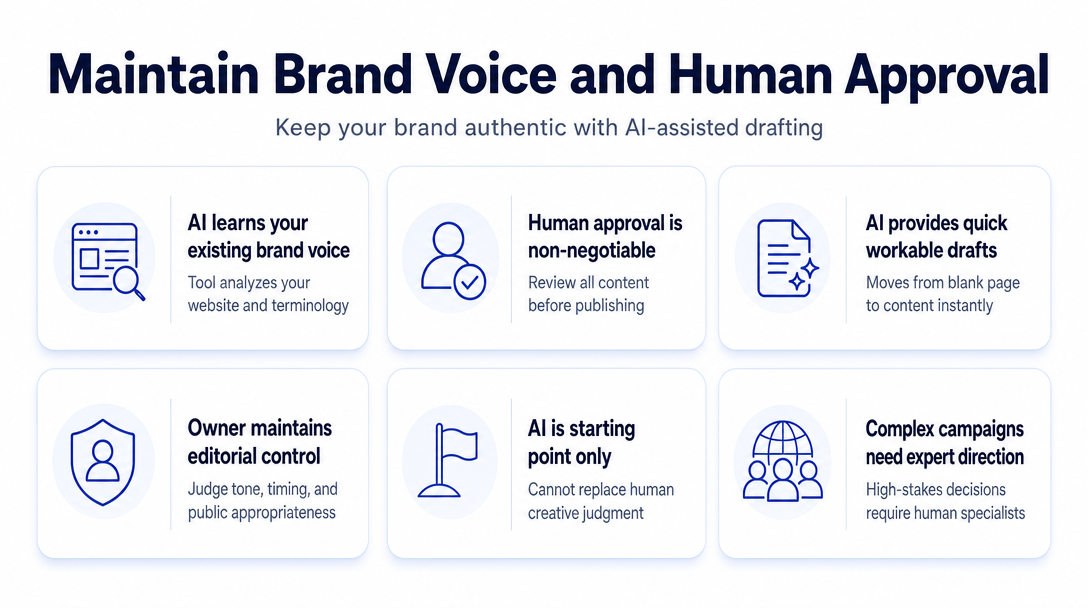
The answer depends entirely on where the AI gets its data. A tool that crawls your own website - reading your existing service descriptions, your tone, your terminology - drafts posts that already approximate your voice, because it's reading your language, not a generic template. NLP-driven analysis of your own site copy means the output starts closer to your brand than anything generated from a cold prompt.
The approval principle is non-negotiable: no responsible AI marketing tool should publish anything without a human reviewing it first. The efficiency gain is getting from blank page to a workable draft in seconds. The owner's judgement - on tone, on timing, on what's appropriate to say publicly - stays in the loop at every step. For complex campaigns, high-stakes brand decisions, or situations requiring specialist creative direction, a human expert remains the right choice. AI-drafted posts are a starting point, not a replacement for editorial judgement.
From an E-E-A-T perspective - Google's quality framework measuring Experience, Expertise, Authoritativeness, and Trustworthiness - social posts that consistently demonstrate topical expertise (surfaced from your own audit data) contribute to your brand's authority signals over time. It's not a direct ranking factor, but consistent, knowledgeable content across channels reinforces the same expertise signals your website content builds.
For more on how the drafting and review workflow operates in practice - including realistic review time expectations - the AI content writing tool guide covers that workflow specifically.
The review-and-approve workflow for an SMB with no marketing team
Receive drafts as a batch - weekly, for example. Review in 10 to 15 minutes. Adjust tone where the AI got it slightly wrong. Approve and post the ones that are ready. This is the lean-team workflow that makes the Audit-to-Calendar Pipeline viable for a one-person business: you're not writing from scratch, you're editing from a strong first draft built on data you already have.
What the Audit-to-Calendar Pipeline Looks Like in Practice
An Australian bookkeeper inputs their URL into Fulcrum AI. The audit returns: three content gaps around common tax questions their competitors answer but they don't, a social presence score of 4/10 (Facebook and Google Business Profile both weak), and competitor activity showing two similar businesses posting five times a week on Facebook.
From that data, the AI drafts six Facebook posts addressing the tax questions, two LinkedIn articles positioned around the bookkeeper's specific approach, and a Google Business Profile update. All are formatted for their respective platforms. All sit in a draft queue awaiting approval. The bookkeeper spends fifteen minutes reviewing, tweaks the tone on two posts, approves the rest, and has two weeks of content scheduled before lunch.
That's what Fulcrum AI's platform - an Australian-built SaaS product starting at $99/month AUD with a free preview - produces from a single audit run. The audit is not a report to file. It's the fuel for your calendar.
Frequently asked questions
Can an SEO audit tool also generate social media posts?
Yes - AI-powered audit platforms like Fulcrum AI crawl your website, identify content gaps and competitor strengths, then draft social posts and ad creatives based on those specific findings. The posts stay in draft form until you approve them, so nothing goes live automatically. The output is grounded in your actual site data, not generic prompts.
Does social media activity affect my SEO in Australia?
Social media doesn't directly change your Google ranking, but it builds the brand signals - consistent mentions, community footprint, content authority - that underpin strong SEO over time. An audit that scores your social presence helps identify where those signals are weakest, so you can close the gaps strategically rather than posting at random.
What's the benefit of using website audit data to write social posts, rather than generic AI tools?
Generic AI social tools write from prompts. Audit-driven AI tools write from your actual website data - your services, your content gaps, your competitors - producing posts that are specific to your business and relevant to the searches your audience is already making. The result is on-brand, on-topic content without the manual briefing process.
How much does an AI social media marketing tool cost for an Australian small business?
Pricing varies depending on the platform and its scope. Fulcrum AI, built in Australia for SMB budgets, offers a free preview with no signup required and a full plan at $99/month AUD - covering audit, content drafting, social posts, and ad creatives in a single platform.
Your audit findings are already your content brief - you just need an AI that knows how to read them.
Fulcrum AI crawls your website, scores it across seven dimensions, then drafts the social posts, articles, and ad creatives that follow directly from what it finds. Nothing goes live until you approve it. Start with a free preview - no signup required.
See What Fulcrum Would Draft for Your Site - fulcrumai.com.au
Related reading
- Competitor Gap Analysis for Australian Small Business SEO: How to Find the Keywords and Citations You're Missing
- AI Content Writing Tool for Australian Small Business: How Fulcrum Drafts Articles and Social Posts From Your Own Audit Data
- The 7 Dimensions of a Proper AI SEO Audit - and Why Most Basic Site Checkers Only Cover 2