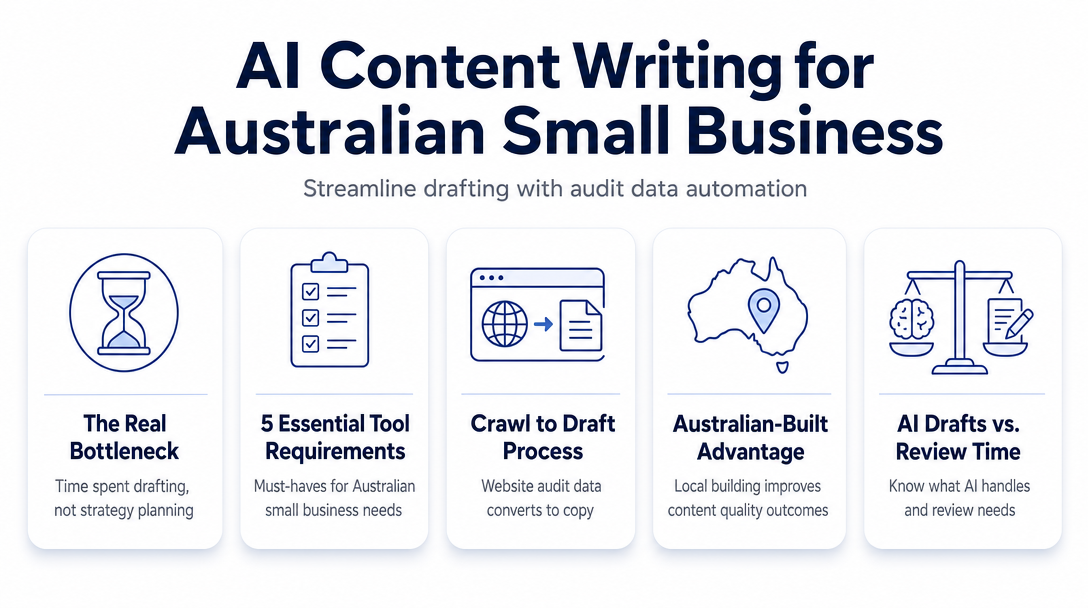
AI Content Writing Tool for Australian Small Business: How Fulcrum Drafts Articles and Social Posts From Your Own Audit Data
Most small businesses don't have a content strategy problem. They have a drafting time problem. Writing one blog post takes an average of 3 hours and…
AI Content Writing Tool for Australian Small Business: How Fulcrum Drafts Articles and Social Posts From Your Own Audit Data
Most small businesses don't have a content strategy problem. They have a drafting time problem. Writing one blog post takes an average of 3 hours and 51 minutes, according to Orbit Media research cited by Semrush. Then comes the social posts about that article. Then the next article. For a sole trader or a team of three, that maths kills any publishing calendar before it starts.
Generic AI tools lower the barrier - but they create a new one. ChatGPT, Jasper, and similar tools draft content blind: they don't know what you sell, what you've already published, or what's missing from your site. The output sounds plausible. It rarely sounds like you.
This article explains what a website-aware AI content writing tool actually does differently, introduces the Stacked Draft model as a practical framework for connected article-and-social drafting, and lays out what to look for before you hand your content program to any AI - including what it still can't do without you.
The Content Bottleneck No One Talks About
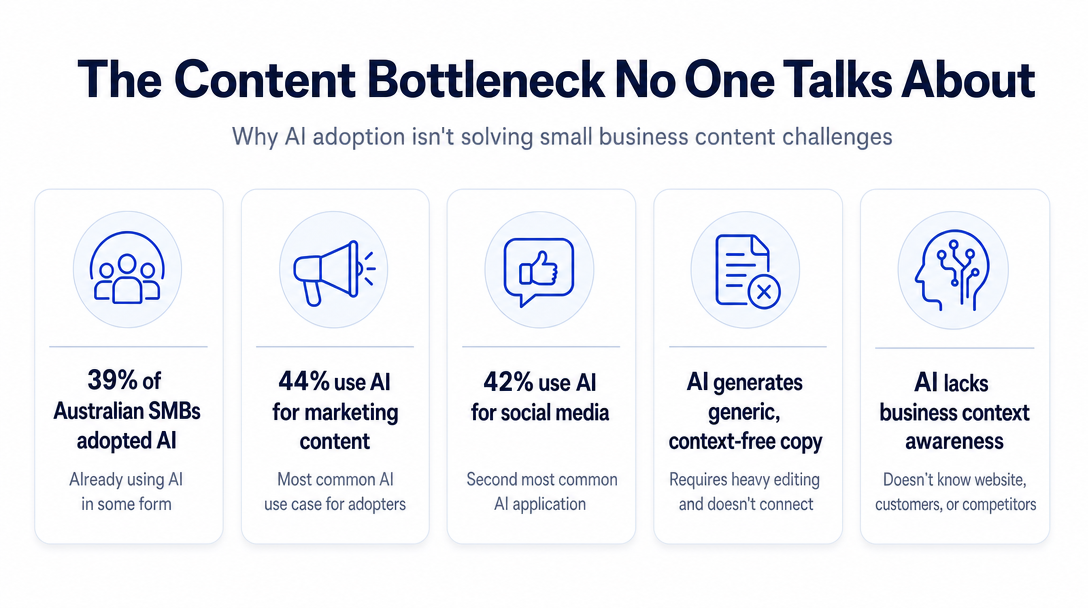
According to the COSBOA State of Small Business Report 2025 (Square/COSBOA), 39% of Australian small businesses have already adopted AI in some form. Of those who have, 44% are using it for marketing content generation and 42% for social media management - making content the single most common AI use case among Australian SMB adopters.
That adoption rate tells half the story. The other half is what those businesses are actually getting from their AI tools: generic copy that requires heavy editing, social posts that don't connect to the article they were supposedly based on, and drafts that repeat content the site already has.
The reason isn't that the tools are bad at writing. It's that they're writing without context. When an AI tool doesn't know what your website says, who your customers are, or what topics your competitors already dominate, it defaults to the median - the kind of content that could belong to any business in your category.
Why Generic AI Copy Sounds Like Everyone Else's Business
A tool like ChatGPT or Copy.ai generates content from what you type into a prompt. If you type "write a blog post about roof plumbing in Melbourne," you get a post about roof plumbing in Melbourne - one that looks remarkably similar to the post your competitor generated with the same prompt last Tuesday.
Website-aware drafting works differently. Before the AI writes a single word, it indexes your existing site: your service pages, your existing articles, your about section, your geographic focus. It uses that foundation as the brief - so the draft it produces builds on what you've already published rather than duplicating it, uses the language patterns that already appear in your content, and targets the gaps your site actually has.
5 Things Your AI Content Writing Tool Must Do for Your Australian Small Business
1. Read Your Website Before It Writes Anything
A content tool that starts from a blank prompt is a sophisticated autocomplete. A tool that starts from your website is closer to a marketing assistant who's actually read your material before their first day.
Website-aware drafting means the AI ingests your existing pages and understands your content landscape - what you cover, how you frame your services, what tone you use. The result is a draft that extends your existing voice rather than importing a generic one.
2. Draft the Article and the Social Posts as a Connected Set
Here's where most small business content programs quietly collapse: the blog post gets written (eventually), and then the social posts that were supposed to go with it never happen because that's a separate task on a separate day.
The Stacked Draft model solves this. A Stacked Draft is when a single website-awareness layer and content brief produces a complete vertical of connected assets in one queued output: one article draft, platform-adapted social posts for that article, and an optional ad creative variant - all sitting in a human-approval queue before anything publishes. Tools like Buffer and Hootsuite can schedule social posts, but they need the content to exist first. Canva handles the visual layer. The Stacked Draft model means the words - article, captions, and creative copy - are produced together, not hunted separately.
This single structural change removes the biggest time tax in small business content: the context-switch cost of going back to draft social posts for an article you wrote three days ago.
3. Know What Your Business Actually Needs to Publish Next
The most useful draft isn't the one you thought to ask for - it's the one targeting a topic your competitors rank for that your site doesn't cover. An AI content tool that identifies your content gaps (topics your site is missing, questions your audience asks that go unanswered) drafts with commercial intent, not just on demand.
This is content intelligence, not content generation. The draft fills a real gap; it doesn't just fill a queue.
4. Never Publish Without Your Approval
This is non-negotiable, and it has a practical legal dimension: under Australian Consumer Law, a business is responsible for every claim made in its published content. An AI content tool that pushes anything live automatically - even a social caption - is a liability risk and a brand risk simultaneously.
The right tool produces copy-paste-ready drafts that sit in an approval queue. You review. You decide. Nothing reaches your audience without a human confirming it's accurate, on-brand, and legally fine to publish.
5. Be Priced for an SMB Budget, Not a Marketing Department
Jasper's Pro plan starts at USD $59/month per seat (verify current pricing at jasper.ai/pricing). Blaze AI's published pricing starts from USD $79/month. Both are US-based tools priced in US dollars - so the actual monthly cost in AUD shifts with the exchange rate.
For a sole trader managing a tight monthly budget, currency volatility on a software subscription is a genuine planning headache. An Australian-built tool at a flat AUD price removes that variable entirely.
How Fulcrum AI Works: From Website Crawl to Copy-Paste Draft
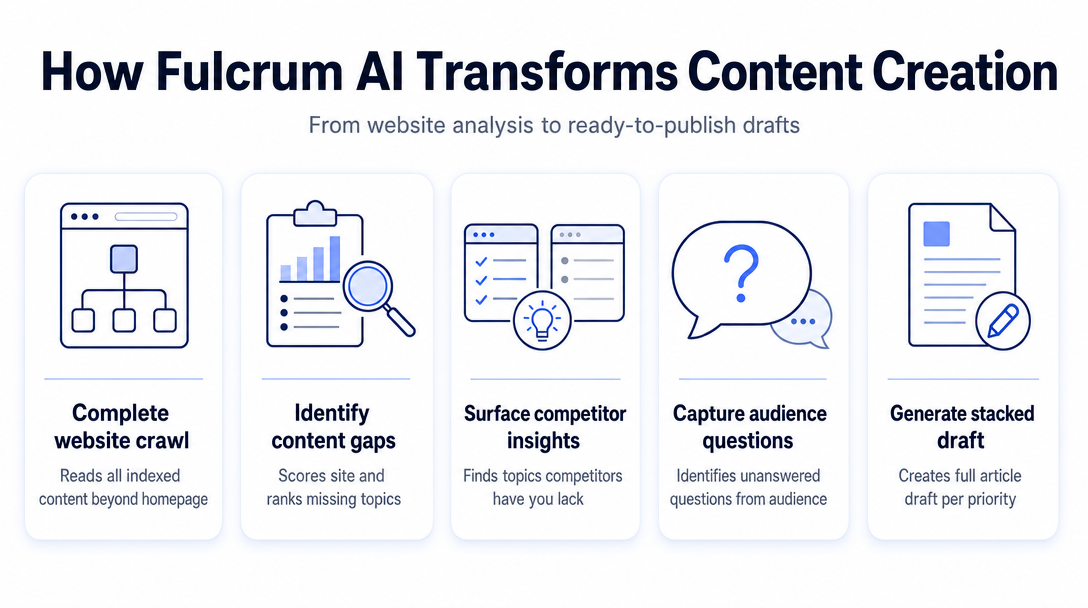
Fulcrum AI is an Australian-built SaaS platform, founded by Cory Nathan, designed specifically for small businesses, sole traders, and lean in-house marketing teams. Here's how the content drafting workflow actually functions in plain language:
Step 1 - Your site gets crawled. Fulcrum doesn't just scan your homepage. It reads your full content landscape: service pages, existing articles, location pages, and any other indexed content. This becomes the foundation for everything drafted.
Step 2 - Gaps and opportunities get ranked. The platform scores your site across content dimensions and surfaces ranked content gaps - specific topics your site is missing that competitors have, or questions your audience is asking that your pages don't answer. For a deeper look at how that seven-dimension scoring works, the GEO audit framework guide covers the audit layer in full. For this article, the relevant output is a prioritised list of what to write next.
Step 3 - Fulcrum drafts the Stacked Draft. For each priority topic, it generates a full article draft plus platform-adapted social posts - LinkedIn, Instagram, Facebook - and ad creative variants if applicable. These are copy-paste-ready drafts, not bullet-point outlines.
Step 4 - Everything waits in your approval queue. Nothing reaches your live site or your social channels automatically. You log in, review the drafts, make any edits, and approve what you're happy with. The live site is never touched without your explicit sign-off.
Step 5 - The system learns your voice. As you approve and publish more content, Fulcrum builds a more accurate model of your tone, your preferred structures, and your positioning. Each round of drafts gets closer to needing less editing.
The before/after shift for a typical small business owner isn't dramatic to describe but significant in practice: instead of clearing a four-hour block to research, outline, and write a post you may not finish, you're spending 20-30 minutes reviewing a ready-to-go draft and three associated social captions. The blank-page problem doesn't exist in that scenario.
Curious what Fulcrum would draft for your own site? The free preview shows you what the tool surfaces before you commit to anything - fulcrumai.com.au.
Why "Australian-Built" Actually Matters for Content Quality
Every competitor reviewed for this article - Otto Media's workflow guide, Scorched Media's Blaze AI review, Dossis Digital's tool comparison - either focuses on US-based tools, quotes USD pricing without flagging the conversion, or treats "Australian" as a badge rather than a functional difference.
There are three concrete reasons it matters:
AUD pricing is a budget protection. At AUD $99/month, Fulcrum's full plan costs a known, stable amount every billing cycle. A USD-priced tool at $59 or $79/month has an AUD cost that varies with exchange rates - sometimes meaningfully, over the course of a financial year.
Australian business context shapes useful content. A generic US-trained AI tool defaults to American examples, American seasonal hooks, and American regulatory framing unless you manually correct it every time. EOFY content planning, Australian public holiday scheduling, state-specific compliance references, and local suburb-level search patterns ("plumber Balmain" rather than "plumber downtown") require Australian business awareness baked into the tool, not prompted in.
Data handling is worth one question. Australian small businesses operate under the Privacy Act. Where your business data - website content, customer-facing copy, operational details - is processed and stored is a legitimate question to ask of any AI platform you use. Worth raising directly with any provider before you start.
Understanding why both GEO and traditional SEO matter for Australian businesses in this context is covered in the companion guide to GEO vs SEO strategy.
What AI Drafts, What It Doesn't, and How Long Your Review Actually Takes
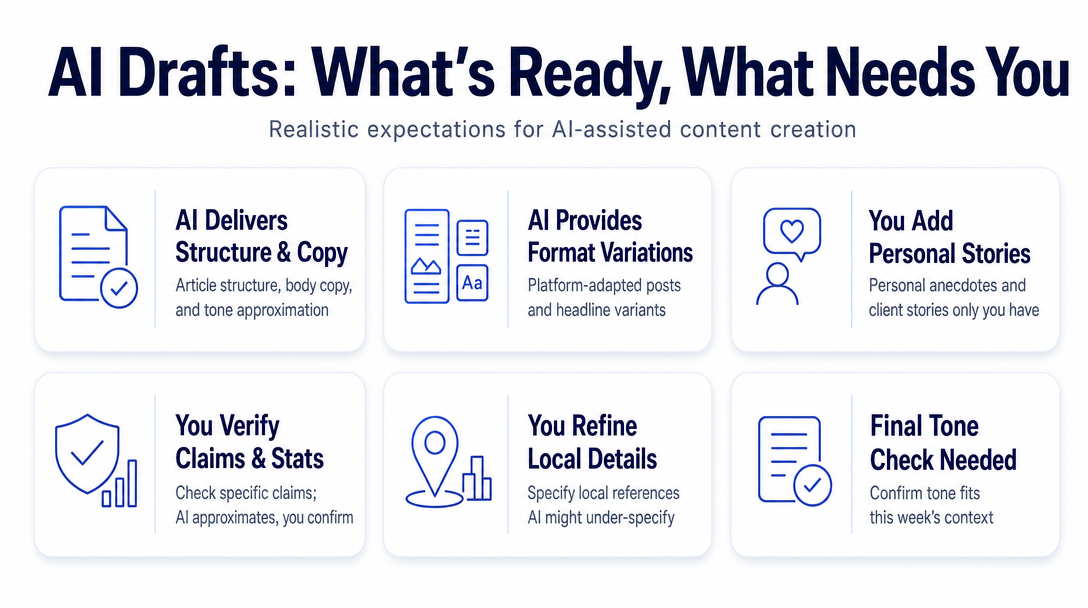
The honest answer to "what does an AI content draft look like?" is: better than most people expect, and not as finished as they hope.
What Fulcrum drafts for you: Article structure and body copy targeted at a specific gap, tone approximations based on your existing site content, platform-adapted social post formats (LinkedIn professional tone, Instagram conversational, Facebook community-focused), headline variants, and meta description suggestions.
What still needs you: Personal anecdotes and client stories the AI has no access to. Specific claims or statistics that require verification - the AI will approximate, and you should check. Local references the AI might under-specify. The final read-through that confirms the tone is right for this week, not just for your site in general.
How long does reviewing a draft actually take? This is the question every busy small business owner has before they commit to any new tool, and most competitor content ignores it completely. Most business owners find reviewing a well-structured AI draft takes considerably less time than writing from scratch - checking for accuracy, adding a personal detail or two, and approving the social posts is a different cognitive task than producing the content yourself. The blank page is gone; what's left is editorial judgment, which most people already have.
The goal of a tool like Fulcrum isn't to remove you from your marketing. It's to remove the part that consumes the most time and delivers the least return: the hours between having an idea and having a publishable draft.
Frequently Asked Questions
Can AI really write content that sounds like my specific business? A website-aware AI content tool can approximate your voice meaningfully, because it drafts from your existing content rather than from a generic prompt. It won't replicate personal stories or insider knowledge - but the structure, terminology, and tone will reflect what's already on your site. Most business owners find the first few drafts need light editing; subsequent drafts need less as the system learns what you approve.
What's the difference between Fulcrum AI and just using ChatGPT? ChatGPT generates content from whatever you type into a prompt - it has no knowledge of your website, your published articles, your service mix, or your content gaps. Fulcrum crawls your site first, identifies what your business specifically needs to publish, and produces a Stacked Draft (article plus social posts) targeted at your actual gaps. It also holds everything in an approval queue, so nothing publishes automatically.
Does Fulcrum AI publish content to my website automatically? No. Every draft - articles, social posts, and ad creatives - sits in a human-approval queue. Nothing is pushed to your live site or social channels without your explicit review and approval. This is a deliberate design choice, not a limitation.
Is Fulcrum AI suitable for a sole trader or one-person business? Yes - it's specifically designed for small businesses, sole traders, and lean teams who don't have a dedicated marketing person. The platform handles the drafting and gap-identification work; your role is editorial review and final approval. No marketing qualifications or SEO knowledge required to use it.
How much does Fulcrum AI cost in AUD? Fulcrum AI offers a free preview so you can see what the platform would draft for your specific site before committing. The full plan is $99/month AUD - a flat Australian dollar price, with no currency conversion surprises. Visit fulcrumai.com.au to check current plan details.
Do I need to understand SEO to use it? No. Fulcrum surfaces the content gaps and ranks what to write next - you don't need to interpret keyword data or build a content strategy from scratch. The tool does the strategic layer; you make the final call on what to publish.
Fulcrum AI crawls your website, identifies your content gaps, and delivers a full Stacked Draft - your next article and matching social posts, ready for your approval - for $99/month AUD. No agency retainer. No prompt engineering. No exchange-rate surprises on your statement.