How to Get Your Australian Small Business Cited in ChatGPT and Perplexity (Step-by-Step)
To get your Australian small business cited in ChatGPT, Perplexity, and Google AI Overviews, you need to do three things: make your business a cleanly…
How to Get Your Australian Small Business Cited in ChatGPT and Perplexity (Step-by-Step)
By Cory Nathan | Published 28 June 2026
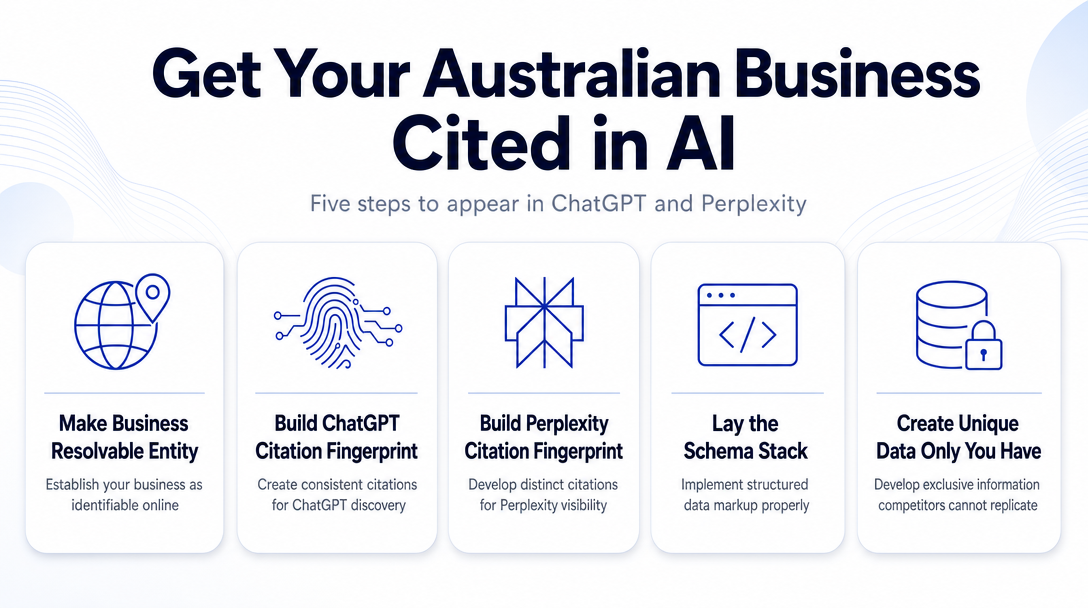
To get your Australian small business cited in ChatGPT, Perplexity, and Google AI Overviews, you need to do three things: make your business a cleanly resolvable entity, publish content structured the way each platform prefers to excerpt, and add the schema markup that signals your content type. The catch is that each platform has a different preference - and a strategy built for one may do nothing for the others.
This guide gives you the exact steps, in order, for each platform. No agency needed.
Why Getting Cited in ChatGPT Is Not the Same as Ranking in Google
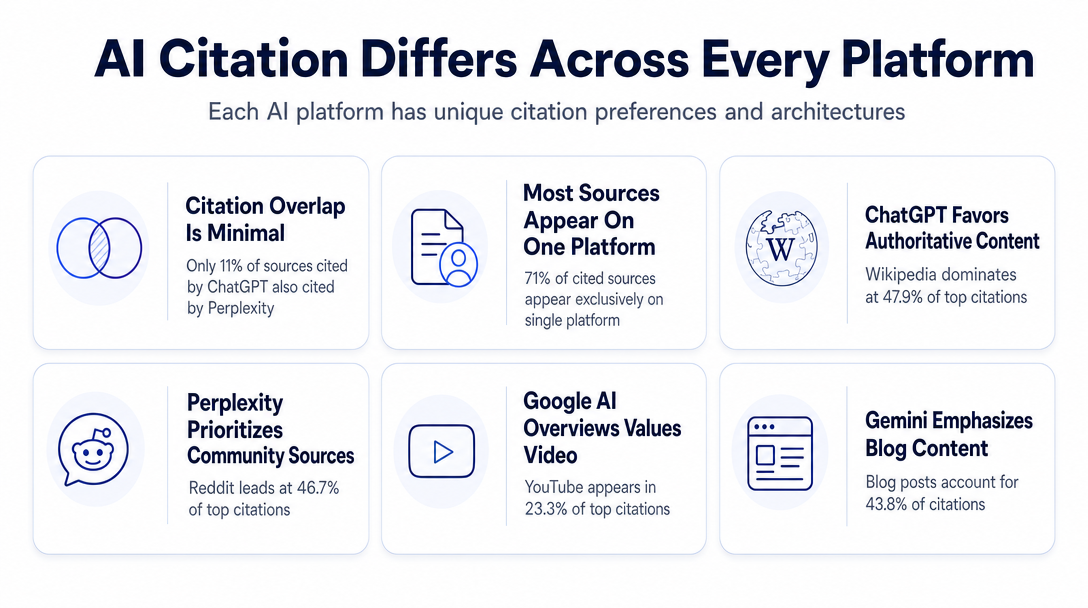
ChatGPT, Perplexity, and Google AI Overviews each have fundamentally different citation architectures. According to analysis by Ziptie.dev, only 11% of domains cited by ChatGPT are also cited by Perplexity for the same query - and 71% of all cited sources appear on just one platform. That single figure collapses the idea that "AI citation" is one thing you optimise for.
Here is what each platform actually does:
- ChatGPT draws from its training data and, in web-browsing mode, favours deep authoritative content. Its top cited source globally is Wikipedia (47.9% of top citations) - encyclopaedic, structured, definitive.
- Perplexity is a live-retrieval engine. Its top cited source is Reddit (46.7%) - community-sourced, fresh, conversational.
- Google AI Overviews still weighs your organic ranking signals heavily. YouTube appears at 23.3% of its top citations.
- Gemini leans heavily on blog content (Claude, similarly, cites blogs at 43.8%) and Google-owned properties.
This cross-platform divergence is why this article introduces a single organising concept: your Citation Fingerprint - the specific combination of content format, source type, entity signals, and content placement that makes each AI platform choose to cite your business over a competitor. You need three different fingerprints, not one.
If you have not yet diagnosed why your business is invisible in AI search, the GEO audit framework in ["Why Your Competitors Rank in AI Search and You Don't"](https://fulcrumai.com.au) is the place to start. And if you are still weighing whether AI search optimisation belongs in your strategy at all, "GEO vs SEO: Why Australian Small Businesses Need Both in 2026" covers that case. This article assumes you are past both questions and ready to act.
Step 1: Make Your Business a Resolvable Entity
ChatGPT cannot cite what it cannot cleanly resolve as an entity. Entity resolution is the prerequisite - before content strategy, before schema, before anything else.
An "entity" in AI terms means your business is recognisable as a specific, consistent thing: a name, a category, a location, and a set of services that appear identically across every source the LLM can read. When those signals conflict, the model loses confidence and skips you.
Three entity problems are common among Australian sole traders:
- Inconsistent NAP (Name, Address, Phone) across directories. Even a small variation - "Pty Ltd" in one place, absent in another - creates entity conflict.
- An unclaimed or incomplete Google Business Profile. This is one of the highest-weight entity signals any AI engine can read. Fill in every field: business category, services, service area, and hours.
- Vague website copy. "I help businesses with their marketing" is unresolvable. "I run paid social campaigns for e-commerce brands in Brisbane" is not.
The NAP audit: check these five sources in five minutes
Open five tabs: your website footer, your Google Business Profile, True Local, Yellow Pages AU, and your Facebook business page. Your business name, address, and phone number must be character-for-character identical across all five. Hotfrog and StartLocal are worth adding as a sixth and seventh check - they are among the Australian directory sources AI engines cross-reference to validate local entities.
This is also where answer engine optimisation (AEO) begins - the broader discipline of structuring your entire web presence to be the best answer to a specific query.
Your action: Claim and complete your free listings on True Local, Yellow Pages AU, Hotfrog, and StartLocal this week - identical NAP on all four.
Step 2: Build Your Citation Fingerprint for ChatGPT
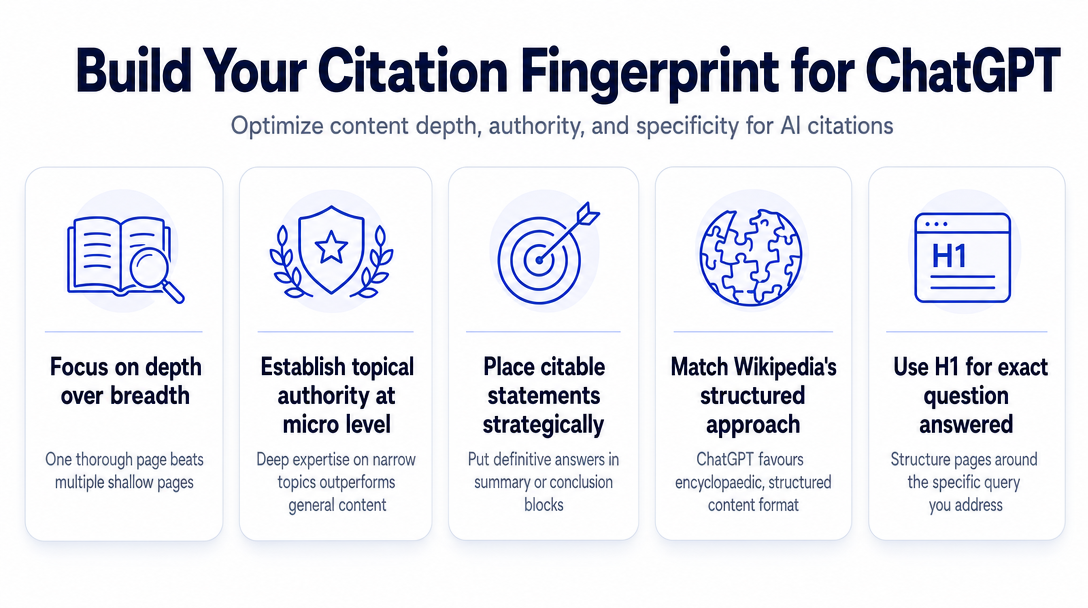
ChatGPT favours depth, authority, and specificity - on a single topic. The Wikipedia dominance in its citations tells you exactly what it is trained to trust: encyclopaedic, structured content that makes definitive statements on a narrow topic.
For a small business, this translates to a simple rule: one page, one query, one definitive answer. A plumber in Geelong writing a thorough page on "what causes blocked drains in Geelong's clay soil" will outperform a plumber writing five shallow pages on general plumbing topics. Topical authority at the micro level beats breadth.
Where to put your most citable sentence
Content placement inside an article matters more than most guides acknowledge. Research on generative engine responses shows AI engines disproportionately excerpt content from the final section of long-form articles - your most citable, definitive statements belong in a summary or conclusion block, not buried in the middle.
The structure of a citation-ready page looks like this:
- H1: The exact question you are answering
- Opening paragraph: A direct, self-contained answer in 40-60 words
- Supporting body: Evidence, context, and specifics
- Summary block: A 3-5 sentence restatement of the key finding or recommendation
The Princeton GEO study (Aggarwal et al., arXiv:2311.09735) found that GEO techniques can boost visibility in generative engine responses by up to 40%. Among the highest-performing tactics: adding verifiable statistics to your content and citing your sources within the body copy. Including one sourced statistic per article is not just good writing - it is a measurable citation signal.
Your action: Identify one narrow query your business can answer better than anyone else in Australia, then write a single page structured as above - question H1, direct opening answer, summary block.
Step 3: Build Your Citation Fingerprint for Perplexity
Perplexity is a live-retrieval engine, and its citation preferences are the opposite of ChatGPT's. Where ChatGPT values depth on your own website, Perplexity values your presence in conversations elsewhere on the web - particularly Reddit (46.7% of its top citations, per Ziptie.dev).
Three practical signals for Perplexity:
-
Reddit presence. Participate genuinely in relevant Australian subreddits - r/aussmallbusiness, r/AusFinance, and r/australia are the most indexed for Australian business queries. A helpful answer in a thread that Perplexity indexes is a direct citation signal. Do not spam; contribute something genuinely useful and include your website link naturally.
-
Fresh content. Perplexity's live retrieval means a well-structured article published three months ago outperforms a three-year-old evergreen page, all else being equal. A consistent publishing cadence - even one article per fortnight - matters.
-
Third-party mentions. A single mention of your business in a regional publication, industry newsletter, or external blog is more valuable for Perplexity than for ChatGPT. If a local business journalist covers your sector, a brief expert comment costs nothing and earns a citable reference.
The mention-source divide: what it is and how to fix it
The mention-source divide is the situation where an AI platform extracts information from a discussion thread or third-party article that references your business - but cites the forum or the article as its source, not your website. Your data, someone else's citation.
The fix is simple: whenever you contribute to a community discussion or are mentioned in external coverage, ensure your business name and website URL appear together in the same paragraph. Perplexity and other live-retrieval engines attribute to the document they retrieve - if your URL is in that document, the path back to you is clear.
Your action: Post one genuinely helpful answer in r/aussmallbusiness this week, including your website URL in context. Check that any recent press mentions include your URL, not just your name.
Step 4: Lay the Schema Stack
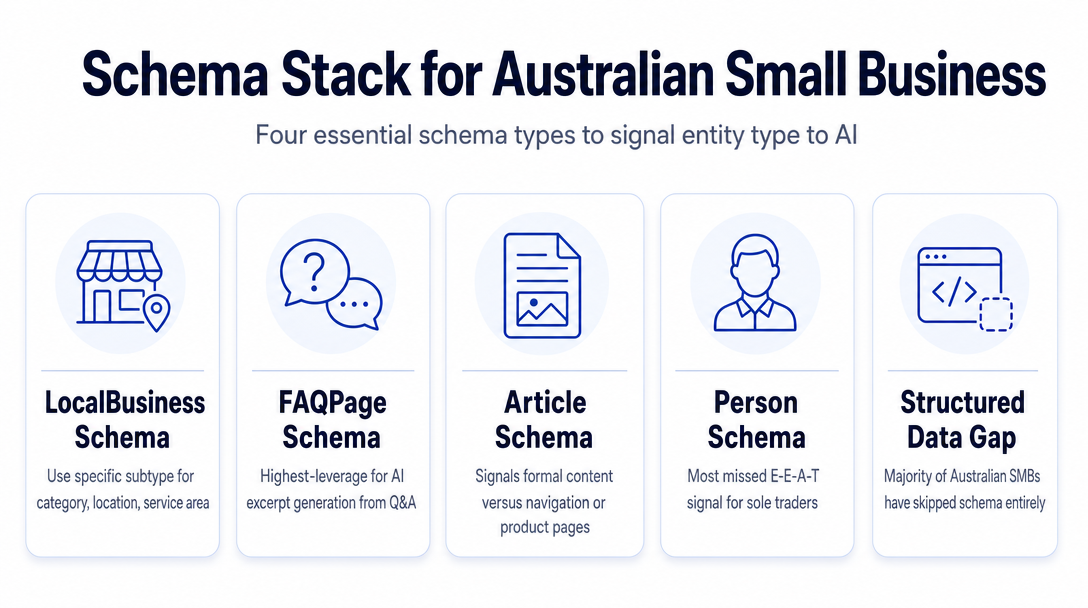
Schema markup is the structured data layer that tells AI engines what type of entity you are - and most Australian SMBs have skipped it entirely.
Research suggests the majority of pages cited by ChatGPT include structured data. The four schema types every Australian small business needs are:
-
LocalBusiness (or its specific subtype - Plumber, AccountingService, HealthAndBeautyBusiness, etc.). This tells AI engines your category, location, and service area. Use the specific subtype, not the generic parent.
-
FAQPage. This is the highest-leverage schema for AI excerpt generation. If your page has a genuine Q&A section, FAQPage schema structures it so AI engines can pull individual questions and answers directly. Do not add it to a page without actual Q&A content.
-
Article (or BlogPosting). This signals that your written content is a formal article, not a navigation page. ChatGPT weights article-type content differently from product or category pages.
-
Person (for sole traders). This is the most commonly missed E-E-A-T signal in the SMB space. Linking your business to a named person with stated expertise - your name, your professional background, your author profile - gives AI engines a human entity to attach authority to.
The sole trader schema stack: four types, one afternoon
- WordPress: Rank Math (free plugin) implements all four schema types through its UI - no code required.
- Shopify: The JSON-LD for SEO app handles LocalBusiness and Article schema with a clean implementation.
- Squarespace: Inject JSON-LD manually through Settings > Advanced > Code Injection.
Do not add schema that mismatches your content. FAQPage schema on a page with no FAQ is a quality mismatch signal, not a boost.
Your action: Install Rank Math (WordPress) or equivalent, then add LocalBusiness schema with your specific business subtype and FAQPage schema to your single best-performing service page.
Step 5: Create One Piece of Data Only You Have
This is the highest-leverage and least-followed citation strategy available to a sole trader. AI engines are trained to cite sources for specific statistics. A statistic that originates from your business is a sole-source fact - the LLM either cites you or it cannot use the number.
You do not need a 500-person survey. A bookkeeper who has worked with 25 sole trader clients can legitimately publish: "Of the 25 sole traders I onboarded in 2025, 68% had no separate business bank account at the start of the engagement." That is a citable statistic no competitor has.
Formatting your finding so AI engines cite you, not paraphrase you
Use this three-sentence structure every time:
- The finding: State the result as a specific claim ("X% of Y in Z context did/experienced/reported...")
- The methodology: State the sample and how you gathered it ("Based on [N] client files / survey responses / project audits between [date range]...")
- The implication: State what this means practically ("This suggests that...")
This mirrors the format AI engines are trained to excerpt and attribute. A finding presented this way is citable. A vague observation ("many of my clients struggle with...") is not.
Your action: Identify one recurring pattern across your last 10-20 clients or projects, then write it up in the three-sentence format above and publish it on your most authoritative service page.
Platform Comparison at a Glance
| ChatGPT | Perplexity | Google AI Overviews | |
|---|---|---|---|
| Top cited source type | Wikipedia (47.9%) | Reddit (46.7%) | YouTube / high-ranking organic |
| Best content format | Deep, authoritative long-form | Fresh, community-sourced discussions | Pages already ranking on Google |
| Key entity signal | Consistent NAP + Google Business Profile | Third-party mentions + community presence | Organic ranking + structured data |
| Your content priority | One-page, one-query depth | Regular publishing + community participation | Standard SEO signals still apply |
Only 11% of domains are cited by both ChatGPT and Perplexity for the same query. Building your presence on all three platforms is the goal - but each requires a distinct fingerprint.
Australian data adds a useful nuance here: according to SmartCompany's analysis of a study across 115 Australian businesses, ChatGPT drives roughly 90% of AI-referred website visits in Australia - but Perplexity and Gemini referrals convert better. Volume and conversion quality are not the same metric, and a multi-platform strategy captures both.
For businesses that want to monitor their citation progress across platforms, tools such as AthenaHQ and Profound are worth evaluating for ongoing tracking.
Frequently Asked Questions
Can a sole trader with a basic website get cited in ChatGPT?
Yes. Platform architecture favours specificity and entity clarity over website size or design quality. A sole trader with a single well-structured service page, consistent NAP across five Australian directories, and one piece of original data has stronger citation signals than a larger competitor with a sprawling site and inconsistent entity information. Start with the entity audit in Step 1.
How long does it take before ChatGPT starts citing my business?
There is no guaranteed timeline, and anyone who gives you a precise number is guessing. ChatGPT's training data has a knowledge cutoff, and its web-browsing mode indexes fresh content at irregular intervals. Perplexity's live-retrieval means your content can appear in Perplexity answers within days of publication. For Google AI Overviews, the timeline tracks your organic ranking progress. A realistic expectation for initial visibility across all three platforms is three to six months of consistent execution.
Does getting more Google reviews help with ChatGPT citations?
Indirectly. Reviews on your Google Business Profile strengthen your entity signal and your Google ranking - which supports Google AI Overviews citations. ChatGPT's direct citation signals are more influenced by your content depth and NAP consistency than by review volume. Reviews are worth building for multiple reasons, but they are not a direct lever for ChatGPT citations specifically.
My business shows up in Google - why am I invisible in ChatGPT?
Google ranking and ChatGPT citation draw on different signals. Google rewards relevance and backlink authority. ChatGPT rewards entity clarity, content specificity, and structured data - and its training data has a cutoff date, meaning a business that became prominent recently may not yet be represented. The most common cause of this gap is entity conflict: inconsistent NAP, a vague business description, or no structured data telling the LLM what category your business belongs to.
Do I need to hire an agency to get cited in AI search?
Not for the foundation steps. The entity audit, directory listings, schema implementation via Rank Math, and content restructuring in this guide are all actions a business owner can complete in a few focused hours. Where specialist help earns its cost is in complex technical migrations, high-stakes PR campaigns, or managing AI visibility at scale across dozens of service pages. For most sole traders and lean teams, the DIY path covers 80% of the citation signal work.
See Your Business's Citation Fingerprint - Free in 60 Seconds
Fulcrum AI crawls your website and scores it across seven dimensions - including your ChatGPT, Perplexity, and Google AI Overviews visibility signals - then generates a ranked list of copy-paste fixes you can act on today. Built in Australia for sole traders and lean teams, with a full plan at $99/month AUD and a free preview to start.
No agency fees. No guesswork. Just a clear picture of exactly which citation signals need attention and what to do about them.
Get My Free AI Visibility Preview