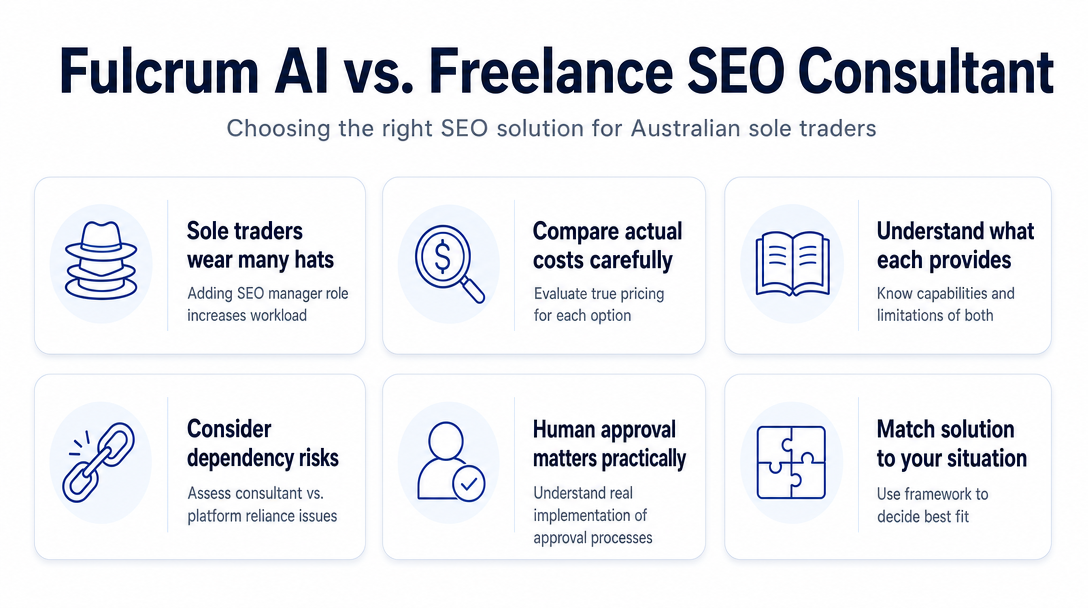
Fulcrum AI vs. Hiring a Freelance SEO Consultant in Australia: Which Is Right for a Sole Trader?
You are already the accounts team, the delivery team, the customer service department, and the sales function. Adding "SEO manager" to that list is not…
Fulcrum AI vs. Hiring a Freelance SEO Consultant in Australia: Which Is Right for a Sole Trader?
Quick answer: For most Australian sole traders, an AI SEO platform is the better starting point - lower cost, no lock-in, and continuous output without management overhead. A freelance consultant earns their fee for specific, complex work: technical migrations, local link-building, and PR. The right answer depends on which of three situations you are in - and most sole traders are not in the situation where a consultant retainer makes financial sense.
The Sole Trader's Real Problem With SEO in 2026
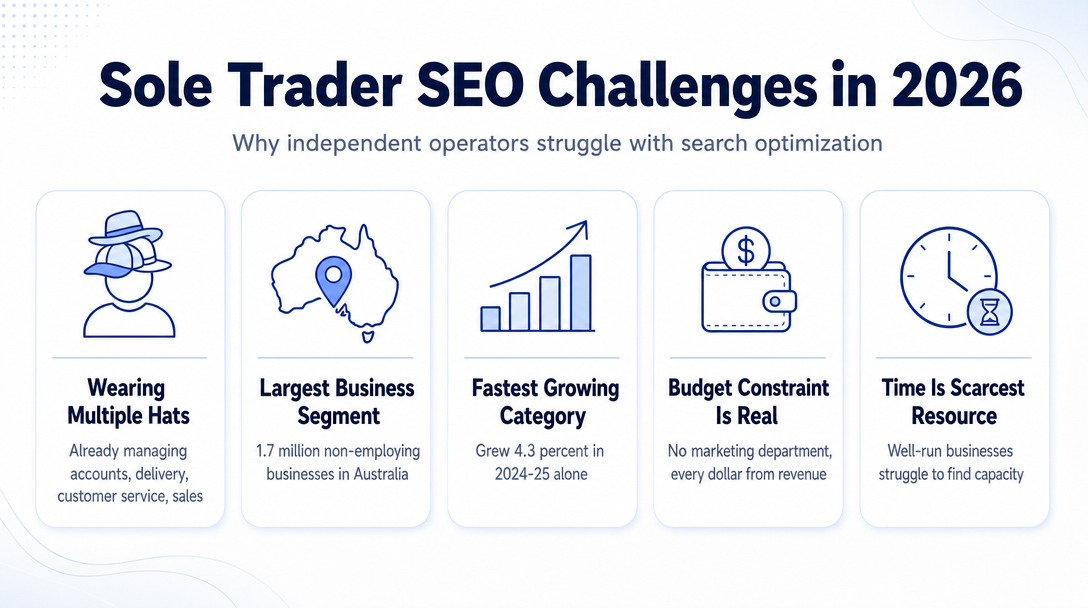
You are already the accounts team, the delivery team, the customer service department, and the sales function. Adding "SEO manager" to that list is not a small ask.
At 30 June 2025, there were 1,735,470 non-employing businesses in Australia - sole operators with no staff at all, representing the majority of all actively trading businesses in the economy. That number grew 4.3 per cent in 2024-25 alone - the fastest-growing segment. This is not a niche situation. It is the Australian business reality.
And nearly every one of those 1.7 million businesses faces the same three constraints that make the SEO decision genuinely difficult:
- Budget is real. There is no marketing department absorbing a $2,000/month retainer. Every dollar comes directly from revenue.
- Time is the scarcest resource. Even a well-run consultant relationship requires briefing, reviewing deliverables, chasing reports, and approving changes. That time has a cost.
- Control matters more than it does in a larger business. Your website is often your primary revenue asset. Anything that touches it - without your explicit sign-off - is a genuine risk.
AI search through ChatGPT, Perplexity, Google AI Overviews, and Gemini has added a new layer to this picture. If you want to understand how those platforms affect your visibility specifically, the GEO vs. SEO landscape is covered in a prior piece on this site. This article assumes you already know both disciplines exist and gets straight to the vendor decision.
What You Actually Pay: A Straight Cost Comparison
Freelance consultant pricing: what the Australian market charges in 2026
Australian freelance SEO consultants charge across several structures. Based on verified market data:
- Hourly: $80-$250/hour, with some agencies at $150-$300/hour
- Day rate: $600-$1,500/day
- Monthly retainer: most Australian SMEs pay $1,500-$3,000/month, with the market average around $1,800-$2,200
Many freelance engagements also carry a minimum term - commonly 3-6 months. Signing a $2,000/month retainer with a 3-month minimum is a $6,000 commitment before you see whether the relationship is working.
AI SEO platform pricing: what the SaaS tier covers
A platform like Fulcrum AI starts with a free preview - no account required - and a full plan at $99/month AUD. The platform's own homepage notes that combining an AI-visibility tracker, local SEO tool, content tool, and SEO suite separately typically runs $300-$700/month across four to six different logins. One platform, one login, one monthly cost.
The hidden time cost sole traders forget to calculate
The invoice is not the whole cost. Managing a consultant relationship - preparing briefs, reviewing draft content, attending check-ins, approving site changes - typically takes several hours per month. If your billable rate as a sole trader sits anywhere between $80 and $150/hour, four hours of management time per month adds $320-$600 to the effective cost of any consultant engagement. That arithmetic is worth doing before you sign anything.
What Each Option Actually Does (and What It Cannot)
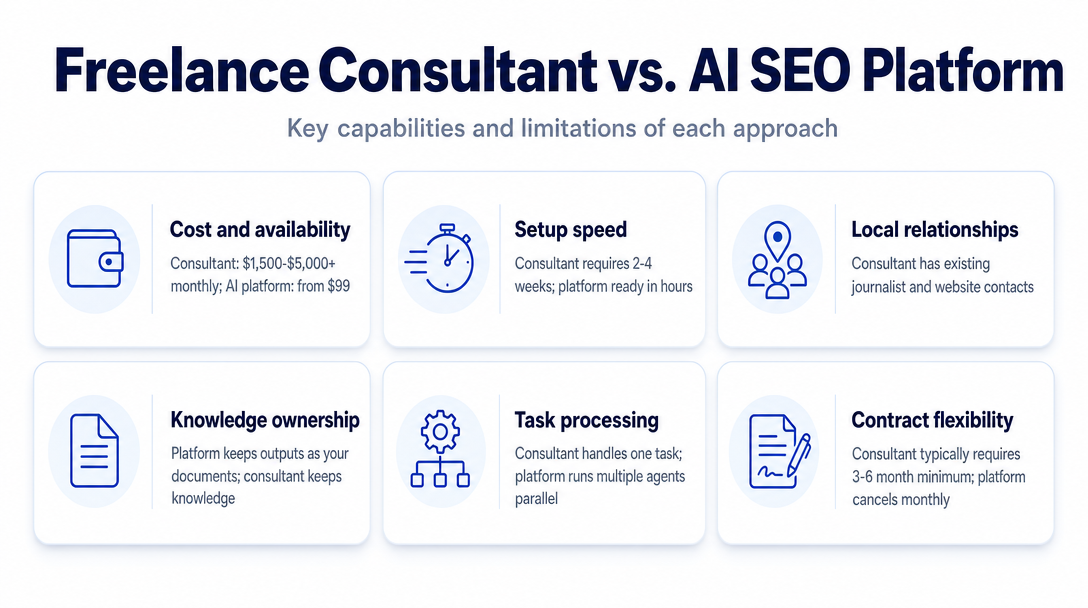
At a glance: platform vs. consultant
| Factor | Freelance SEO Consultant | AI SEO Platform (e.g. Fulcrum AI) |
|---|---|---|
| Monthly cost (AUD) | $1,500-$5,000+ retainer | From $99 |
| Availability | Business hours, one person | Continuous |
| Setup / onboarding time | 2-4 weeks before first deliverables | Hours |
| AI/GEO search visibility coverage | Varies by consultant specialisation | Built-in |
| Human approval before publishing | Consultant typically has CMS access | Yes - nothing publishes without your sign-off |
| Knowledge stays in your business | Often no - lives in the consultant's head | Yes - outputs are your documents |
| Lock-in risk | Common 3-6 month minimum terms | Cancel monthly |
| Local relationships / link-building | Yes | No |
| Complex technical SEO migrations | Yes | Partial |
| Simultaneous tasks running | One task at a time | Multiple agents in parallel |
Where a freelance consultant earns their fee
A skilled consultant brings things a platform cannot replicate: an existing relationship with local journalists and relevant websites for link-building; the ability to negotiate directly with your developer on a complex technical migration; nuanced schema markup implementation suited to your specific business type; and the longer-term topical authority strategy that comes from someone deeply familiar with your industry and customers over time. E-E-A-T signals - author credentials, review content, expert commentary - also benefit from a consultant who understands how to build and position them for your specific context.
Consultants also typically bundle access to professional tools like Ahrefs, SEMrush, or Moz into their retainer fee, which means their clients get research-grade data without separate subscriptions.
Where an AI platform runs rings around a consultant
An AI SEO platform is always available. It does not go on leave. It does not pick up a larger client and deprioritise yours. It runs multiple tasks at once - crawling your site for technical issues, tracking competitor positioning, identifying content gaps, and generating drafted articles and social posts - simultaneously, not sequentially.
Platforms purpose-built for the current search landscape also cover AI/GEO search visibility as standard. Many generalist freelance consultants have not yet developed deep expertise in optimising for AI-generated answers - what some describe as the "AI visibility gap" in traditional SEO practice. If visibility in ChatGPT, Perplexity, and Google AI Overviews matters to your business, confirm before engaging any consultant that this sits within their documented scope.
For a deeper look at what AI search scoring actually examines, the GEO audit framework article on this site covers the mechanics.
The one thing neither can do without you
Neither a consultant nor a platform knows your customers the way you do. The consultant's strategy is only as good as the briefing you give them. The platform's content drafts are only as good as your review and refinement. In both cases, your knowledge of what your customers actually ask, worry about, and search for is the irreplaceable input. The human approval step in a well-designed platform is where that knowledge gets applied.
The Risks Nobody Talks About: Consultant Dependency vs. Platform Dependency
What happens to your SEO when the consultant relationship ends?
This is the "knowledge hostage" problem - and no competing analysis addresses it directly. When a freelance consultant's engagement ends, whether because they raise prices, take on a bigger client, go on parental leave, or simply exit the market, the SEO strategy often leaves with them. Keyword targets, content calendars, competitor insights, link-building contacts: if none of it was documented and handed over in a usable format, you are starting from scratch. For a sole trader with no internal marketing team to maintain institutional knowledge, this is a genuine operational risk.
Lock-in contracts: what to check before you sign
Many Australian SEO engagements carry 3-6 month minimum terms. Before signing, confirm: what is the minimum term? What are the exit conditions? What deliverables are yours to keep if you leave early? What access to your own platforms (Google Search Console, your CMS, your analytics) does the consultant require, and how is that access revoked at the end? These are not adversarial questions - they are standard due diligence for any service engagement.
Control and the human approval question
Platform dependency is a different kind of risk. If a SaaS platform changes its model, you need to rebuild processes. The mitigation is straightforward: any outputs the platform has generated - audit reports, drafted articles, fix recommendations, social posts - exist as your own files and documents. You own them.
The structural control question is also worth asking about any platform: does anything publish to your live site without your explicit approval? For a sole trader whose website is their primary revenue asset, a platform that holds all outputs in a review queue until you approve them is meaningfully different from one that publishes automatically - or from a consultant who has standing CMS access.
The Decision Framework: Which Situation Are You In?
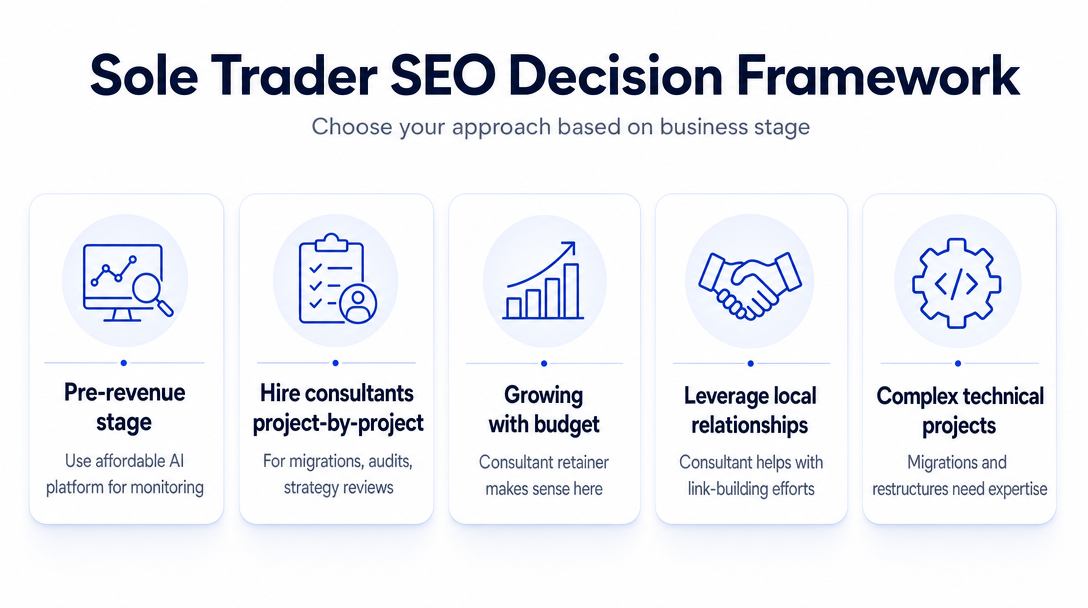
This is the "Sole Trader SEO Stack" Decision Matrix - a three-scenario guide built specifically for non-employing businesses at different stages.
Scenario A: Pre-revenue or early-stage sole trader
Budget is the binding constraint. A $1,500-$5,000/month consultant retainer is not viable before the business is generating consistent revenue. An AI SEO platform at $99/month gives you continuous site monitoring, content drafts, competitor tracking, and actionable fix recommendations without the commitment. When a specific technical need arises - a site migration, a one-off audit, a backlink strategy review - engage a consultant project-by-project rather than on retainer. Keep the platform as your permanent base layer.
Scenario B: Growing sole trader with a dedicated marketing budget
A consultant relationship makes genuine sense here if: you have local industry relationships to leverage through link-building; you are running a complex technical project (a site migration, a domain change, a major content restructure); or you need someone who can represent your brand in industry media. Even so, a platform running continuously between consultant touchpoints ensures you are not paying retainer rates for work that automation can handle. The two are not mutually exclusive.
Scenario C: Established sole trader optimising time per dollar
You have the revenue to afford a consultant, but your time is the real constraint. A platform that functions as a continuous marketing team - running audits, generating content, tracking competitors, flagging technical issues - removes the need for a retainer for day-to-day SEO and content work. Engage a consultant quarterly for strategic review, not monthly for execution. This is typically the highest return per dollar spent.
The three questions to ask yourself before signing anything
- Do you have a specific complex project underway (migration, rebrand, major technical issue) that requires human judgment and developer negotiation? If yes, a consultant for that project. If no, move to the next question.
- Do you have the budget to cover a 3-6 month minimum retainer without that commitment affecting your business operations? If yes, Scenario B may apply. If no, Scenario A.
- Is your main need continuous monitoring and content output rather than a one-off project? If yes, Scenario C - platform as base layer, consultant as periodic advisor.
Most sole traders who are genuinely asking this question are in Scenario A or C.
What "Human Approval" Actually Means in Practice
This is the part most platform comparisons skip entirely.
In a well-designed AI SEO platform, the workflow is: the platform crawls your site, identifies issues and opportunities, and generates outputs - a drafted article, a ranked list of on-page fixes, suggested social posts, ad creative options. Those outputs sit in a review queue. Nothing goes to your live site until you review it, edit it if needed, and explicitly approve it.
For a sole trader, this matters for three specific reasons.
First, brand voice. You know how your customers talk and what they care about. The platform generates the draft; you refine it. The final output carries your voice, not a generic one.
Second, revenue protection. Your website is likely your primary sales channel. A system that cannot change anything on your live site without your sign-off is structurally safer than one that auto-publishes or gives a third party standing edit access.
Third, gradual capability building. Each time you review a platform's recommendations - reading through a technical fix suggestion, editing a draft article - you build familiarity with what good SEO looks like without needing to understand the mechanics from first principles. You are learning by reviewing, not by studying.
Fulcrum AI is built on this model: outputs generated, reviewed, approved. Nothing to the live site without your go-ahead. No technical SEO knowledge required to use it. A free preview crawls your site and generates the first round of recommendations before you commit to anything.
Frequently Asked Questions
How much does a freelance SEO consultant cost in Australia in 2026?
Australian freelance SEO consultants typically charge $80-$250/hour or $600-$1,500/day. Monthly retainers for Australian SMEs commonly sit between $1,500 and $5,000, with the market average around $1,800-$2,200 per month. Many engagements carry a 3-6 month minimum term.
Can an AI SEO platform replace a freelance consultant entirely?
For most sole traders handling day-to-day SEO and content production, yes. For specific needs - local link-building, complex technical migrations, PR relationships, or nuanced E-E-A-T strategy - a human consultant still adds value that a platform cannot replicate. The practical answer for most sole traders is: platform as the permanent base layer, consultant as a project-based specialist when a specific gap arises.
What does "human approval" mean in an AI SEO tool?
In a human-approval workflow, the platform generates outputs - drafted articles, fix recommendations, social posts - and holds them in a review queue. Nothing publishes to your live site until you review and approve each item. This means your site cannot be changed without your explicit sign-off, and you can edit any draft before it goes live.
What happens to my SEO strategy when I stop using a freelance consultant?
If the consultant has not documented and handed over the strategy in a usable format, the strategic knowledge typically leaves with them. Keyword targets, competitor insights, content plans, and link-building contacts may need to be rebuilt from scratch. This "knowledge hostage" risk is a genuine consideration for sole traders with no internal marketing team.
Is there a lock-in risk with freelance SEO contracts?
Many Australian SEO engagements include a 3-6 month minimum term. Before signing, confirm the exit conditions, what deliverables are yours to keep, and how platform access (Google Search Console, CMS) is managed at the end of the engagement.
Does using an AI SEO platform require technical skills?
A platform built on a human-approval model does not require technical SEO knowledge to operate. You review recommendations written in plain language, edit drafts if needed, and approve what goes live. The technical analysis runs in the background; what you see are actionable outputs, not raw data.
See what an AI SEO platform actually produces for your business before committing to anything. Fulcrum AI's free preview crawls your site, scores it, and generates the first round of fixes - no account required, nothing published without your approval. Run your free preview at fulcrumai.com.au